Advanced Air Mobility Report
: Analysis on the Market, Trends, and TechnologiesThe advanced air mobility market shows clear commercial momentum and a measurable scale-up path: the internal trend data records a market compound annual growth rate of 20.6% and a 2034 market projection of $73.5 billion—numbers that frame near-term investment and infrastructure decisions at scale. Order books and program pipelines reinforce this projection: over 11,000 committed orders across more than two dozen OEMs confirm latent demand for certified aircraft and supporting services Advanced Air Mobility – Snapshot April 2025 – Cirium. Taken together, the data indicate that market winners will be those that pair aircraft capability with certified operational infrastructure, airspace integration, and repeatable commercial routes rather than airframe design alone Advanced Air Mobility Market – Mode of Operation, Vehicle Type, Propulsion Type, Range, Application, End Use– Global Forecast, 2025 – 2034.
This report was last updated 92 days ago. Spot an error or missing detail? Help us fix it by getting in touch!
Topic Dominance Index of Advanced Air Mobility
To identify the Dominance Index of Advanced Air Mobility in the Trend and Technology ecosystem, we look at 3 different time series: the timeline of published articles, founded companies, and global search.
Key Activities and Applications
- Urban air taxis for point-to-point passenger services in dense metros; operators and planners target travel-time reductions and hub-to-hub connections as primary value drivers
- Regional commuter services (regional air mobility) connecting secondary airports and towns on 100–300 km routes to relieve road congestion and restore feeder traffic to airline networks Advanced Air Mobility Market Opportunity, Growth Drivers, Industry Trend Analysis, and Forecast 2025-2034 MD Aircraft GmbH.
- Cargo and logistics middle-mile and last-mile deployments for high-value/time-critical shipments where airborne routing reduces transit cost or time relative to ground in remote corridors Advanced Air Mobility (AAM) Market By Component… Forecast to 2033
- Emergency response, medical evacuation and disaster relief using VTOL platforms to reach areas with limited road access and to shorten golden-hour response times Acadian Air Med.
- Vertiport design, construction and operations (including charging and ground handling) to provide the physical interfaces that enable high-frequency AAM services
Emergent Trends and Core Insights
- Order momentum far outstrips current production/certification capacity: >11,000 order commitments across ~27 OEMs create a multi-year production pipeline and pressure on supply chains and certification resources
- Forecast dispersion but consensus on high growth: independent market studies place CAGR in the 18–25% band and long-run market values from tens to >100 billion dollars by early-to-mid 2030s, reflecting differing scope and time horizons (see synthesized table below) Advanced Air Mobility Market Size – Grand View Research
- Geography is asymmetrical: China, India and parts of Europe show aggressive adoption targets and infrastructure investment, while the U.S. leads in OEM investment and regulatory testing—policy choices will shape regional leaderboards Advanced Air Mobility Market – Future Market Insights
- Regulation and UTM/ATM integration are gating factors: FAA, EASA and national agencies run pilot programs and data-sharing initiatives that will determine the pace of commercial operations; progress in certification is uneven but accelerating Advanced Air Mobility – APA Trend Report US Air Force to share data with FAA on advanced air mobility testing.
- Infrastructure and data systems create durable moats: firms that control vertiport footprints, traffic-management software, and integration with existing transport nodes stand to capture recurring service fees and regulatory tie-ins Acumen Aviation.
- Investment focus is shifting toward operations and ecosystem providers as prototype-to-commercial transitions require certified services, not just novel airframes.
Technologies and Methodologies
- Battery and hybrid propulsion tradeoffs: pure-electric solutions enable low noise and zero local emissions but face energy-density limits for longer ranges; hybrid and turbogenerator approaches target RAM and heavy-lift missions
- Distributed electric propulsion (DEP) and slowed-rotor/hybrid configurations that increase cruise efficiency (SRC) remain prioritized design approaches to balance hover safety and cruise economics Jaunt Air Mobility
- AI/ML decision systems for sustainment, route optimization and predictive MRO underpin operational reliability and lower life-cycle costs; these systems become core differentiators for fleet operators Aerogility
- UTM/low-altitude traffic management and digital twin simulation used for certifying high-throughput vertiports and for pre-validating dense schedule scenarios
- Additive manufacturing and composite aerostructures to reduce part count and turnaround times, enabling faster iterations of prototypes and localized production capacity
Advanced Air Mobility Funding
A total of 150 Advanced Air Mobility companies have received funding.
Overall, Advanced Air Mobility companies have raised $24.5B.
Companies within the Advanced Air Mobility domain have secured capital from 668 funding rounds.
The chart shows the funding trendline of Advanced Air Mobility companies over the last 5 years
Advanced Air Mobility Companies
- Urban-Air Port — Urban-Air Port designs and operates compact, high-capacity vertiports and modular ground infrastructure for passenger, cargo and emergency AAM services; the company couples physical landing/charging infrastructure with digital operations to enable dense-city siting and co-location with existing transport hubs, positioning it as an early vertiport operator and site licensor.
- Aerial Vehicle Automation — Focused on large autonomous VTOL trucks capable of 200+ lb payloads and 300 mi ranges, the firm targets middle-mile logistics and hard-to-reach resupply missions where runways are unavailable; its proposition is lower operating cost per flight-hour versus conventional rotorcraft, prioritizing endurance and payload economics over ultralight air taxi designs.
- AIRBILITY — South Korean developer pursuing distributed electric fanjet architectures and modular hybrid energy systems to extend mission range and maintain quiet operations; the engineering emphasis on variable inlet and fanjet design targets regional and medium-range AAM missions that battery-only aircraft struggle to serve today.
- UAM Geomatics — Market intelligence and route/vertiport optimisation firm serving state governments and investors; UAM Geomatics supplies forecasts and route modelling that inform infrastructure siting and investor underwriting for AAM projects, making it a critical input provider for site economics and demand validation.
Identify and analyze 549 innovators and key players in Advanced Air Mobility more easily with this feature.
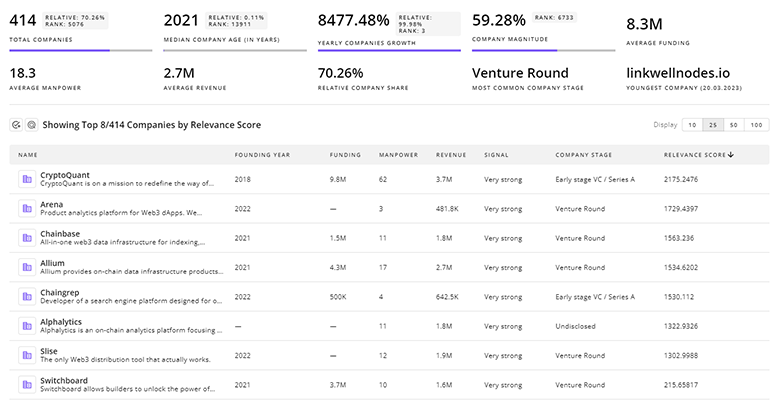
549 Advanced Air Mobility Companies
Discover Advanced Air Mobility Companies, their Funding, Manpower, Revenues, Stages, and much more
Advanced Air Mobility Investors
TrendFeedr’s investors tool offers a detailed view of investment activities that align with specific trends and technologies. This tool features comprehensive data on 839 Advanced Air Mobility investors, funding rounds, and investment trends, providing an overview of market dynamics.
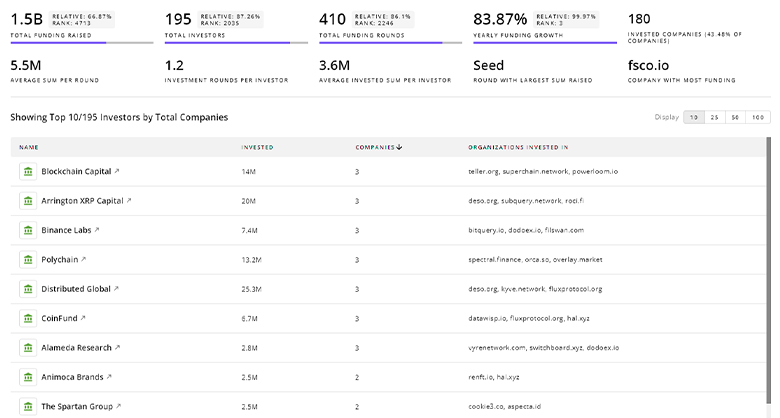
839 Advanced Air Mobility Investors
Discover Advanced Air Mobility Investors, Funding Rounds, Invested Amounts, and Funding Growth
Advanced Air Mobility News
Stay informed and ahead of the curve with TrendFeedr’s News feature, which provides access to 2.1K Advanced Air Mobility articles. The tool is tailored for professionals seeking to understand the historical trajectory and current momentum of changing market trends.

2.1K Advanced Air Mobility News Articles
Discover Latest Advanced Air Mobility Articles, News Magnitude, Publication Propagation, Yearly Growth, and Strongest Publications
Executive Summary
AAM has moved from laboratory prototypes to commercial planning where demand signals, order books, and public programs now require pragmatic choices about production capacity, infrastructure, and airspace governance. The most durable commercial positions will come from organisations that secure vertiport footprints, integrate UTM/ATM services, and offer repeatable, certifiable operational chains rather than those that focus solely on vehicle novelty. Investors and operators should prioritise deals that combine airframe capability with rights or technology for ground-air interfaces, traffic management, or long-term service contracts; these are the assets that translate order commitments into sustainable revenue streams.
Interested in enhancing our coverage of trends and tech? We value insights from experts like you - reach out!