Aerospace Defense Report
: Analysis on the Market, Trends, and TechnologiesThe aerospace defense market sits at a strategic inflection where sustained procurement and sensor-led architectures are driving measurable expansion: the domestic sector is valued at $525,160,000,000 in 2025 with an operating CAGR of 5.76%. Budget and order signals show large, persistent demand—including record backlogs—while spending shifts toward space sensing, counter-UAS, and AI-enabled C2; these dynamics create an opening for specialized suppliers that supply sensor fusion, low-SWaP components, sustainment services, and C-UAS effectors to capture outsized margin and relevance Aerospace & Defense Market – Size, Share & Industry Statistics.
This report was last updated 29 days ago. Spot an error or missing detail? Help us fix it by getting in touch!
Topic Dominance Index of Aerospace Defense
To identify the Dominance Index of Aerospace Defense in the Trend and Technology ecosystem, we look at 3 different time series: the timeline of published articles, founded companies, and global search.
Key Activities and Applications
- Counter-UAS / Airspace Security — Deployment and integration of multi-sensor detection (RF, radar, EO/IR, acoustic) and non-kinetic/kinetic defeat options around bases, ports, and critical infrastructure; the tactical requirement is for layered, interoperable suites to detect small, low-signature platforms and enable controlled, safe mitigation.
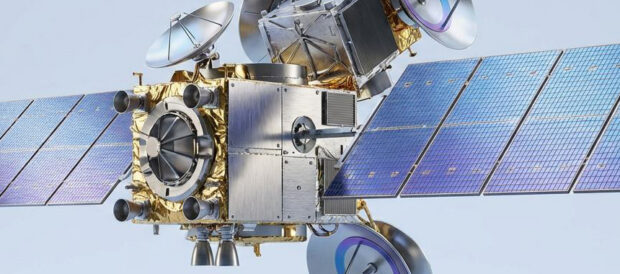
- Space and Satellite-enabled Early Warning — Rapid fielding of LEO/LEO-proximate constellations and OPIR sensors to improve persistence for missile and hypersonic tracking and to shorten sensor-to-shooter timelines.
- Integrated Air & Missile Defense (IAMD) and Networked C2 — Building "any-sensor / any-shooter" nets and unified battle management for launch-on-remote engagements across SHORAD/MRAD/LRAD layers, emphasizing modularity and data standardization.
- Digital Sustainment & MRO — Legacy fleet life-extension, depot repairs, obsolescence mitigation and digital twin applications to increase aircraft availability and reduce per-platform cost; this is a high-velocity revenue stream for specialists in depot electronics and avionics sustainment.
- Materials & Additive Manufacture for Agility — Rapid, low-volume production of airframe and propulsion parts using advanced composites and microwave-assisted deposition, shortening lead times and easing obsolescence risk in constrained supply chains Aerospace and Defense Materials Market Research Report.
Emergent Trends and Core Insights
- Sensor-First Architectures Are Winning — Investment is concentrating on sensor reach and fidelity (space, stratospheric, airborne) because early, persistent tracking materially enlarges defended areas and enables cheaper, higher-confidence engagements Getting on Track: Space and Airborne Sensors for Hypersonic Missile Defense.
- Counter-UAS Is Now a Major Budget Line — Governments and civil critical-infrastructure operators allocate recurring procurement to detection + mitigation stacks that favor signal-processing software, RF identification, and non-destructive mitigation methods to avoid collateral impact.
- Ingredient Suppliers Capture Margin via SWaP and Cyber-Hardened IP — Photonics, compact AESA radars, hardened crypto and FPGA subsystems are emerging as non-substitutable inputs; platform integrators prize suppliers that reduce Size/Weight/Power and increase cyber resilience.
- Industrial Base & Supply-Chain Rebalancing — Order backlogs and capacity constraints are pressuring near-term deliveries; countries and primes pursue domesticized or diversified suppliers and additive manufacturing to shorten lead times and control critical-item risk Aerospace & Defense Industry Report – Q3 2024.
- Software Is the Cost-Efficient Lever — Sensor fusion, edge AI, and battle management software deliver high revenue per dollar invested and are the fastest path for small firms to scale influence inside large procurement programs Vigilant Aerospace.
Technologies and Methodologies
- Multi-Phenomenology Sensor Fusion — Concurrent RF, EO/IR, passive IR and acoustic pipelines combined with probabilistic ML classifiers to reduce false positives on small UAS and hybrid threats.
- Photonics Integrated Circuits (PICs) for RF/EO Payloads — Photonics reduces SWaP and improves bandwidth for EW and SATCOM payloads; components from specialist firms provide decisive size/energy advantages.
- AI at the Edge for C2 Autonomy — Low-latency neural inferencing on embedded hardware to support autonomous intercept decisions and reduce human-in-the-loop burden, improving engagement timelines in congested environments Countering Small Uncrewed Aerial Systems.
- Additive & Microwave-Assisted Deposition (MAD) 3D Printing — Rapid qualification and small-lot production of high-tolerance composite and metal parts to address obsolescence and scale localized production.
- Directed-Energy and Non-Kinetic Defeat Methods — High-energy lasers and microwave systems move from prototypes into operational demos for point defense and C-UAS defeat; maturity timelines vary but they are prioritized for cost per shot advantages in the mid-term Top Growth Opportunities in Defense.
- Digital Thread / MBSE and DevSecOps — Model-based systems engineering and integrated DevSecOps pipelines compress integration cycles for complex IAMD programs and help enforce cyber and classification boundaries across the sensor-to-shooter chain.
Aerospace Defense Funding
A total of 1.6K Aerospace Defense companies have received funding.
Overall, Aerospace Defense companies have raised $227.0B.
Companies within the Aerospace Defense domain have secured capital from 4.3K funding rounds.
The chart shows the funding trendline of Aerospace Defense companies over the last 5 years
Aerospace Defense Companies
- AeroDefense — A U.S. vendor of RF-centric drone detection suites (AirWarden®) with deployments across public safety and critical infrastructure; the company holds 6 patents, multiple SBIR awards and two DHS SAFETY Act designations that materially reduce liability risk for clients and improve procurement attractiveness for infrastructure operators. AeroDefense's passive RF approach scales from LTE Remote ID receivers to advanced spectrum sensors, enabling layered detection where radar alone struggles.
- D-Fend Solutions — Israeli provider of non-kinetic RF cyber-takeover mitigation (EnforceAir) that executes autonomous RF interventions to force a safe landing of rogue UAS; the offering minimizes collateral effects in dense urban or airport environments and has attracted government and major airfield customers worldwide. The company's approach is an operationally attractive mitigation layer where jamming or hardkill carries excessive risk Strategic Intelligence - Counter-Drone Technologies.
- Duotech Services — Depot and sustainment specialist that extends legacy radar, avionics and ATE lifecycles through repair, obsolescence mitigation, and rapid prototyping; Duotech's hands-on depot capabilities and recent M&A position it to capture sustainment demand as fleets age and procurement lead times stretch. The firm's offering materially reduces platform downtime and purchase pressure on primes during surge demand cycles.
- Metro Aerospace — Niche 3D-printed parts manufacturer with AS9100D certification that commercializes patented drag-reduction technologies for military transports (Microvanes) and demonstrates how additive manufacturing delivers rapid ROI through fuel savings and extended sortie intervals. Their licensing model (commercializing prime-origin IP) shows a viable path for small suppliers to scale via platform value rather than platform build volume.
- DAS Photonics — European photonics SME producing Photonics Integrated Circuits (PICs) for EW, ELINT/ESM and space payloads; PIC-based front ends drastically reduce SWaP for RF and SATCOM receivers, making DAS an attractive ingredient supplier for EW and small-sat integrators seeking higher bandwidth at lower power.
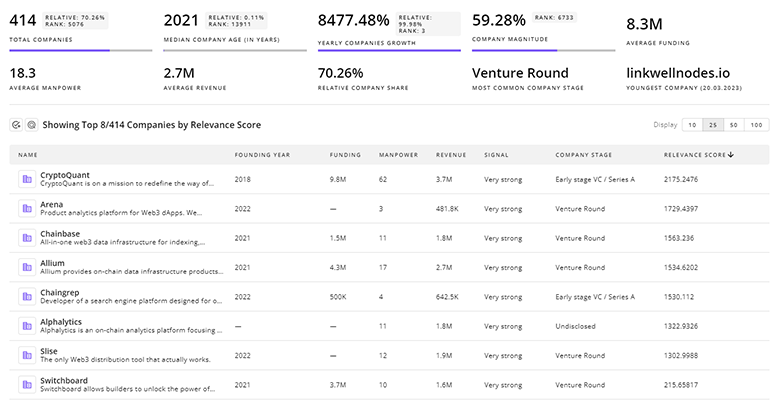
Identify and analyze 11.2K innovators and key players in Aerospace Defense more easily with this feature.
11.2K Aerospace Defense Companies
Discover Aerospace Defense Companies, their Funding, Manpower, Revenues, Stages, and much more
Aerospace Defense Investors
TrendFeedr’s investors tool offers a detailed view of investment activities that align with specific trends and technologies. This tool features comprehensive data on 4.1K Aerospace Defense investors, funding rounds, and investment trends, providing an overview of market dynamics.
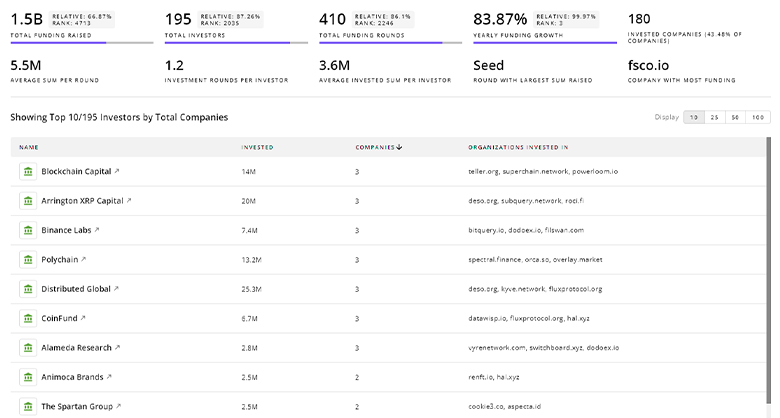
4.1K Aerospace Defense Investors
Discover Aerospace Defense Investors, Funding Rounds, Invested Amounts, and Funding Growth
Aerospace Defense News
Stay informed and ahead of the curve with TrendFeedr’s News feature, which provides access to 19.1K Aerospace Defense articles. The tool is tailored for professionals seeking to understand the historical trajectory and current momentum of changing market trends.
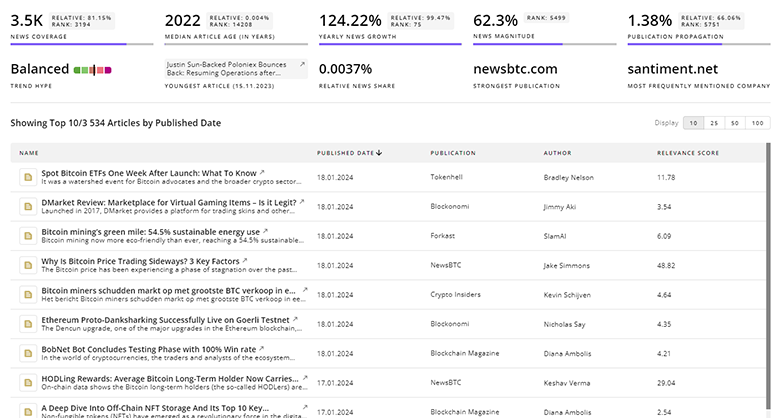
19.1K Aerospace Defense News Articles
Discover Latest Aerospace Defense Articles, News Magnitude, Publication Propagation, Yearly Growth, and Strongest Publications
Executive Summary
The aerospace defense market is funding a generational shift from platform-centric buying toward sensor-centric and data-centric architectures. That trend elevates companies that supply sensor fusion, photonics, software for edge AI, sustainment services, and counter-UAS stacks. Commercially scaled software and low-SWaP hardware capture outsized leverage: they raise the marginal value of every dollar of procurement and shorten delivery cycles. Strategic choices for investors and primes should focus on (1) winning ingredient status inside multi-domain sensor stacks, (2) securing certification and liability shields for critical C-UAS and sustainment offerings, and (3) partnering to accelerate delivery of space and airborne sensing capabilities that materially enlarge defended coverage. Prioritizing these vectors aligns business models with the largest, fastest-growing government demand signals while mitigating the procurement and supply-chain frictions that constrain platform deliveries.
Interested in enhancing our coverage of trends and tech? We value insights from experts like you - reach out!