
AI In Energy Report
: Analysis on the Market, Trends, and TechnologiesThe AI-in-energy market will force strategic choices about where to compete: in energy supply and siting or in asset-level efficiency—and winners will be those who secure power availability while demonstrating measurable ROI. Market forecasts diverge, but a consensus signal is strong growth: USD 55.76 billion by 2032. At the same time, AI compute is already altering energy markets and bills—AI workloads now account for a material share of electricity use in advanced economies, with estimates of 4.4% of U.S. power demand coming from AI-related compute technologyreview – AI Energy Usage Climate Footprint, 2025. These dynamics create two parallel profit pools: capital-intensive infrastructure (gigawatt campuses, microgrids, PPAs) and software-driven operating leverage (forecasting, predictive maintenance, digital twins). Short-term returns favor operational intelligence; long-term platform power accrues to those who can guarantee 24/7 low-carbon energy for compute.
This report was last updated 307 days ago. Spot an error or missing detail? Help us fix it by getting in touch!
Topic Dominance Index of AI In Energy
To identify the Dominance Index of AI In Energy in the Trend and Technology ecosystem, we look at 3 different time series: the timeline of published articles, founded companies, and global search.
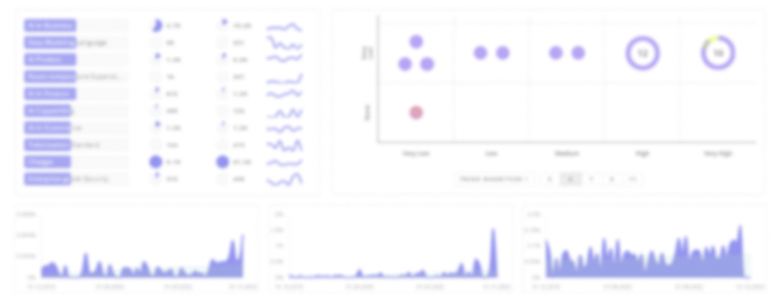
Key Activities and Applications
- Grid balancing and demand response orchestration — AI coordinates dispatch across batteries, VPPs, and flexible loads to reduce peak exposure and increase renewable utilization; deployment of AI in grid operations is a core growth vector.
- Renewable generation forecasting and dispatch — ML and physics-informed models reduce intermittency risk by improving wind/solar forecast accuracy, which directly increases renewable yield and storage efficiency The role of artificial intelligence in accelerating renewable energy.
- Predictive maintenance and asset performance management — AI models (RUL, anomaly detection) cut downtime and O&M costs across turbines, inverters, and transformers, delivering rapid payback in distributed-generation fleets.
- Energy-aware data-centre control and workload orchestration — Platforms that schedule training/inference against grid conditions or heat-reuse options convert data centres from cost centres into grid-stabilizing partners.
- Heat valorization and co-location business models — Using waste heat from high-density compute for district heat or industrial processes creates secondary revenue and large net-decarbonization effects.
Emergent Trends and Core Insights
- Energy availability is now a strategic constraint for AI. Large buyers are contracting or building dedicated power capacity rather than accepting grid latency and congestion; the trend drives vertical integration between compute and power Fermi America.
- Two-track market structure is hardening: (1) capital-heavy energy-supply plays (gigawatt campuses, microgrids, advanced nuclear/geothermal PPAs) and (2) software-first efficiency plays that monetize existing assets through measurable savings.
- Model and hardware efficiency matter commercially. Smaller, task-specific models and energy-aware silicon reduce operating cost and shift the optimal compute location toward edge and co-located renewable sites.
- Heat becomes a tradable commodity. Data-centre heat reuse (hot-water networks, industrial heat) creates new integrated offerings that pair compute capacity with low-carbon heat supply.
- Policy and procurement shape capital flows. Governments and major tech buyers are already directing capital toward clean, reliable power through novel PPAs and procurement vehicles; this will accelerate adoption of advanced fission, geothermal and grid-scale storage where regulatory support exists Why artificial intelligence and clean energy need each other.
Technologies and Methodologies
- Physics-informed machine learning and digital twins — Hybrid models that embed conservation laws increase forecast reliability for grid and asset scenarios and improve explainability for operators MAI OptiTek.
- Edge AI with federated learning — On-site inference and federated training protect data sovereignty for distributed renewables while reducing latency and network load for field assets GREEN.DAT.AI.
- Reinforcement learning for active grid control — RL agents learn dispatch strategies that balance storage, generation, and demand in near real time, increasing VRE utilization and reducing balancing costs AI in Energy Management market briefs.
- Energy-aware model and silicon co-design — Algorithmic changes (smaller, task-specific models) plus specialized low-power accelerators materially lower energy per inference, shifting viability to edge or co-located compute Energy-efficient Hardware Research.
- AI orchestration platforms for data centres — Systems that match compute workload to grid signals and reuse thermal output turn data centres into flexibility resources for operators and communities Emerald AI.
AI In Energy Funding
A total of 518 AI In Energy companies have received funding.
Overall, AI In Energy companies have raised $46.1B.
Companies within the AI In Energy domain have secured capital from 1.9K funding rounds.
The chart shows the funding trendline of AI In Energy companies over the last 5 years
AI In Energy Companies
- Project Ohm
Project Ohm builds decentralised, energy-aware AI nodes that schedule workloads to use stranded renewable energy rather than grid fossil fuels. Its model prioritizes rapid deployment near underused solar and overloaded substations to convert curtailed renewables into compute capacity and local economic activity. The approach reduces marginal carbon intensity for AI training and provides a pathway for hyperscalers to diversify siting risk. Project Ohm targets operators seeking lower-cost, lower-carbon capacity without the delays of large grid interconnection. - AI Energy Technologies
AI Energy Technologies delivers the Navigator platform to optimize fossil-fired power-plant operations, extracting fuel and emission reductions with no hardware changes. The company reports efficiency improvements in thermal plants that translate to immediate ROI for operators and measurable emissions cuts, positioning software as a near-term decarbonization lever for incumbent generators. Their advisory board and utility pilots prioritize integration with SCADA and control systems to minimize operational friction. - EvoChip
EvoChip develops ultralight training and inference engines designed to reduce transistor count and energy per operation by orders of magnitude, enabling complex models to run on constrained silicon. The company claims dramatic energy and cost reductions versus conventional GPU stacks, making high-value AI feasible at the edge and in remote renewable sites. If validated at scale, its architecture threatens the assumption that centralized hyperscale compute is the only path for heavy AI workloads. - Digital Energy
Digital Energy pairs high-density compute with heat recovery to produce 70°C hot water for greenhouses and industrial customers, monetizing waste heat and decarbonizing local heating loads. Co-located AI factories both supply compute and deliver low-carbon process heat, creating a two-sided value proposition for landowners and data-centre operators seeking community acceptance and additional revenue. This model reduces the net carbon impact of compute and shortens the payback for on-site generation investments. - Tinental
Tinental focuses on industrial energy optimization for fluid-dynamic machinery (pumps), claiming up to 60% reductions in energy consumption for targeted applications and up to 30% cut in maintenance costs via anomaly detection and adaptive control. Their solution exemplifies the high-ROI niche plays: domain-specific AI that displaces variable operating cost and supports industrial decarbonization without large capital projects.
Identify and analyze 2.4K innovators and key players in AI In Energy more easily with this feature.
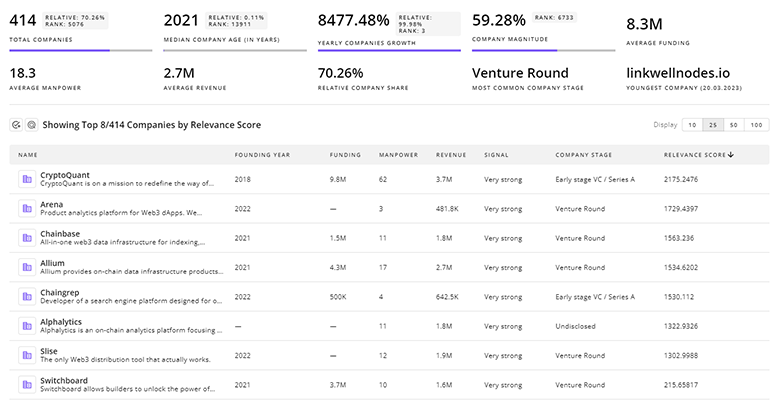
2.4K AI In Energy Companies
Discover AI In Energy Companies, their Funding, Manpower, Revenues, Stages, and much more
AI In Energy Investors
TrendFeedr’s investors tool offers a detailed view of investment activities that align with specific trends and technologies. This tool features comprehensive data on 2.3K AI In Energy investors, funding rounds, and investment trends, providing an overview of market dynamics.
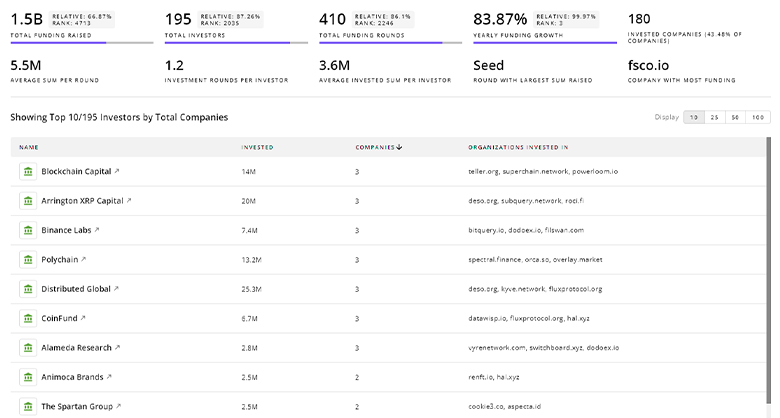
2.3K AI In Energy Investors
Discover AI In Energy Investors, Funding Rounds, Invested Amounts, and Funding Growth
AI In Energy News
Stay informed and ahead of the curve with TrendFeedr’s News feature, which provides access to 6.2K AI In Energy articles. The tool is tailored for professionals seeking to understand the historical trajectory and current momentum of changing market trends.
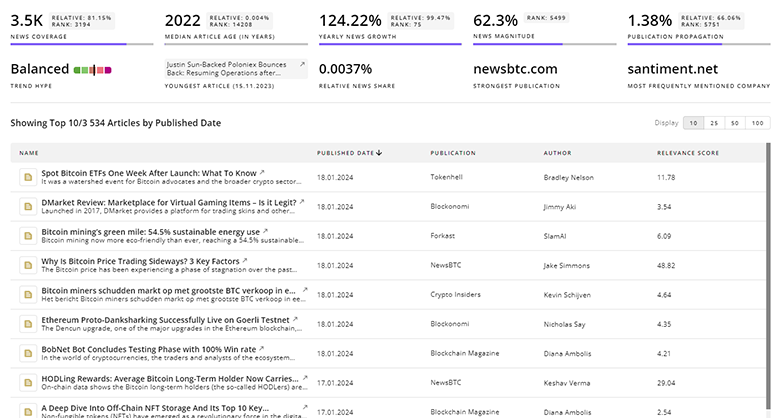
6.2K AI In Energy News Articles
Discover Latest AI In Energy Articles, News Magnitude, Publication Propagation, Yearly Growth, and Strongest Publications
Executive Summary
The AI-in-energy opportunity divides into two durable strategic plays: guarantee and price raw power for compute, or extract outsized margin from existing assets via intelligent software. Short-term value flows to firms that can prove measurable cost or emission reductions quickly; medium to long term, control of dispatchable, low-carbon power for 24/7 AI workloads will create the largest platform advantages. Investors and operators should triage bets by capital intensity, time to revenue, and regulatory exposure: software-first optimization yields fast payback and broad addressable markets today, while vertically integrated power solutions win when buyers require guaranteed, low-carbon, high-density capacity. Firms that can combine energy-aware compute orchestration, energy-efficient silicon and models, and commercial heat reuse will shape the profitable intersection between AI demand and decarbonization.
Interested in enhancing our coverage of trends and tech? We value insights from experts like you - reach out!