
Artificial Intelligence In Logistics Report
: Analysis on the Market, Trends, and TechnologiesThe logistics sector is shifting from manual processes to AI-orchestrated operations, producing measurable business impact: the internal trend report records a market size of USD 12.0 billion in 2023 and a projected CAGR of 46.7% for the AI in logistics market. This shift concentrates value in demand forecasting, route optimisation, predictive maintenance and warehouse automation, while the investment picture shows sizable capital flowing into the space (total funding noted in the landscape reaches billions). The combination of large addressable markets, accelerating adoption of cloud and edge AI, and concrete efficiency gains gives operators a clear set of actions: industrialise data pipelines, prioritise high-ROI AI use cases, and adopt modular platforms that integrate forecasting, execution and visibility functions AI In Logistics Market 2025: Detailed Insights into Market Size and Future Growth.
This report was last updated 332 days ago. Spot an error or missing detail? Help us fix it by getting in touch!
Topic Dominance Index of Artificial Intelligence In Logistics
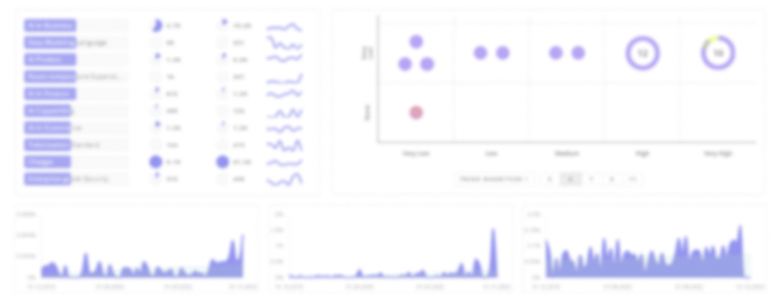
To identify the Dominance Index of Artificial Intelligence In Logistics in the Trend and Technology ecosystem, we look at 3 different time series: the timeline of published articles, founded companies, and global search.
Key Activities and Applications
- Demand forecasting and inventory planning — AI models combine historical demand, external signals and promotions to cut forecast error and free working capital; inventory control accounted for a 32% share in 2023 within the market applications, Global AI in Logistics Market By Technology.
- Route and fleet optimisation — real-time route recomputation reduces fuel, empty miles and delivery time while improving service levels; adopters report double-digit reductions in transport cost and emissions in case studies Generative AI in Logistics Market 2025.
- Warehouse automation and robotics — machine vision + ML enable item recognition and autonomous picking that multiply throughput and cut labor hours; robotics and AMR uptake drives hardware and integration spend in warehousing AI In Warehousing Market Research Report, Artificial Intelligence in Warehousing Market.
- Predictive maintenance and telematics — sensor fusion and ML forecast failures and schedule interventions, reducing downtime and maintenance cost while extending asset life Navigating Future: AI and IoT Fleet Management Systems.
- Document automation and freight orchestration — NLP and ML parse emails, bills of lading and invoices to automate forwarding and brokerage workflows, cutting manual processing time per shipment by hours Raft.
- Visibility and control-tower analytics — real-time integration of IoT, GPS and telematics with AI enables proactive exception management and scenario testing using digital twins Digital twin and AI adoption in logistics.
Emergent Trends and Core Insights
- Agentic and generative AI applied to operations — generative models and agentic agents now move beyond text generation into operational plan drafting, automated document creation and scenario synthesis; market estimates show generative AI segments growing rapidly from small bases Generative AI in Logistics Market (GMI Insights).
- Convergence of digital twins, simulation and live operation — companies deploy twinled simulations to test network changes, then feed live telemetry into models for continuous optimisation, shortening decision cycles and lowering risk.
- No-code/low-code orchestration and AIaaS for diffusion — AI as a service and no-code orchestration lower barrier to entry for mid-market logistics users, making advanced use cases accessible without large internal ML teams, Cargoflow.ai.
- Sustainability and emissions reduction as procurement criterion — route consolidation and load matching from ML models reduce CO2 per shipment and increasingly influence carrier selection and customer contracting Awake.AI.
- Integration and data harmonisation as primary barrier and moat — companies that can ingest disparate EDI, email, ERP and telematics data yield more accurate predictions and retain customers; data integration becomes a defensible asset.
- Robotics and AMR scale-up drives services and fractional consumption models — Robotics-as-a-Service (RaaS) and subscription deployment patterns accelerate adoption by shifting capex to opex.
Technologies and Methodologies
- Machine learning families (supervised, unsupervised, reinforcement) — core engines for forecasting, demand sensing and optimisation; reinforcement learning appears in dynamic routing and load allocation.
- Generative AI and LLMs with retrieval grounding (RAG) — used for document automation, plan generation and human-facing copilots; grounding with company data improves accuracy for operations tasks.
- Computer vision and sensor fusion — item recognition, damage detection and inventory counts rely on high-accuracy vision stacks combined with barcode/RFID and depth sensing.
- Edge AI and on-vehicle inference — latency-sensitive functions for autonomous vehicles and on-truck safety use edge compute combined with cloud orchestration.
- Digital twin frameworks and simulation engines — mix IoT feeds with optimisation engines for capacity planning and what-if analysis.
- Optimization algorithms and operations research — large-scale linear and combinatorial solvers plus heuristic and ML-driven optimisers solve routing, slotting and network design problems, Transmetrics.
Artificial Intelligence In Logistics Funding
A total of 241 Artificial Intelligence In Logistics companies have received funding.
Overall, Artificial Intelligence In Logistics companies have raised $5.0B.
Companies within the Artificial Intelligence In Logistics domain have secured capital from 838 funding rounds.
The chart shows the funding trendline of Artificial Intelligence In Logistics companies over the last 5 years
Artificial Intelligence In Logistics Companies
- RouteQ — RouteQ provides AI delivery management and last-mile optimisation that combines route generation and track-and-trace; the company reports client outcomes of 15–20% delivery cost reduction and 20–30% improvement in delivery efficiency and supports real-time visibility for urban deliveries.
- Fast Trek — Fast Trek focuses on long-haul network route optimisation to lower carbon emissions and haulage cost; the startup targets network redesign and visualization to consolidate lanes and reduce empty miles for road freight operators.
- Synkrato — Synkrato offers an AI + digital twin warehouse optimisation platform that stitches real-time telemetry into a warehouse decision framework for slotting, staffing and throughput planning; it positions simulation as the executionable plan for ongoing optimisation.
- Numeo — Numeo provides dispatcher co-pilot AI agents that automate brokerage calls, negotiate rates and manage load discovery for trucking and car-haul operations; the product targets 24/7 dispatch automation and rate capture for small to mid sized carriers.
Identify and analyze 1.1K innovators and key players in Artificial Intelligence In Logistics more easily with this feature.
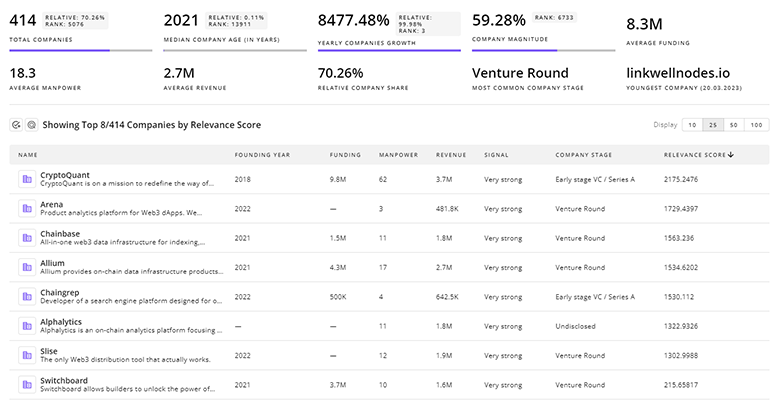
1.1K Artificial Intelligence In Logistics Companies
Discover Artificial Intelligence In Logistics Companies, their Funding, Manpower, Revenues, Stages, and much more
Artificial Intelligence In Logistics Investors
TrendFeedr’s investors tool offers a detailed view of investment activities that align with specific trends and technologies. This tool features comprehensive data on 1.2K Artificial Intelligence In Logistics investors, funding rounds, and investment trends, providing an overview of market dynamics.
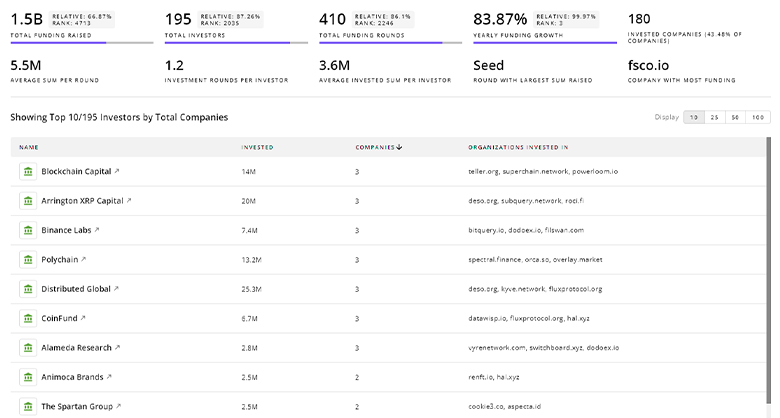
1.2K Artificial Intelligence In Logistics Investors
Discover Artificial Intelligence In Logistics Investors, Funding Rounds, Invested Amounts, and Funding Growth
Artificial Intelligence In Logistics News
Stay informed and ahead of the curve with TrendFeedr’s News feature, which provides access to 1.1K Artificial Intelligence In Logistics articles. The tool is tailored for professionals seeking to understand the historical trajectory and current momentum of changing market trends.
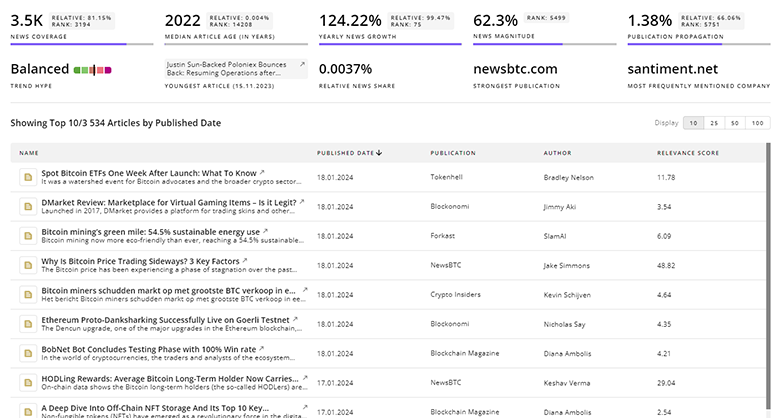
1.1K Artificial Intelligence In Logistics News Articles
Discover Latest Artificial Intelligence In Logistics Articles, News Magnitude, Publication Propagation, Yearly Growth, and Strongest Publications
Executive Summary
AI in logistics now addresses concrete cost and service levers: better forecasts, tighter inventory, fewer empty miles, and lower incident rates. The market signals from the data available indicate very rapid revenue growth and intense productisation: specialised ML stacks, generative and agentic capabilities, digital twins and integrated robotics form the technology mix that will determine winners. For executives, the immediate priorities are pragmatic: consolidate data sources, pilot high-payback automation in warehousing and transport, and select partners that provide modular APIs and domain expertise. Firms that sequence investments—start with predictive visibility and execution automation, then scale to agentic orchestration and autonomous hardware—will capture measurable margin improvement while managing integration risk and capital intensity.
Interested in enhancing our coverage of trends and tech? We value insights from experts like you - reach out!