
Artificial Intelligence Of Things Report
: Analysis on the Market, Trends, and TechnologiesThe Artificial Intelligence of Things market is maturing into a measurable industrial domain: the 2025 market size is estimated at $ 63,770,000,000 with a projected compound annual growth rate of 21.4%. This indicates a market where edge-first deployments, continual on-device learning, and physics-aware models will determine value capture; recent independent forecasts that show larger headline totals simply reflect differences in horizon and segmentation assumptions MarketsandMarkets – AIoT Market Size & Forecast. For practitioners, the immediate implication is that strategies which secure proprietary physical-data loops and certified, explainable control stacks will command price premiums as deployments shift from pilots to continual production.
This report was last updated 240 days ago. Spot an error or missing detail? Help us fix it by getting in touch!
Topic Dominance Index of Artificial Intelligence Of Things
To identify the Dominance Index of Artificial Intelligence Of Things in the Trend and Technology ecosystem, we look at 3 different time series: the timeline of published articles, founded companies, and global search.
Key Activities and Applications
- Predictive maintenance and anomaly detection applied at the sensor and controller level, enabling real-time failure prevention and reduced downtime; this is a primary application area cited across market reports and internal trend data Grand View Research - Artificial Intelligence of Things (AIoT) Market Report, 2030.
- AI-driven industrial process control where Domain-Expert Agents convert operator expertise into deterministic control policies for semiconductor fabs and high-reliability manufacturing.
- Embodied perception and 3D scene understanding for autonomous vehicles and robotics that rely on passive sensors (cameras) to derive precise 3D models for action planning, replacing more expensive sensor suites in many use cases.
- Energy and facility optimization where virtual plant operators use continual learning to produce multi-tens of percent energy reductions in mission-critical facilities.
- Automated visual inspection and submicron quality control in electronics and semiconductor lines that materially improve yield and reduce scrap, representing a direct ROI path for AIoT vendors.
Emergent Trends and Core Insights
- Edge-first model operations and data sovereignty: deployments prioritize on-premise inference, on-device updates, and closed-loop telemetry to meet latency and regulatory constraints.
- Continual, in-situ learning that reduces the need for periodic retraining at centralized compute farms; systems that learn on-device preserve bandwidth and produce faster operational improvements.
- Neurosymbolic and hybrid architectures for explainability and determinism: fusion of symbolic logic with statistical models appears as the preferred route for safety-critical control loops where probabilistic outputs are insufficient UnlikelyAI.
- Multimodal physical-world models that fuse visual, inertial, acoustic, and tactile signals with language and metadata to produce actionable world representations for robots and infrastructure multimodal AI research.
- Regulatory and certification pressures will reprice risk: vendors that can provide verifiable behavior, audit trails, and deterministic fallbacks will secure enterprise contracts sooner than feature-driven competitors.
Technologies and Methodologies
- Edge machine learning and Tiny model toolchains for microcontrollers and gateways that deliver millisecond-scale inference at low power and cost.
- Neuromorphic computing and spiking neural networks as a low-power path for continuous sensing and embodied cognition workloads.
- Domain-Expert Agents (DXAs) and neurosymbolic stacks that convert domain heuristics into deterministic action policies for capital-intensive industries.
- Simulation-to-reality (Sim2Real) pipelines and high-fidelity digital twins used to speed safe deployment of autonomous behaviors while minimizing real-world trial risk Automotive Artificial Intelligence (AAI) GmbH.
- Feature compression and selective telemetry that preserve bandwidth while shipping only essential model updates and summary features to central systems.
Artificial Intelligence Of Things Funding
A total of 371 Artificial Intelligence Of Things companies have received funding.
Overall, Artificial Intelligence Of Things companies have raised $20.5B.
Companies within the Artificial Intelligence Of Things domain have secured capital from 1.4K funding rounds.
The chart shows the funding trendline of Artificial Intelligence Of Things companies over the last 5 years
Artificial Intelligence Of Things Companies
- ARIS Technology — ARIS Technology builds autonomous 3D robotic scanning systems that collect metrology-grade spatial data for factories and digital twins; their product integrates augmented reality and human-robot collaboration to accelerate inspection cycles. They position themselves as a data provider for high-fidelity manufacturing simulation and downstream AI model training
- AITOMATIC — AITOMATIC converts industrial expertise into Domain-Expert Agents for semiconductor and precision manufacturing environments, emphasizing deterministic decision rules and explainability in control loops; the company targets deployments where statistical variance is unacceptable and where reproducible actions drive yield improvement
- Averroes.ai — Averroes.ai offers a no-code AI visual inspection platform tuned for high-precision manufacturing that claims near-zero false positives and rapid model adaptation across lines; their stack maps directly to the predictive-maintenance and yield-improvement workflows described in market analyses
- Compound Eye — Compound Eye provides camera-only 3D perception that rivals active sensor stacks, enabling cost-effective depth, scene understanding, and localization for autonomy and heavy equipment; their approach reduces dependency on expensive hardware while preserving the necessary fidelity for control
- AiGENT-TECH LTD — AiGENT-TECH fuses knowledge graphs and LLMs to create adaptive agents that reason over structured domain knowledge and sensor inputs; this neurosymbolic stance addresses the trust and auditability requirements industrial customers increasingly demand
Identify and analyze 2.6K innovators and key players in Artificial Intelligence Of Things more easily with this feature.
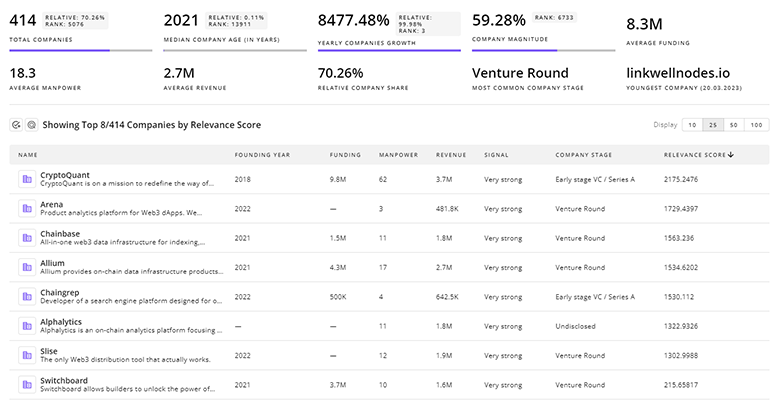
2.6K Artificial Intelligence Of Things Companies
Discover Artificial Intelligence Of Things Companies, their Funding, Manpower, Revenues, Stages, and much more
Artificial Intelligence Of Things Investors
TrendFeedr’s investors tool offers a detailed view of investment activities that align with specific trends and technologies. This tool features comprehensive data on 1.4K Artificial Intelligence Of Things investors, funding rounds, and investment trends, providing an overview of market dynamics.
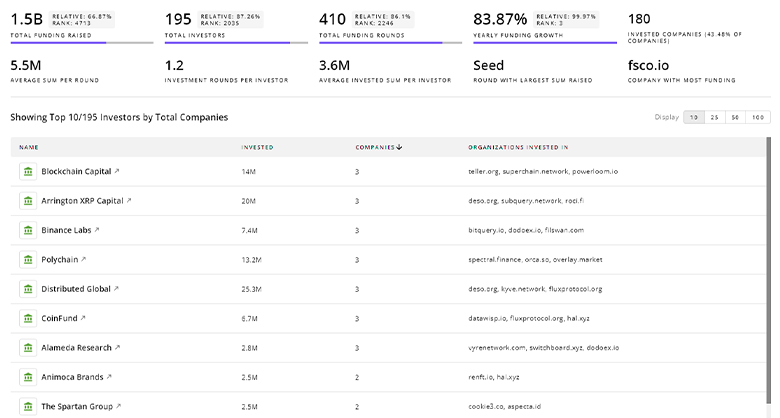
1.4K Artificial Intelligence Of Things Investors
Discover Artificial Intelligence Of Things Investors, Funding Rounds, Invested Amounts, and Funding Growth
Artificial Intelligence Of Things News
Stay informed and ahead of the curve with TrendFeedr’s News feature, which provides access to 3.6K Artificial Intelligence Of Things articles. The tool is tailored for professionals seeking to understand the historical trajectory and current momentum of changing market trends.
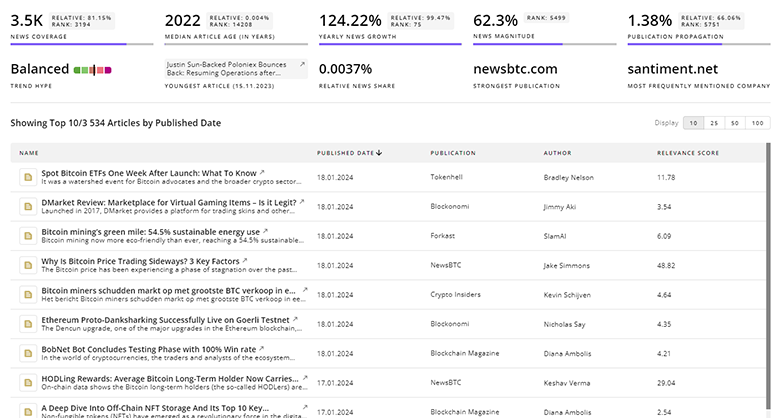
3.6K Artificial Intelligence Of Things News Articles
Discover Latest Artificial Intelligence Of Things Articles, News Magnitude, Publication Propagation, Yearly Growth, and Strongest Publications
Executive Summary
The Artificial Intelligence of Things market is shifting from experimental projects to production systems where proprietary physical data loops, explainable decision frameworks, and edge-native learning determine commercial winners. Companies that deliver deterministic behavior, certify safety properties, and control the closed-loop telemetry between sensors and actuators will capture the highest margins. For investors and strategists, immediate priorities are: secure partnerships that grant access to operational data, invest in neurosymbolic and low-data learning capabilities, and establish audit and compliance pathways now while procurement cycles remain flexible. This combination will separate durable AIoT moats from one-off pilots and position organizations to scale physical AI services into recurring, mission-critical revenue.
Interested in enhancing our coverage of trends and tech? We value insights from experts like you - reach out!