Asset Tracking Report
: Analysis on the Market, Trends, and TechnologiesThe asset-tracking market shows strong commercial momentum with USD 25.36 billion in reported 2023 market size and an internal CAGR benchmark of 12.6% that frames medium-term expectations. Market projections from independent analysts indicate a range of end-state scenarios (mid-range forecasts spanning USD 51B–74B by early 2030s) driven by wider IoT adoption, cloud platform consolidation, and higher-value use cases such as cold-chain and regulated healthcare grandviewresearch – Asset Tracking Market, 2025. This report synthesizes market sizing, applications, technology stacks, and company-level positioning to inform investment, procurement, and product strategy.
This report was last updated 27 days ago. Spot an error or missing detail? Help us fix it by getting in touch!
Topic Dominance Index of Asset Tracking
To identify the Dominance Index of Asset Tracking in the Trend and Technology ecosystem, we look at 3 different time series: the timeline of published articles, founded companies, and global search.
Key Activities and Applications
- Real-Time Location & Visibility — continuous tracking for pallets, containers, tools, and rented equipment; solutions increasingly replace manual checks and shrink audit cycles.
- Condition and Compliance Monitoring — sensor fusion for temperature, humidity, shock and seal status in cold chain and pharmaceuticals; condition events trigger workflows and claims-ready records Smart asset monitoring.
- Fixed Asset Verification & Financial Reconciliation — automated audits, depreciation inputs, and year-end FAR reconciliation; software + RFID/barcode integration cuts audit time substantially in enterprise deployments Fixed asset tracking software.
- Fleet & Telemetry Optimization — telematics for utilization, preventive maintenance and driver performance; fleet telematics remains a major revenue generator inside logistics and construction verticals.
- Precision Indoor Localization & Automation — UWB, BLE Angle-of-Arrival, and GNSS+UWB hybrids for centimeter-level positioning in manufacturing and robotics, enabling AGV/robot coordination and tool tracking.
Emergent Trends and Core Insights
- Edge-first analytics and on-tag intelligence are reducing telemetry volume and latency as vendors push inference to devices and gateways; this lowers connectivity costs while enabling faster exception handling.
- Multi-modal coverage (indoor/outdoor) is becoming standard — hybrid stacks that combine GPS, LPWAN (LoRaWAN/NB-IoT/LTE-M), BLE/UWB and RFID enable seamless handoffs across environments.
- Provenance and auditability are moving from pilots into production for regulated goods (pharma, high-value luxury) where immutable custody records (DLT/blockchain) add measurable compliance and finance utility researchandmarkets - Asset Tracking Market, 2025.
- Energy autonomy for remote/unpowered assets is a high-value hardware frontier: solar and energy-harvesting trackers extend life to multi-year operational windows and materially reduce field servicing hoopo.tech.
- Data hygiene and ERP/financial integration separate winners from commodities — platforms that feed audit and depreciation workflows capture disproportionate willingness to pay.
Technologies and Methodologies
- RFID / NFC / Barcode — foundational ID layer for item-level visibility and rapid inventory cycles; passive RFID remains cost-efficient for large SKU volumes.
- Global Navigation Satellite Systems (GNSS) + Cellular IoT (LTE-M / NB-IoT / CAT-M1) — primary wide-area option for mobile assets; hybrids with satellite coverage for remote corridors now common.
- Ultra-Wideband (UWB) and BLE AoA/RTLS — centimeter to sub-meter indoor accuracy for manufacturing, robotics, and high-density warehouses.
- Edge AI & Sensor Fusion — local anomaly detection, motion-aware reporting and predictive maintenance enable event-driven reporting and lower cloud costs.
- Energy Harvesting & Solar-assisted Power — long-life tags and trackers that remove battery replacement as an operational burden for remote assets.
- Cloud-native, API-first Platforms — modular SaaS platforms with ERP/ITSM connectors drive the highest commercial value by embedding tracking into transactional workflows.
Asset Tracking Funding
A total of 528 Asset Tracking companies have received funding.
Overall, Asset Tracking companies have raised $9.5B.
Companies within the Asset Tracking domain have secured capital from 1.8K funding rounds.
The chart shows the funding trendline of Asset Tracking companies over the last 5 years
Asset Tracking Companies
INLAN — focused on affordable, item-level RFID localization for warehouse and retail automation; the company packages scalable RFID systems intended to deliver tight indoor positioning without the cost penalty of bespoke RTLS, positioning INLAN for high-volume SKU environments where incremental accuracy yields operational payback.
INLAN's product set targets large indoor sites where per-item visibility drives inventory turns and loss reduction. Their commercial case centers on low tag cost and integration with warehouse automation. Early deployments emphasize robot navigation and pick-path accuracy.**FORMATION GmbH — German firm using QR and spatial mapping to enable mass asset tagging with minimal hardware; the company's approach emphasizes user-centric maps and fast time-to-value in events and buildings rather than heavy sensor infrastructure.
Their solution reduces up-front sensor expense by coupling QR/visual tags with spatial maps and AR-style retrieval workflows; this lowers the adoption threshold for SMEs and event operators.**IndoTraq™ LLC — deep-tech startup providing sub-millimeter 3D position tracking via a fused camera/IMU/UWB approach; technology supports high-frequency updates (150 Hz) and sub-millimeter precision needed in VR/robotics and advanced manufacturing.
Their moat is a patented fusion stack that delivers motion-grade tracking; commercial paths include robotics orchestration, AR/VR production, and precision calibration tasks where centimeter-class systems cannot meet requirements.**Detagto — provides mark-free optical fingerprinting (IRIS) to trace individual parts without labels, allowing serialization where labeling is impractical; this enables forgery-resistant provenance for small components and high-value assemblies.
Detagto's IRIS reduces dependency on applied identifiers and offers a fast camera-based verification workflow that scales to production speeds. The use case fits industries that require tamper-resistant part-level traceability.**PASSIVE EYE Ltd — inventor of an energy-harvesting, self-sustaining outdoor tracker that eliminates manual battery recharging for land and marine equipment; the technology reduces lifecycle cost and field servicing for dispersed heavy assets.
Their USP is perpetual operation via energy harvesting and advanced power management, making them a candidate for infrastructure and maritime applications where battery logistics dominate OPEX.
Identify and analyze 4.6K innovators and key players in Asset Tracking more easily with this feature.
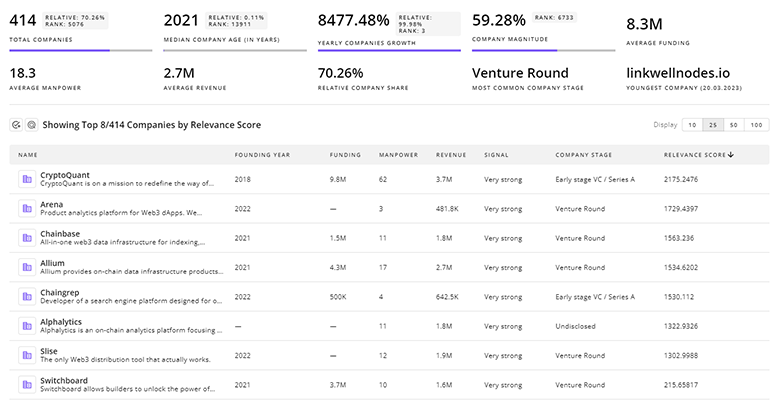
4.6K Asset Tracking Companies
Discover Asset Tracking Companies, their Funding, Manpower, Revenues, Stages, and much more
Asset Tracking Investors
TrendFeedr’s investors tool offers a detailed view of investment activities that align with specific trends and technologies. This tool features comprehensive data on 1.9K Asset Tracking investors, funding rounds, and investment trends, providing an overview of market dynamics.
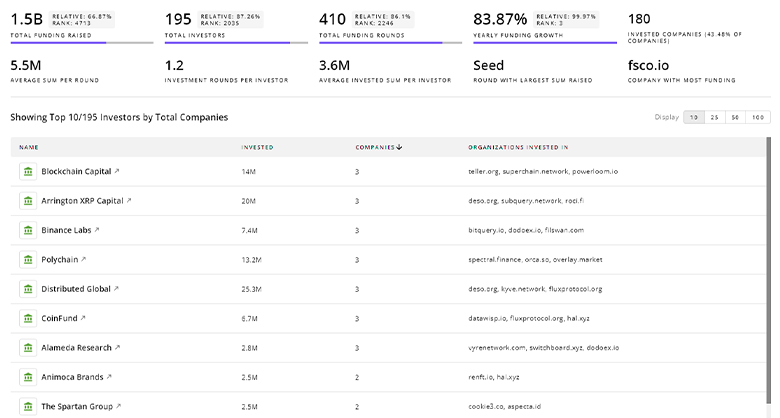
1.9K Asset Tracking Investors
Discover Asset Tracking Investors, Funding Rounds, Invested Amounts, and Funding Growth
Asset Tracking News
Stay informed and ahead of the curve with TrendFeedr’s News feature, which provides access to 3.6K Asset Tracking articles. The tool is tailored for professionals seeking to understand the historical trajectory and current momentum of changing market trends.
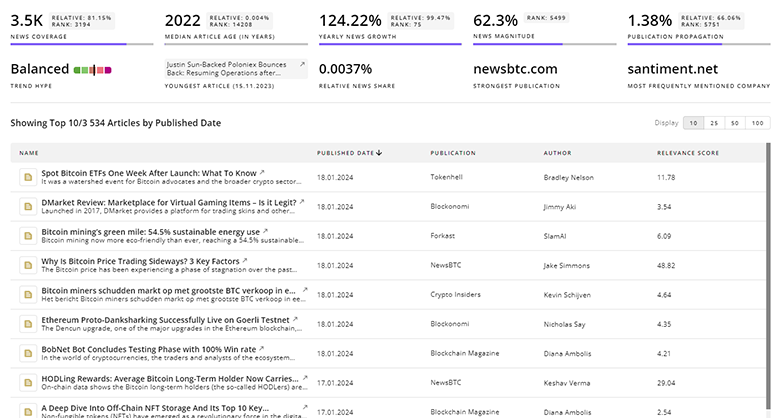
3.6K Asset Tracking News Articles
Discover Latest Asset Tracking Articles, News Magnitude, Publication Propagation, Yearly Growth, and Strongest Publications
Executive Summary
The asset-tracking market is at a pragmatic inflection: the technical building blocks (RFID, BLE/UWB, GNSS, LPWAN, edge AI) are mature enough that commercial differentiation shifts to data utility, integration depth, and device economics. Organizations buying tracking systems care less about tags and more about whether tracking data feeds audit, maintenance, and financial workflows with confidence and low manual overhead. Short and medium term winners will be those that (1) deliver cross-environment continuity at predictable TCO, (2) remove field servicing as a recurring cost through long-life power strategies, and (3) ship verticalized, API-rich platforms that embed tracking outputs directly into ERP, ITSM, or compliance processes. Strategic buyers should prioritize pilots that validate not only location accuracy but also end-to-end data fidelity for accounting and regulatory workflows, while technology investors should focus on sensor-to-cloud primitives that convert telemetry into monetizable, auditable signals.
Interested in enhancing our coverage of trends and tech? We value insights from experts like you - reach out!