Augmented Intelligence Report
: Analysis on the Market, Trends, and TechnologiesThe augmented intelligence market sits at a decisive inflection point: internal data records a market size of $21.73 billion in 2023 with an internal projection to $166.54 billion by 2032 at a 25.4% CAGR, signaling sustained high growth driven by enterprise adoption of AI-augmented decision tools and sector-specific deployments. External market estimates differ in scale but align on trajectory: Zion Market Research projects growth from about $23.3 billion (2023) to $250.01 billion by 2032 Augmented Intelligence Market Size, Share, Growth & Forecast 2032 while Grand View Research reports $29.15 billion in 2023 with a projected CAGR around 25.2% to 2030 Augmented Intelligence Market Size & Share Report, 2030. These overlapping signals indicate two practical implications: (1) demand concentrates on software and cloud-delivered analytics and copilots, and (2) firms that combine explainability, domain data assets, and edge-capable inference stand to capture disproportionate value.
This report was last updated 85 days ago. Spot an error or missing detail? Help us fix it by getting in touch!
Topic Dominance Index of Augmented Intelligence
To identify the Dominance Index of Augmented Intelligence in the Trend and Technology ecosystem, we look at 3 different time series: the timeline of published articles, founded companies, and global search.
Key Activities and Applications
- Augmented analytics for business decision making — AI automates data preparation, surfaces causal signals, and produces narrative explanations for non-technical users; this reduces analyst cycle time and expands insight access across functions Augmented Intelligence Market 2025: Detailed Insights into Market Size and Future Growth.
So what: democratized analytics increases throughput for strategy and operations teams and raises the commercial value of domain-specific data platforms. - Clinical decision support and digital health assistants — AI-aided imaging interpretation, treatment planning, and workflow automation accelerate diagnostics and clinician productivity, generating early regulatory approvals that de-risk enterprise spend in health systems.
So what: regulatory acceptance in healthcare creates high-value, defensible niches for vendors with validated clinical outcomes. - Connected worker and frontline AR guidance — AR overlays plus contextual AI deliver step-by-step procedures, remote expert support, and live anomaly detection on the shop floor, reducing onboarding time and error rates.
So what: industrial adopters prioritize integration with MES/ERP and low-latency edge inference. - AI copilots and agentic assistants for workflows — Multi-agent systems and retrieval-augmented generation (RAG) power assistants that propose actions, draft communications, and run scenario simulations across logistics, sales, and legal workflows Augment Retrieval Augmented Generation: The Secret to Building Smarter, More Adaptive AI Systems.
So what: firms that embed agent safety, audit trails, and domain grounding win enterprise procurement decisions. - Computer vision for quality, safety, and automation — Visual inspection and spatial computing reduce defects and enable autonomous guidance in manufacturing, retail, and logistics — often deployed at the edge for latency and privacy reasons Augmented Intelligence in the US - Market Research Report (2020-2035).
So what: hardware and model co-design becomes a differentiator for real-time applications.
Emergent Trends and Core Insights
- Agentic AI and multi-agent automation — Systems move from reactive assistants to proactive agents that coordinate multi-step tasks, create monitoring loops, and execute constrained actions; this raises productivity but heightens the need for guardrails and verifiable behavior Yugaa AI.
So what: governance, logging, and explainability become procurement filters for enterprise buyers. - RAG and retrieval-first architectures to reduce hallucination — Combining vector retrieval with LLMs improves factuality and enables direct linking to enterprise knowledge bases, which lowers legal and compliance risk for document-heavy workflows.
So what: vendors that deliver turnkey RAG pipelines for regulated verticals shorten sales cycles. - Edge inference for frontline and privacy-sensitive use cases — Deploying models on-device reduces latency and avoids moving sensitive data to the cloud; this pattern appears in manufacturing, clinical devices, and retail sensors Global Augmented Intelligence Market Size, Share & Trends.
So what: edge-capable model architectures and lightweight compression techniques command price premia. - Explainability and human-in-the-loop controls — Demand for auditable decisions grows as AI supports higher-stakes decisions; explainable AI features now affect vendor selection in finance and healthcare Third Insight.
So what: explainability is not optional for enterprise-grade augmented intelligence in regulated verticals. - Verticalization: deep domain models beat horizontal generalists for value capture — Market evidence points to specialization in healthcare, manufacturing, and finance where domain data and compliance expertise create barriers to entry Market Research Future US report Precedence Research.
So what: strategic buyers prefer vendors that demonstrate measurable KPIs in the target domain.
Technologies and Methodologies
- Generative AI and large language models (LLMs) — Drive conversational assistants, summarization, and report generation across business functions; enterprise adoption focuses on guardrails and integration with source-of-truth data.
Impact: LLMs enable new UX patterns but require retrieval and control layers for production use. - Retrieval-Augmented Generation (RAG) — Use retrieval layers to ground model outputs in enterprise knowledge bases; reduces factual errors and supports provenance requirements.
Impact: RAG becomes a platform feature buyers expect for document workflows. - Computer vision and spatial computing — Combine image understanding with AR overlays for diagnostics, quality control, and guided operations.
Impact: Integration with optical hardware and edge models defines product roadmaps. - Hybrid neuro-symbolic and explainable AI — Blend statistical learning with symbolic reasoning for traceable inference in regulated contexts.
Impact: This approach improves auditability and supports rule-based compliance checks. - Continual learning and reinforcement learning for agents — Allow assistants to adapt to organizational policy and feedback loops; used in copilots and autonomous agents to refine behavior over time.
Impact: Organizations need safe update workflows and monitoring to prevent drift.
Augmented Intelligence Funding
A total of 156 Augmented Intelligence companies have received funding.
Overall, Augmented Intelligence companies have raised $4.2B.
Companies within the Augmented Intelligence domain have secured capital from 648 funding rounds.
The chart shows the funding trendline of Augmented Intelligence companies over the last 5 years
Augmented Intelligence Companies
- Augmenta
Augmenta applies mathematical optimization and AI to automate building design tasks for the construction industry, reducing modeling time for complex systems such as electrical conduits. Their product targets engineering bottlenecks where domain constraints and deterministic optimization produce measurable efficiency gains. Augmenta's focus on embedding engineering rules into AI models gives purchasing teams clear ROI metrics in capital projects, which shortens procurement cycles in construction. - Integrator JSC (ntgr.ai)
Integrator JSC offers a language-agnostic Digital Augmentation Agent that enhances employee productivity through simultaneous interactions and secure data handling, backed by ISO/IEC 27001:2022 certification. Their security posture appeals to regulated buyers in finance and healthcare who require strict controls and auditability. The company positions itself as a bridge for enterprises moving legacy workflows into AI-augmented operations. - Retrocausal
Retrocausal builds manufacturing-focused intelligence augmentation systems that combine generative models with computer vision to produce shopfloor copilots for assembly and inspection tasks. Their Copilot product elevates task performance of less-experienced workers, reducing defect rates and operator variability. This vertical specialization creates measurable production KPIs that industrial customers can validate before scaling. - Augmentir
Augmentir delivers connected worker solutions that integrate AI with AR for onboarding, skills tracking, and on-the-job guidance in industrial settings. The platform emphasizes closed-loop training and performance improvement tied to frontline metrics. Industrial customers value the combination of AR guidance and AI-driven analytics because it yields immediate reductions in time-to-competency. - Augmentus
Augmentus focuses on AI-driven robotics and 3D vision for adaptive automation in high-mix, high-variability manufacturing environments. Their no-code robot programming approach reduces engineering overhead for automation deployment. For manufacturers with frequent changeovers, Augmentus cuts integration time and increases line flexibility.
(Each company summary above reflects company profiles and product emphasis as presented in the available company landscape and trend data).
Identify and analyze 676 innovators and key players in Augmented Intelligence more easily with this feature.
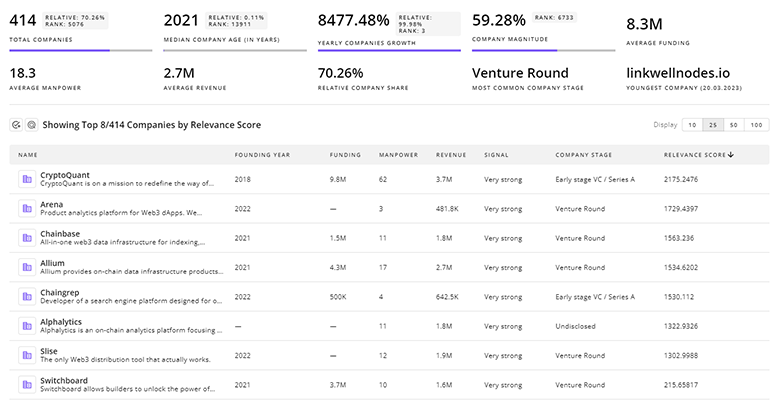
676 Augmented Intelligence Companies
Discover Augmented Intelligence Companies, their Funding, Manpower, Revenues, Stages, and much more
Augmented Intelligence Investors
TrendFeedr’s investors tool offers a detailed view of investment activities that align with specific trends and technologies. This tool features comprehensive data on 696 Augmented Intelligence investors, funding rounds, and investment trends, providing an overview of market dynamics.
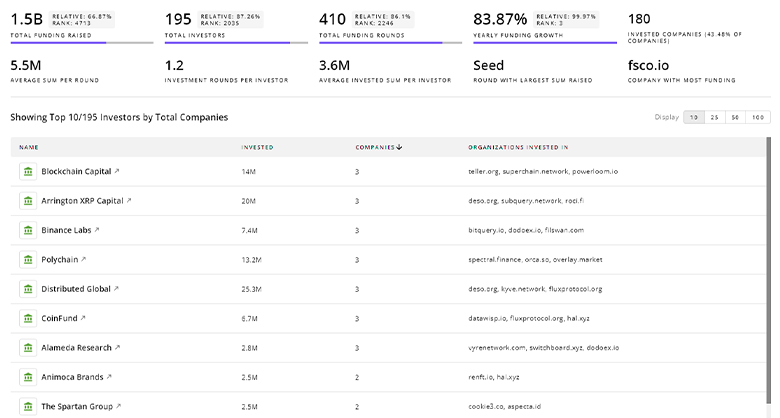
696 Augmented Intelligence Investors
Discover Augmented Intelligence Investors, Funding Rounds, Invested Amounts, and Funding Growth
Augmented Intelligence News
Stay informed and ahead of the curve with TrendFeedr’s News feature, which provides access to 902 Augmented Intelligence articles. The tool is tailored for professionals seeking to understand the historical trajectory and current momentum of changing market trends.
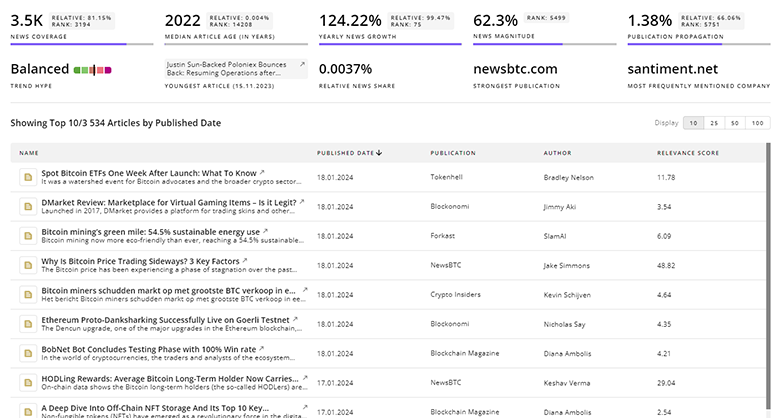
902 Augmented Intelligence News Articles
Discover Latest Augmented Intelligence Articles, News Magnitude, Publication Propagation, Yearly Growth, and Strongest Publications
Executive Summary
The data shows augmented intelligence is moving from niche pilots to mission-critical enterprise deployments. Market growth expectations remain strong across reputable forecasters, but absolute forecasts vary by definition and time horizon. Practical buyers reward vendors that deliver measurable KPIs, domain-grounded accuracy, and auditable decision traces. Vendors that package explainable models, RAG-grounded LLM functions, and edge-capable inference for frontline use cases will face favorable buying conditions. For procurement and strategy teams, the immediate priorities are (1) validate claims with domain KPIs, (2) insist on provenance and audit capabilities, and (3) prefer modular architectures that integrate into existing data estates to accelerate time to value.
Interested in enhancing our coverage of trends and tech? We value insights from experts like you - reach out!