Autonomous Robot Report
: Analysis on the Market, Trends, and TechnologiesThe autonomous robot market is at an inflection where scale, specialization, and software-driven operations define winners: global market sizing in the internal autonomous robot trend places current market volume at USD 7,500,000,000 with a 14.79% CAGR and a forecast projection of USD 22,900,000,000, framing a multi-billion dollar growth runway for companies that can convert sensor and operational data into repeatable service economics.
This report was last updated 26 days ago. Spot an error or missing detail? Help us fix it by getting in touch!
Topic Dominance Index of Autonomous Robot
To identify the Dominance Index of Autonomous Robot in the Trend and Technology ecosystem, we look at 3 different time series: the timeline of published articles, founded companies, and global search.
Key Activities and Applications
- Intralogistics and Warehouse Automation — Autonomous mobile robots (AMRs) perform goods-to-person picking, sorting and transport to reduce labor costs and increase throughput; adoption is strongest where integration with WMS/ERP yields measurable cycle-time reductions
- Industrial Inspection and Maintenance — Quadrupeds and rugged AMRs undertake inspections in oil & gas, power and process plants to access hazardous or confined spaces and generate high-frequency condition data for predictive maintenance.
- Healthcare and Service Robotics — Delivery, disinfection, and patient-assistance robots address staffing gaps and infection control while opening service contracts in hospitals and hospitality venues.
- Autonomous Drones and Drone-in-a-Box — Persistent aerial inspection and logistics use automated launch/charging pods and BVLOS flight profiles to deliver scalable monitoring and last-mile payloads.
- Specialized Heavy-Payload and Retrofit Autonomy — Bolt-on autonomy kits and high-payload AMRs enable retrofitting of forklifts and heavy machinery to achieve Level-adapted autonomy without replacing fleets, accelerating ROI for industrial operators.
- Security, Surveillance and Public Safety — Autonomous patrol units and aerial swarm systems provide continuous perimeter monitoring and rapid incident verification, positioned against rising security demands Global Autonomous Navigation Robots Outlook 2025.
Emergent Trends and Core Insights
- Market scale and growth concentration — Multiple market studies converge on a strong expansion profile (mid-teens to high-teens CAGR across AMR and autonomous-robot segments), creating distinct windows for platform play and vertical specialists Autonomous Mobile Robots Market Overview 2025.
- Platform versus specialization schism — The sector is bifurcating into (a) software/platform orchestration layers that monetize operational data and fleet orchestration and (b) highly specialized hardware providers that justify premiums by delivering unique physical capabilities (ATEX, extreme terrain, confined-space morphologies) ANYbotics.
- Vision and sensor fusion overtaking beaconed systems — Vision-based SLAM and LiDAR-vision fusion are expanding rapidly, lowering infrastructure costs for deployments and enabling mapless operation in GNSS-denied and unstructured spaces Autonomous Mobile Robots Market Size & Share Analysis.
- Healthcare and last-mile delivery as high-velocity verticals — Healthcare shows some of the highest projected growth rates among verticals due to labor pressures and infection-control needs; last-mile delivery captures rapid pilot programs that scale where regulation enables BVLOS or sidewalk corridors Autonomous Mobile Robots Market Report, 2033.
- RaaS and subscription models enable faster adoption by SMEs — Robotics-as-a-Service lowers capex barriers and shifts risk to suppliers, accelerating uptake among mid-market warehouse and facility operators.
- Edge AI and on-platform inference — Onboard neural inference reduces latency and enables autonomy where connectivity is intermittent; this creates a competitive edge for systems that pair efficient compute with optimized perception stacks.
Technologies and Methodologies
- 3-D visual SLAM + LiDAR fusion — Multi-sensor stacks that merge LiDAR, stereo vision and IMU provide resilient localization and obstacle handling in diverse lighting and weather.
- Edge-AI compute stacks — Embedded platforms (accelerated SoCs and optimized inference runtimes) enable closed-loop perception and control without constant cloud connectivity.
- Digital twins and simulation-first validation — Cloud simulation and digital twins reduce field testing time, speed safety validation and shrink commissioning cycles for high-risk deployments.
- Multi-agent orchestration and decentralized control — Decentralized coordination algorithms and fleet orchestration layers enable cooperative tasks, improved resilience to comms loss, and scalable multi-robot missions.
- Hybrid autonomy with human-in-the-loop supervision — Shared autonomy architectures keep humans as supervisory agents to handle edge cases and guarantee safety while most routine tasks execute autonomously.
- Energy autonomy and battery management — Autonomous charging, battery-swap mechanisms and power-aware task scheduling extend mission durations and reduce downtime for continuous operations.
Autonomous Robot Funding
A total of 1.2K Autonomous Robot companies have received funding.
Overall, Autonomous Robot companies have raised $68.4B.
Companies within the Autonomous Robot domain have secured capital from 5.3K funding rounds.
The chart shows the funding trendline of Autonomous Robot companies over the last 5 years
Autonomous Robot Companies
- RoBoa — A Swiss developer of snake-like, growing-locomotion robots designed for confined and collapsed-space inspection; RoBoa's morphology addresses inspection tasks that wheeled platforms cannot reach, creating a defensible hardware niche and reducing retrofit complexity in disaster-response and industrial inspection settings
- Cyberbee — An Israeli supplier of compact navigation modules that deliver low-power, vision-SLAM capabilities for small indoor AMRs; Cyberbee's navigational ingredient approach helps low-cost robot makers avoid long in-house navigation development and accelerates deployments in GNSS-denied facilities
- STAR ROBOTICS — Madrid-based provider targeting security and inspection with cloud orchestration (AUROS) and mid-market commercial bundles; STAR ROBOTICS focuses on rapid ROI through standardized deployment packages for facility security teams
- VeroBotics — Focused on autonomous exterior building maintenance and high-rise inspection, VeroBotics combines tetherless locomotion and multi-modal sensors to reduce scaffold and rope-access costs for building owners; the company's vertical specialization targets CAPEX-sensitive facilities operators seeking inspection frequency improvements
Identify and analyze 4.0K innovators and key players in Autonomous Robot more easily with this feature.
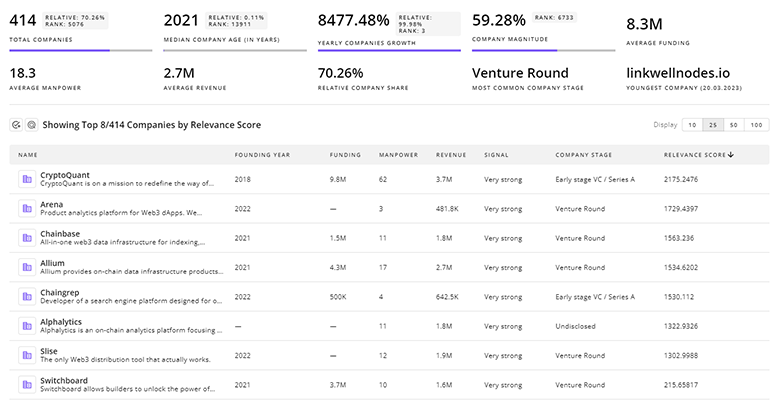
4.0K Autonomous Robot Companies
Discover Autonomous Robot Companies, their Funding, Manpower, Revenues, Stages, and much more
Autonomous Robot Investors
TrendFeedr’s investors tool offers a detailed view of investment activities that align with specific trends and technologies. This tool features comprehensive data on 6.2K Autonomous Robot investors, funding rounds, and investment trends, providing an overview of market dynamics.
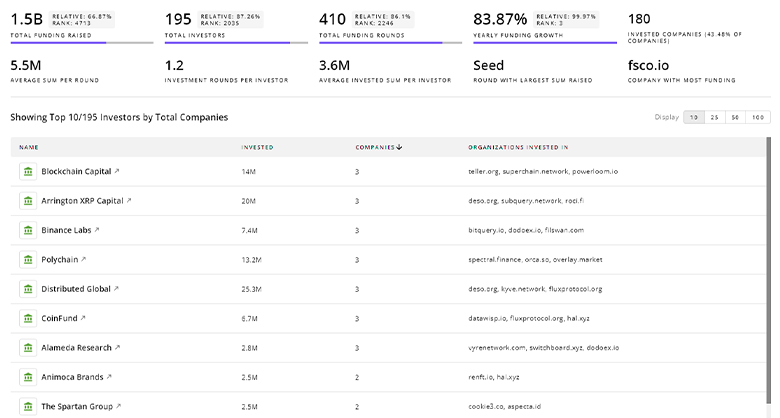
6.2K Autonomous Robot Investors
Discover Autonomous Robot Investors, Funding Rounds, Invested Amounts, and Funding Growth
Autonomous Robot News
Stay informed and ahead of the curve with TrendFeedr’s News feature, which provides access to 5.8K Autonomous Robot articles. The tool is tailored for professionals seeking to understand the historical trajectory and current momentum of changing market trends.
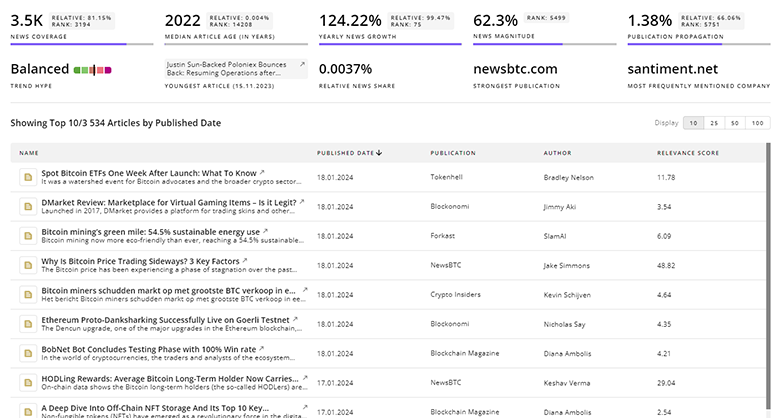
5.8K Autonomous Robot News Articles
Discover Latest Autonomous Robot Articles, News Magnitude, Publication Propagation, Yearly Growth, and Strongest Publications
Executive Summary
Investment and technology signals show the autonomous robot sector moving from technical validation into commercial scaling where data capture, software orchestration and domain-specific physical performance determine margin capture. Market growth projections—backed by internal forecasts—create a large addressable opportunity, but winners will be those that convert operational telemetry into repeatable services (RaaS/subscriptions), reduce integration friction with existing enterprise stacks, and demonstrate certified safety in regulated verticals. For strategic investors and operators, the immediate priorities are (1) secure long-term service contracts to aggregate operational data, (2) invest in edge-optimized perception and simulation tooling to shorten deployment cycles, and (3) select verticals where physical capability commands a persistent premium—such as hazardous inspection, high-payload logistics, and specialized outdoor delivery—where hardware differentiation remains defensible.
Interested in enhancing our coverage of trends and tech? We value insights from experts like you - reach out!