
Battery Report
: Analysis on the Market, Trends, and TechnologiesThe battery sector is at a critical inflection point driven by accelerating demand for EVs and grid storage, with total funding in the topic area reported at $935.05B and yearly funding-round growth of 33.75% in the internal data, reflecting strong capital flows into the space and intensifying commercialization pressure. Patent and company formation rates have slowed while news momentum is strong, indicating a transition from basic discovery to systems, manufacturing, and deployment-focused activity.
This report was last updated 156 days ago. Spot an error or missing detail? Help us fix it by getting in touch!
Topic Dominance Index of Battery
To identify the Dominance Index of Battery in the Trend and Technology ecosystem, we look at 3 different time series: the timeline of published articles, founded companies, and global search.
Key Activities and Applications
- Energy storage for grid stabilization and renewables integration: large-scale ESS deployments are a primary driver for LiFePO4 and flow battery applications, tying directly to revenue and funding growth in energy storage companies The Global Market for Advanced Batteries 2024-2034.
- Electric mobility batteries (EVs and e-mobility): heavy patenting around battery packs, integration, and BMS highlights automotive electrification as a persistent application focus.
- Battery management and diagnostics: development of predictive BMS and data-driven state estimation to improve lifetime and safety is a frequent theme in patents and company solutions.
- Second-life and circular models: upcycling of EV packs into residential and commercial storage is emerging as a scalable business model addressing supply risk and cost betteries AMPS GmbH company profile.
- Portable and specialty batteries (aerospace, medical, industrial): mission-critical niches continue to demand custom chemistries and qualification testing, supported by legacy specialist suppliers EaglePicher Technologies company profile.
Emergent Trends and Core Insights
- Chemistry diversification with commercial focus on Li-ion variants and LFP: Li-ion dominance continues, but LiFePO4 adoption for ESS and commercial EVs is expanding due to safety and lifecycle economics The Global Market for Advanced Batteries 2024-2034 and company emphasis on LFP Shenzhen Leadyo Technology Co.,Ltd.
- Manufacturing and cost-disruption efforts: additive and novel production approaches aim to reduce $/kWh; a single startup claims >40% manufacturing cost reduction via dry-spray additive techniques, implying a path to the $100/kWh target that unlocks mass electrification Kinetic Batteries profile.
- Software and physics-based optimization: companies using physics-driven models and optimal charging profiles report dramatic cycle-life improvements (up to doubling or more), signaling software-as-leverage to defer costly chemistry changes BattGenie Inc. profile.
- Fast-charging architectures and electrolytes: advances in electrode/electrolyte design and additive screening (often assisted by ML) are enabling much faster charge rates with controlled degradation risk, creating a competitive axis beyond energy density [industry research and news on electrolyte additives and fast charging].
- Circular economy and second-life value chains: modular repurposing of EV battery packs into stationary storage is maturing as a commercially viable route that both reduces system costs and mitigates raw material demand pressure betteries AMPS GmbH profile.
- Geographic R&D concentration and IP intensity: patent activity is concentrated in Japan and China, with increasing US and European investment in specialized manufacturing and mission-critical chemistries, implying geopolitical risk in material supply chains and opportunities for regional manufacturing investments.
Technologies and Methodologies
- LiFePO4 and advanced Li-ion variants: favored for ESS and commercial EV use for safety and life-cycle economics; manufacturing and cathode-anode material advances remain focal points The Global Market for Advanced Batteries 2024-2034.
- Solid-state and beyond-Li chemistries: solid-state remains a high-value R&D area with potential energy-density and safety benefits; several developers are in pilot or pre-commercial stages solid-state and advanced chemistry sections of the market report.
- Additive manufacturing for electrodes and cell form factors: 3D and dry-spray additive deposition promise cost and design flexibility advantages in electrode architecture and enable conformal/structural batteries Kinetic Batteries profile.
- Physics-based BMS and optimal charging: model-driven BMS that tailor charging profiles to cell state and chemistry can materially extend cycle life and enable faster charging without sacrificing longevity BattGenie Inc. profile.
- Testing, qualification, and lifecycle analytics: growth in battery testing equipment and data-driven validation reflects rising demand for certified packs across EV and aerospace segments [batteries testing equipment overview and companies].
- Recycling and direct cathode recovery methods: hydrometallurgy, pyrometallurgy, and emerging direct recycling approaches are being compared and commercialized to recover critical materials at scale The Global Market for Advanced Batteries 2024-2034.
Battery Funding
A total of 15.7K Battery companies have received funding.
Overall, Battery companies have raised $928.7B.
Companies within the Battery domain have secured capital from 47.3K funding rounds.
The chart shows the funding trendline of Battery companies over the last 5 years
Battery Companies
-
Kinetic Batteries
Small startup pioneering a dry-spray additive manufacturing process for electrodes that claims >40% manufacturing cost reductions and the ability to print conformal/structural batteries. Their approach targets the manufacturing cost curve and could materially change sourcing and pack design economics if scaled Kinetic Batteries profile. -
BattGenie Inc.
Early-stage company offering physics-based BMS and charging algorithms that report substantial cycle-life improvements (up to ~100% increase vs standard charging). Their value lies in software-first extension of cell lifetimes applicable across EV, consumer, and stationary storage markets BattGenie Inc. profile. -
BSLBATT – SOLAR
Manufacturer focused on LiFePO4 solar-storage solutions and C&I systems. Their product set targets long-cycle, low-temperature performance and anti-thermal-runaway features, reflecting the commercial pull toward safe, durable ESS chemistries. -
EaglePicher Technologies
Legacy supplier for aerospace and defense batteries with deep qualification capability; their strength is mission-critical customization and long-term reliability verification, a continued competitive moat in high-value applications EaglePicher Technologies profile.
Identify and analyze 189.8K innovators and key players in Battery more easily with this feature.
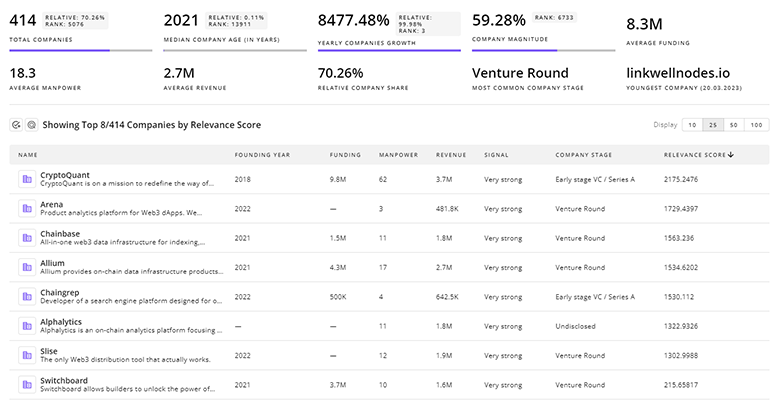
189.8K Battery Companies
Discover Battery Companies, their Funding, Manpower, Revenues, Stages, and much more
Battery Investors
TrendFeedr’s investors tool offers a detailed view of investment activities that align with specific trends and technologies. This tool features comprehensive data on 31.5K Battery investors, funding rounds, and investment trends, providing an overview of market dynamics.
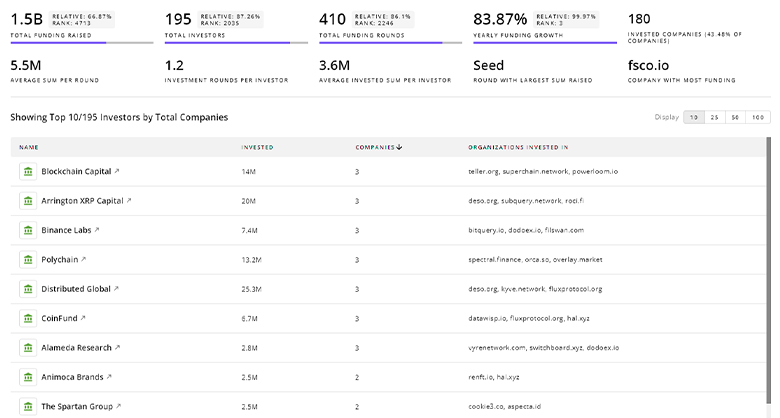
31.5K Battery Investors
Discover Battery Investors, Funding Rounds, Invested Amounts, and Funding Growth
Battery News
Stay informed and ahead of the curve with TrendFeedr’s News feature, which provides access to 291.8K Battery articles. The tool is tailored for professionals seeking to understand the historical trajectory and current momentum of changing market trends.
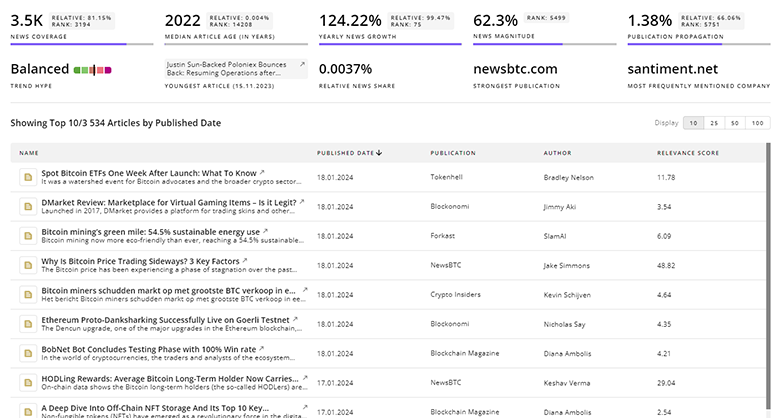
291.8K Battery News Articles
Discover Latest Battery Articles, News Magnitude, Publication Propagation, Yearly Growth, and Strongest Publications
Executive Summary
The battery market is shifting from singular chemistry races to an ecosystem competition defined by manufacturing economics, system-level software intelligence, and circular supply models. Investors and industrial players should prioritize three strategic moves: (1) invest in manufacturing-process innovations that materially lower $/kWh, (2) adopt physics-based BMS and data platforms that extend asset life and enable premium services, and (3) integrate second-life and recycling pathways to reduce material risk and lower total system cost. Companies that secure proprietary “ingredient” technologies (manufacturing processes, universal fast-charging electrolytes, or BMS algorithms) will likely extract value either through licensing or acquisition, while platform builders must coordinate supply, software, and end-market channels to sustain scale economics.
Interested in enhancing our coverage of trends and tech? We value insights from experts like you - reach out!