
Biodiversity Report
: Analysis on the Market, Trends, and TechnologiesThe global biodiversity emergency presents a direct commercial and systemic risk: the Living Planet Index records an average decline of 73% in vertebrate population sizes between 1970 and 2020, a quantitative baseline that reframes biodiversity as an economic exposure rather than a charitable cause. Corporate and public funding flows are rising but remain misaligned with the scale of need: ecosystem-focused companies collectively report $576.24B in total funding across the sector, yet directed biodiversity finance for conservation projects is an order of magnitude smaller and unevenly distributed. This report synthesizes the operational activities, emergent industry trends, leading technological methods, and five under-the-radar companies positioned to convert measurement into verified ecological outcomes.
This report was last updated 308 days ago. Spot an error or missing detail? Help us fix it by getting in touch!
Topic Dominance Index of Biodiversity
To identify the Dominance Index of Biodiversity in the Trend and Technology ecosystem, we look at 3 different time series: the timeline of published articles, founded companies, and global search.
Key Activities and Applications
- Automated biodiversity monitoring and reporting — High-throughput pipelines convert field inputs (eDNA, acoustic, imagery) into compliance-ready indicators used for CSRD/TNFD disclosures and regulatory permitting; this activity is central to corporate adoption because it reduces audit friction and enables performance tracking.
- Creation and trading of biodiversity credits (biocredits) — Project developers design verifiable units sold to corporate buyers; digital MRV platforms are emerging to provide real-time verification and prevent greenwashing in nascent markets.
- Spatial conservation planning and Biodiversity Net Gain (BNG) delivery — Practitioners translate high-level conservation targets into site- and landscape-scale interventions that satisfy permitting regimes and deliver measurable habitat outcomes.
- eDNA and genomic surveillance for cryptic and aquatic species — Non-invasive genetic sampling provides rapid presence/absence and community composition data at scales previously impossible with manual surveys, accelerating baseline establishment and post-intervention verification.
- Bioacoustics and IoT sensor networks for continuous detection — Acoustic detectors and low-power sensor arrays generate temporally dense datasets that feed automated species-detection pipelines, lowering sampling variance across complex habitats.
- Restoration and engineered habitats — From modular artificial reefs to designed urban green infrastructure, practitioners pair site engineering with MRV to translate investments into measurable biodiversity uplift.
Emergent Trends and Core Insights
- Financial instruments are maturing but the supply–demand gap persists. Public bilateral biodiversity finance rose in recent years, yet conservation funding still falls well short of the estimates needed to meet global targets Biodiversity Finance Trends 2025 – The Nature Conservancy.
- Monitoring technologies are converging into integrated dMRV stacks that combine eDNA, remote sensing, and bioacoustics to produce audit-ready evidence streams, shifting verification from episodic to continuous measurement.
- Measurement is moving beyond species counts toward functional and phylogenetic metrics that better predict ecosystem service delivery and resistance to climatic shocks; this reorientation changes which projects qualify as high-value credits and how restoration success is defined Biodiversity – Our World in Data.
- Geographic concentration of decline creates differentiated risk exposure: freshwater systems and specific regions show the steepest population drops, implying that investors and developers must apply spatially targeted strategies rather than uniform portfolio-wide approaches WWF Living Planet Report 2024: A Planet in Crisis.
- Credibility and traceability are the market's gating factors; lessons from carbon markets make clear that high-integrity MRV and transparent governance will determine which credit frameworks scale and which will face skepticism.
Technologies and Methodologies
- Environmental DNA (eDNA) metabarcoding — Rapid community-level detection from water, soil, and air samples reduces field costs and enables frequent baseline checks for aquatic and cryptic taxa.
- AI-driven remote sensing and hyperspectral analysis — Machine learning models translate multi- and hyper-spectral satellite data into habitat condition and species-proxy layers used for large-scale change detection.
- Bioacoustic classification pipelines — Automated acoustic species-recognition models provide continuous presence/absence signals, improving temporal resolution for mobile and vocal taxa.
- Digital MRV platforms and dMRV toolkits — Systems that stitch together sensor streams, genetic results, and remote sensing to produce auditable records for crediting and compliance.
- Blockchain and ledger systems for traceability — Distributed registries are being piloted to provide immutable transaction histories for biodiversity units and benefit-sharing arrangements.
- Digital twins and predictive ecological models — High-resolution simulation environments allow scenario testing and prioritized action selection under uncertainty, aiding funders and regulators in trade-off assessments.
- Engineered habitat construction (3D-printed reefs, modular structures) — Physical interventions designed to maximize structural complexity and ecological niches are paired with pre-defined MRV plans to create sellable restoration outcomes.
Biodiversity Funding
A total of 2.4K Biodiversity companies have received funding.
Overall, Biodiversity companies have raised $596.9B.
Companies within the Biodiversity domain have secured capital from 7.5K funding rounds.
The chart shows the funding trendline of Biodiversity companies over the last 5 years
Biodiversity Companies
- Leeana — Leeana provides an AI workspace that enables non-GIS teams to run spatial environmental checks and generate audit-ready outputs for reporting and permitting; their product cuts the turnaround time for site-level biodiversity risk screening to minutes, which directly supports company compliance workflows for CSRD and TNFD. Leeana positions itself as the front-end interface for portfolio-level geospatial governance and can reduce advisory costs for developers while improving consistency of disclosure.
- Boosterra.io — Boosterra.io markets biocredits monitored via satellite and AI with a digital MRV approach that targets corporate buyers seeking credible, traceable nature outcomes; their product bundles conservation projects with ESG-ready documentation to lower greenwashing risk. By emphasizing community benefit sharing and species protection metrics, Boosterra.io attempts to bridge investor demand and high-integrity on-the-ground delivery while operating at seed scale.
- Hula — Hula works on real-time sensor networks and compact IoT nodes for ecosystem monitoring, aiming to provide continuous inputs for dMRV processes; their approach reduces temporal sampling gaps that commonly undermine credit verification and adaptive management. Hula targets landscape managers and project developers that need persistent, high-frequency telemetry to demonstrate outcomes to buyers and regulators.
- NatureAlpha — NatureAlpha focuses on computational biodiversity risk assessment and high-velocity analytics, producing scored risk outputs used by financial institutions to price nature-related exposure; their platform claims to perform billions of calculations per second to support portfolio-level screening. By turning complex ecological inputs into investor-usable signals, NatureAlpha helps align capital allocation with measurable ecological risk metrics and supports fiduciary integration of nature dependencies.
- SimplexDNA — SimplexDNA operates end-to-end eDNA services (sampling design to data delivery) that enable project developers and conservation teams to incorporate genetic verification into monitoring plans; their workflow lowers laboratory bottlenecks and standardizes outputs suitable for accreditation. SimplexDNA's value lies in converting raw genetic reads into statistically defensible presence/absence and relative-abundance claims, which are essential for high-integrity credit issuance and regulatory reporting.
Identify and analyze 24.4K innovators and key players in Biodiversity more easily with this feature.
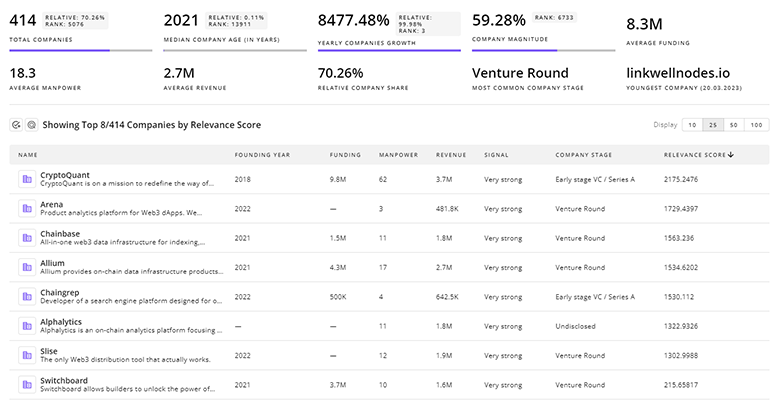
24.4K Biodiversity Companies
Discover Biodiversity Companies, their Funding, Manpower, Revenues, Stages, and much more
Biodiversity Investors
TrendFeedr’s investors tool offers a detailed view of investment activities that align with specific trends and technologies. This tool features comprehensive data on 6.5K Biodiversity investors, funding rounds, and investment trends, providing an overview of market dynamics.
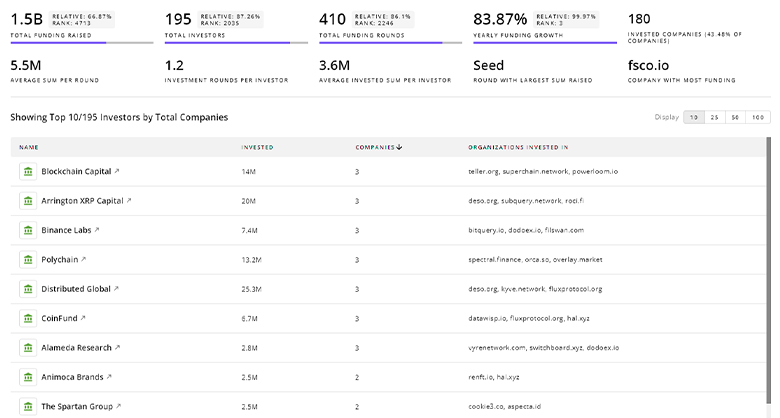
6.5K Biodiversity Investors
Discover Biodiversity Investors, Funding Rounds, Invested Amounts, and Funding Growth
Biodiversity News
Stay informed and ahead of the curve with TrendFeedr’s News feature, which provides access to 36.6K Biodiversity articles. The tool is tailored for professionals seeking to understand the historical trajectory and current momentum of changing market trends.
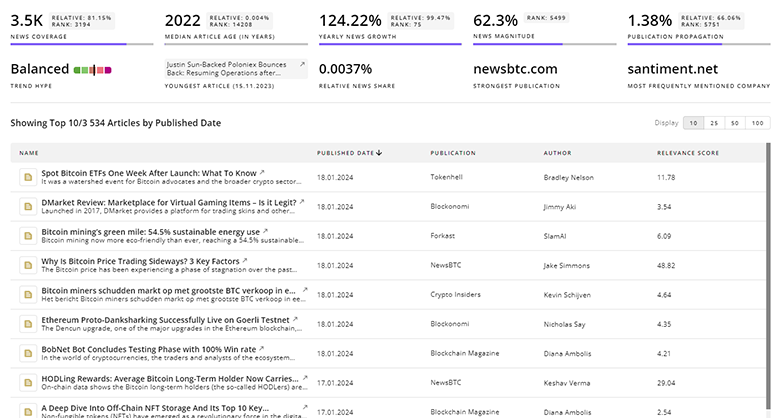
36.6K Biodiversity News Articles
Discover Latest Biodiversity Articles, News Magnitude, Publication Propagation, Yearly Growth, and Strongest Publications
Executive Summary
Businesses and investors face a clear choice: either treat biodiversity exposure as a financial line-item that requires systems for continuous verification and capital allocation, or accept unmanaged ecological risk as an unpriced liability. Measurable indicators such as the 73% Living Planet Index decline create objective baselines that transform conservation from narrative to balance-sheet material. The immediate commercial plays are twofold: invest in high-integrity dMRV data streams that feed regulatory and market frameworks, and finance implementation partners who can deliver verifiable, spatially targeted ecological outcomes. Those who combine rigorous measurement with accountable financing and community-aligned implementation will convert biodiversity obligations into durable enterprise value.
Interested in enhancing our coverage of trends and tech? We value insights from experts like you - reach out!