Bioenergy Report
: Analysis on the Market, Trends, and TechnologiesThe bioenergy sector is maturing into a capital-intensive, feedstock-centric industry with a clear growth profile: the internal bioenergy data shows a market CAGR of 7.81%, and the topic records $44.86B in aggregate funding to date, indicating strong investor commitment to scaling deployment and commercial projects. External market work supports a multi-hundred-billion-dollar opportunity driven by heat, power, and liquid fuels where forecasts cluster in the 7–10% CAGR range through the early 2030s, but success will require closing technology-to-scale gaps, securing low-cost feedstock logistics, and integrating carbon management in project economics Bioenergy Market 2025: Detailed Insights into Market Size and Future Growth.
This report was last updated 321 days ago. Spot an error or missing detail? Help us fix it by getting in touch!
Topic Dominance Index of Bioenergy
To identify the Dominance Index of Bioenergy in the Trend and Technology ecosystem, we look at 3 different time series: the timeline of published articles, founded companies, and global search.
Key Activities and Applications
- Waste-to-value systems: Municipal solid waste, food waste, and industrial organics are routed to anaerobic digestion and gasification facilities that produce pipeline-grade RNG, biomethane, or syngas for upgrading to liquids; this activity links waste-management fees to energy revenue and reduces landfill emissions
- Utility-scale anaerobic digestion (AD) and RNG for transport: Developers build utility-grade AD plants that guarantee performance metrics and deliver carbon-negative RNG for vehicle fleets and grid injection, supporting municipal and corporate decarbonization targets
- Drop-in liquid fuels and SAF: Integrated gasification + Fischer-Tropsch and advanced biochemical routes target renewable diesel and sustainable aviation fuel to meet blending mandates and high-value transport demand
- Biorefinery fractionation for high-value co-products: Fractionation technologies extract cellulose, hemicellulose, and lignin for materials and chemical markets, increasing margin by selling non-fuel streams (textiles, bioplastics, platform chemicals) alongside fuels
- Carbon management (BECCS and biochar): Projects combine bioenergy with carbon capture or produce biochar for verified soil carbon sequestration, enabling net-negative emissions pathways and new revenue from carbon markets
Emergent Trends and Core Insights
- Shift from single-product plants to integrated biorefineries: Patent and company activity shows movement to co-produce fuels, power, and chemicals from a single feedstock stream; the commercial implication is higher project resilience via diversified revenue and improved lifecycle carbon metrics.
> So what: Investors will prefer projects with multiple monetizable outputs because they reduce commodity-price exposure and improve unit-economics at scale. - Feedstock logistics become the primary moat: Market concentration and company cases show winners control aggregated, low-cost supply (residues, municipal streams, contracted forestry thinning) rather than just conversion IP
> So what: Project developers must secure long-term feedstock contracts and invest in preprocessing and densification to protect margins. - Modular deployment and decentralized hydrogen from biomass: A class of modular/hybrid units (e.g. ethanol-to-hydrogen thermocatalytic systems) targets onsite hydrogen for heavy transport and industrial use, offering pragmatic hydrogen rollout without full electrolyzer infrastructure
> So what: These solutions reduce hydrogen distribution capex and open near-term decarbonization routes for rail, maritime, and refinery operations. - Digital optimization and performance guarantees: Leading AD and gasification operators emphasize guaranteed throughput and performance, backed by digital twins and advanced O&M contracts, shifting investor focus from R&D risk to operational execution risk.
> So what: Buyers (municipalities, food processors) accept higher upfront tariffs if operators deliver verified energy, waste diversion, and carbon outcomes. - BECCS and carbon credit monetization as strategic value drivers: Policy movements and pilot projects tie bioenergy economics to carbon markets; projects with capture and storage have a pathway to premium pricing and negative-emissions profiles.
> So what: Early BECCS adopters can secure long-term offtake and carbon revenue, improving bankability for capital-intense biorefineries.
Technologies and Methodologies
- Thermochemical conversion (gasification, pyrolysis, torrefaction): Mature route for converting diverse solid feedstocks into syngas or bio-oil; recent technical focus is on tar minimization and syngas cleaning to reduce downstream capex Frontline BioEnergy LLC.
- Advanced anaerobic digestion and RNG upgrading: High-performance AD with preprocessing and VSA/PSA upgrading enables pipeline-quality biomethane for transport and grid injection; governments create fiscal incentives and tax breaks to accelerate deployment Bioenergy Market 2025 (The Business Research Company).
- Consolidated bioprocessing (thermophilic microbes): Emerging biological routes use thermophiles or engineered strains to reduce pretreatment and enzyme costs, promising materially lower conversion OPEX if scaled Terragia Biofuel.
- Electrochemical and electrified upgrading: Electrified routes (electro-fermentation, electrochemical upgrading) appear in pilot projects to convert intermediates into higher-value fuels or chemicals, enabling coupling to low-carbon electricity.
- Fractionation and valorization (cellulose / lignin streams): Chemical fractionation platforms that separate cellulose, hemicellulose, and lignin create pathways to sell non-fuel co-products and improve project IRR CH-Bioforce Oy.
Bioenergy Funding
A total of 294 Bioenergy companies have received funding.
Overall, Bioenergy companies have raised $44.7B.
Companies within the Bioenergy domain have secured capital from 863 funding rounds.
The chart shows the funding trendline of Bioenergy companies over the last 5 years
Bioenergy Companies
-
Bioenergy Devco
Bioenergy Devco develops, finances, and operates advanced anaerobic digestion facilities and positions itself as a performance-guaranteed AD operator with utility-grade plants and soil amendment co-products. The company’s operating track record (150+ plants developed/operated) gives it a supply-chain and O&M advantage when bidding municipal and corporate contracts; its model converts organic waste streams into pipeline-quality RNG while selling nutrient-rich outputs to agriculture -
Terragia Biofuel
Terragia targets consolidated bioprocessing using thermophilic bacteria to process lignocellulosic feedstocks with minimal pretreatment and no added enzymes. The company’s focus addresses two core cost drivers—pretreatment and enzyme expense—potentially delivering a low-cost pathway for cellulosic fuels if the thermophile-based CBP approach scales commercially -
CH-Bioforce Oy
CH-Bioforce commercializes a fractionation technology (BIOFORSENSE®) that separates biomass into cellulose, sulphur-free lignin, and hemicellulose, enabling sale of high-purity streams to materials and chemical customers rather than only producing fuels. Their business model increases product optionality and improves project margins by redirecting value into higher-priced chemical markets -
Frontline BioEnergy LLC
Frontline designs and sells biomass gasification and gas-cleaning equipment, including low-tar gasifiers that simplify syngas conditioning for downstream synthesis. Their equipment-centric model suits distributed biomass and waste-to-fuel projects where customized gas-cleaning materially reduces project complexity and operating risk -
SBI BioEnergy Inc.
SBI develops the Gölu-H2 thermocatalytic approach to produce hydrogen from ethanol and water without grid electricity, enabling decentralized green hydrogen generation that leverages existing liquid fuel logistics. This pragmatic hydrogen-on-demand strategy targets heavy transport and industrial users who lack mature hydrogen infrastructure
Identify and analyze 2.9K innovators and key players in Bioenergy more easily with this feature.
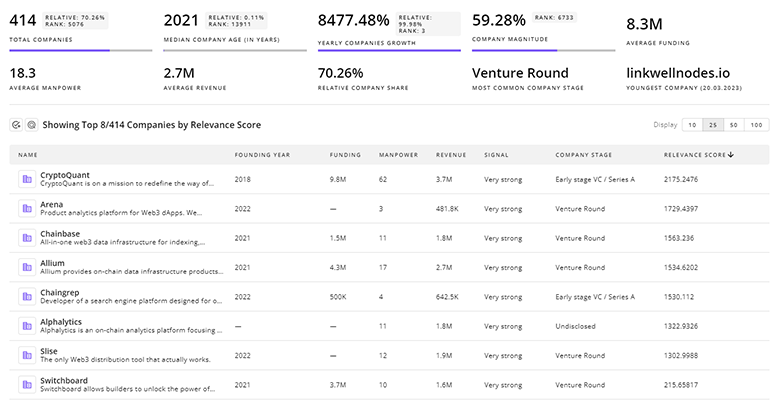
2.9K Bioenergy Companies
Discover Bioenergy Companies, their Funding, Manpower, Revenues, Stages, and much more
Bioenergy Investors
TrendFeedr’s investors tool offers a detailed view of investment activities that align with specific trends and technologies. This tool features comprehensive data on 778 Bioenergy investors, funding rounds, and investment trends, providing an overview of market dynamics.
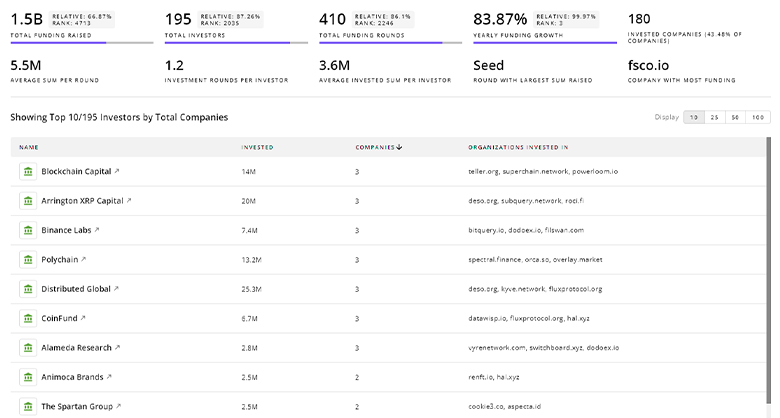
778 Bioenergy Investors
Discover Bioenergy Investors, Funding Rounds, Invested Amounts, and Funding Growth
Bioenergy News
Stay informed and ahead of the curve with TrendFeedr’s News feature, which provides access to 8.4K Bioenergy articles. The tool is tailored for professionals seeking to understand the historical trajectory and current momentum of changing market trends.
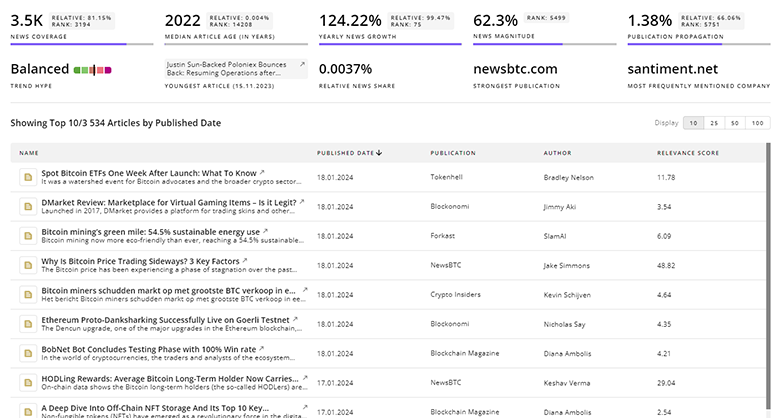
8.4K Bioenergy News Articles
Discover Latest Bioenergy Articles, News Magnitude, Publication Propagation, Yearly Growth, and Strongest Publications
Executive Summary
The bioenergy opportunity sits at the intersection of three economic levers: feedstock control, integrated product portfolios, and decarbonization value (including carbon credits and BECCS). Market forecasts and internal indicators point to sustained mid-single to high-single-digit CAGR growth, but the winners will be projects that secure low-cost, high-volume feedstock, extract multiple revenue streams from co-products, and bundle carbon management into the value proposition. For investors and developers, the priority actions are: (1) lock long-term feedstock aggregation and preprocessing capacity, (2) prioritize technologies that monetize co-products or enable drop-in fuels for high-value transport segments, and (3) structure financing that recognizes carbon revenue streams and operational performance guarantees to shorten time-to-bankability. These measures convert theoretical addressable markets into investable, bankable projects that can scale rapidly in the coming decade.
Interested in enhancing our coverage of trends and tech? We value insights from experts like you - reach out!