Blockchain Report
: Analysis on the Market, Trends, and TechnologiesThe blockchain market shows sharp growth but conflicting size estimates; the internal trend data reports a 2024 market value of $6.2 billion and a 44.6% CAGR projection toward $56.8 billion by 2030—figures that frame an enterprise-centered expansion in tokenization, BaaS and security services. At the same time, external market sources report larger short-term totals, which signals definitional and scope differences (platform services vs. broader ecosystem revenue) that materially affect strategic choices statista.com.
This report was last updated 247 days ago. Spot an error or missing detail? Help us fix it by getting in touch!
Topic Dominance Index of Blockchain
To identify the Dominance Index of Blockchain in the Trend and Technology ecosystem, we look at 3 different time series: the timeline of published articles, founded companies, and global search.
Key Activities and Applications
- Cross-border payments — Real-time settlement, lower fees, and programmable rails remain the primary enterprise use case driving adoption and vendor growth.
So what: payments deliver immediate cost and time savings that justify integration investments and pilot-to-production moves by banks and payments firms. - Supply-chain provenance and traceability — End-to-end tracking and immutable audit trails reduce recall costs and enhance compliance in regulated goods.
So what: measurable operational savings in logistics create a short ROI horizon for pilots, increasing the probability of enterprise rollout. - Real-World Asset (RWA) tokenization — Tokenization pipelines for real estate, commodities and financial instruments scale liquidity and fractional ownership models.
So what: tokenization becomes the bridge for institutional capital into on-chain markets; platforms that embed compliance will capture enterprise flows. - Decentralized identity and KYC/AML — Self-sovereign identity and verifiable credentials reduce friction for regulated onboarding.
So what: identity is a gating item for financial and government use cases; solutions that meet privacy and compliance tests unlock broader deployments. - Smart contracts and automation — Programmable agreements drive ERP automation, trade finance, and automated settlements.
So what: smart contracts reduce manual reconciliation and settlement cost, making blockchain a productivity play for enterprises. - Security, auditing and forensic services — Smart contract audits, monitoring, and incident response emerge as required operational capabilities marketresearch.com.
So what: security services convert risk (exploits) into a commercial category; buyers will pay for continuous monitoring and verification.
Emergent Trends and Core Insights
- Interoperability and omnichain apps are the strategic nexus — Cross-chain messaging, universal smart contracts and bridges are moving from research to production, and market winners will be judged by security and UX of their bridges.
So what: firms without safe, audited cross-chain paths risk isolation; integrators that provide safe liquidity routing gain platform leverage. - Enterprise BaaS and no-code stacks drive adoption velocity — Cloud delivered blockchain frameworks and low-code tooling reduce integration costs and accelerate pilots into production researchandmarkets.com.
So what: commoditization of infrastructure shifts competition to developer experience, compliance features, and partner ecosystems. - Security and AI for continuous assurance — AI-assisted auditing, fuzzing and runtime monitoring scale smart contract assurance and reduce exploit dwell time.
So what: buyers will favor vendors whose toolchains lower residual exploit risk and provide forensics and insurance integrations. - Tokenization meets regulation — Regulatory sandboxes and frameworks (MiCA, VARA pilots) push token standards that embed compliance features, shaping which platforms capture institutional flows marketresearch.com.
So what: compliant L1s and issuance engines will command higher valuations in the RWA market since they remove legal barriers for institutions. - Scalability via modular architectures and Layer-2 — App-chain and rollup patterns reduce costs per transaction and accommodate high throughput use cases like gaming and payments.
So what: successful players will combine low gas overheads with strong developer tooling to attract dApp ecosystems.
Technologies and Methodologies
- Zero-Knowledge Proofs (ZKPs) for privacy and off-chain verification — used to minimize data leakage while proving correctness.
Practical effect: enables compliance-friendly proofs of solvency, KYC status, or provenance without exposing raw data. - Layer-2 rollups and state sharding — Rollups (optimistic and ZK) plus adaptive sharding address throughput and latency constraints gartner.com.
Practical effect: lowers marginal cost per transaction, making high-frequency enterprise workflows feasible. - Hybrid and energy-efficient consensus — PoS and hybrid PoW/PoS variants target lower energy profiles and higher transaction capacity.
Practical effect: improves ESG alignment for enterprise buyers and regulators. - Decentralized oracle networks — Secure off-chain data feeds and cross-chain messaging (oracles/CCIP) are required for real-world automation.
Practical effect: reliable oracles convert external events into on-chain triggers that power DeFi and enterprise automation. - AI-assisted auditing and runtime monitoring — Machine learning aids vulnerability discovery and anomaly detection.
Practical effect: reduces audit cycle time and increases confidence in smart contract deployments.
Blockchain Funding
A total of 11.7K Blockchain companies have received funding.
Overall, Blockchain companies have raised $402.8B.
Companies within the Blockchain domain have secured capital from 37.2K funding rounds.
The chart shows the funding trendline of Blockchain companies over the last 5 years
Blockchain Companies
- MANTRA — MANTRA operates an EVM-compatible Layer-1 built for real-world asset tokenization with native regulatory features and a VARA VASP license in Dubai; it targets institutional issuance and compliant marketplaces and reports focused growth and cross-chain capabilities that suit regulated RWA workflows.
Why it matters: their compliance-first L1 shortens legal onboarding for institutions seeking tokenized asset rails. - Supra — Supra develops a vertically integrated high-performance Layer-1 and cross-chain primitives including oracle and randomness services; its emphasis on execution performance and native interoperability targets high-throughput dApps and enterprise integrations.
Why it matters: performance and integrated primitives reduce integration friction for complex dApps needing reliable off-chain data. - Chainlink — Chainlink provides decentralized oracle services and cross-chain messaging that feed real-world data to smart contracts; its oracle network and evolving CCIP capabilities make it a foundational middleware between legacy systems and smart contracts.
Why it matters: secure, auditable off-chain data links are essential for DeFi, RWA settlement and automated enterprise contracts. - ZetaChain — ZetaChain offers omnichain smart contracts and a universal chain approach to grant one-chain access to multi-chain liquidity and execution; that model simplifies UX for developers and end users by removing the need to juggle multiple chains.
Why it matters: unified UX plus native access to non-EVM chains reduces integration complexity for cross-chain dApps. - Blockchains Experts — A specialist security services provider focused on smart contract audits, penetration testing and incident response for Web3 projects; the firm targets the increasing demand for continuous security assurance in production deployments.
Why it matters: as production deployments grow, outsourced security and monitoring convert into recurring revenue and form an essential trust layer for enterprise buyers.
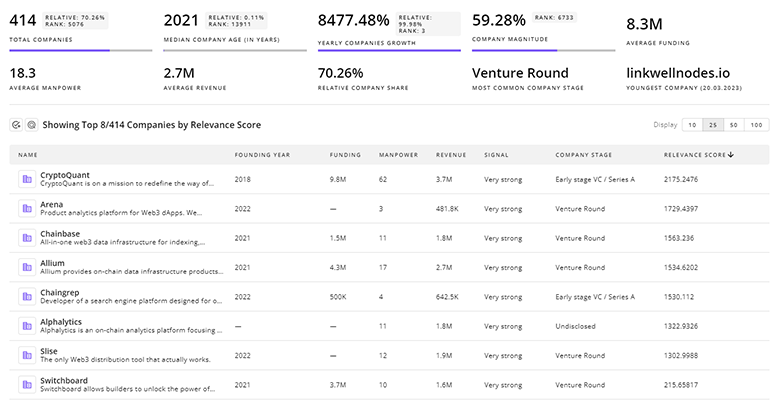
Identify and analyze 72.5K innovators and key players in Blockchain more easily with this feature.
72.5K Blockchain Companies
Discover Blockchain Companies, their Funding, Manpower, Revenues, Stages, and much more
Blockchain Investors
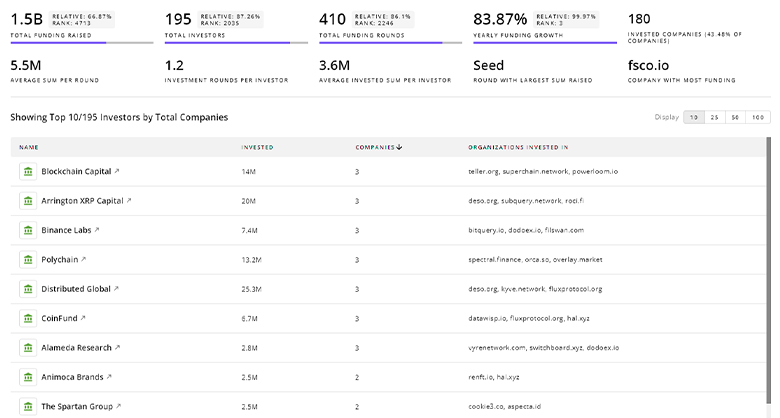
TrendFeedr’s investors tool offers a detailed view of investment activities that align with specific trends and technologies. This tool features comprehensive data on 27.6K Blockchain investors, funding rounds, and investment trends, providing an overview of market dynamics.
27.6K Blockchain Investors
Discover Blockchain Investors, Funding Rounds, Invested Amounts, and Funding Growth
Blockchain News
Stay informed and ahead of the curve with TrendFeedr’s News feature, which provides access to 223.0K Blockchain articles. The tool is tailored for professionals seeking to understand the historical trajectory and current momentum of changing market trends.
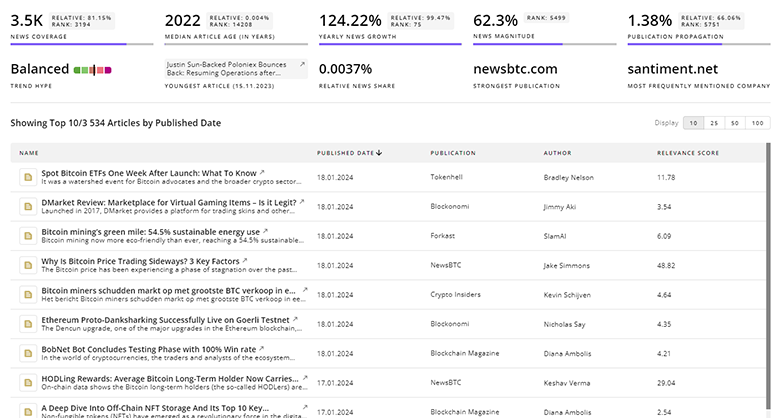
223.0K Blockchain News Articles
Discover Latest Blockchain Articles, News Magnitude, Publication Propagation, Yearly Growth, and Strongest Publications
Executive Summary
The available data shows an industry in strong expansion with two parallel dynamics: measured, enterprise-driven growth in services and BaaS (internal estimate: $6.2B in 2024 moving toward $56.8B by 2030) and a larger public-market/ecosystem valuation band reported by external sources. Strategic winners will be those that (1) embed compliance and security into developer-facing products, (2) deliver seamless cross-chain interoperability with auditable oracle inputs, and (3) lower integration cost via BaaS and no-code tooling. For product and corporate strategy, that means prioritizing secure interoperability, auditability, and compliance primitives that permit institutions to move from pilots into production while monetizing continuous assurance and tokenization services.
Interested in enhancing our coverage of trends and tech? We value insights from experts like you - reach out!