Business Process Automation Report
: Analysis on the Market, Trends, and TechnologiesThe global Business Process Automation market reached $16,600,000,000 in 2024 and is forecast to expand to $36,900,000,000 by 2030 at a 14.2% CAGR, reflecting sustained enterprise investment in AI-enabled automation and low-code delivery models. Market signals show a clear pivot from isolated task bots to integrated automation stacks that combine process discovery, intelligent document handling, and decisioning layers—an evolution that compresses time-to-value for finance, compliance, and customer-facing processes while raising the bar on governance and data controls Zion Market Research – Business Process Automation Market.
This report was last updated 47 days ago. Spot an error or missing detail? Help us fix it by getting in touch!
Topic Dominance Index of Business Process Automation
To identify the Dominance Index of Business Process Automation in the Trend and Technology ecosystem, we look at 3 different time series: the timeline of published articles, founded companies, and global search.
Key Activities and Applications
- Customer Service Support Automation — Chatbots, ticket routing, automated SLAs and conversational interfaces that reduce handling time and drive measurable CSAT improvements; common in BFSI, retail, and telecom.
- Accounting and Finance Automation (AP/AR / Reconciliations) — Invoice capture, validation, exception handling and straight-through processing deliver direct cashflow benefits; enterprise AP automation remains a primary ROI case where companies aim for near-touchless operations Basware.
- Process Discovery and Mining — Task and process mining identify high-value automation candidates and feed orchestration rules; process intelligence is now a prerequisite before large-scale automation.
- HR and Employee Lifecycle Workflows — Onboarding, payroll orchestration and case management use low-code forms and IDP for faster throughput and audit trails.
- Supply Chain & Order-to-Cash Automation — Demand signals, inventory updates, and exception routing integrated with ERP via iPaaS reduce fulfillment delays and shrink working capital needs.
- Compliance, Audit and Regulatory Workflows — Embedded rule engines and immutable audit logs mitigate regulatory risk in finance and healthcare; automation platforms that natively support compliance controls win procurement cycles.
Emergent Trends and Core Insights
- Agentic and Decision-Centric Automation is moving automation from scripted bots to AI co-workers that make and reframe decisions within workflows; vendors positioning "agentic" capabilities see deployment traction in knowledge-intensive domains.
- Hyperautomation stacks that combine RPA, IDP, process mining, and decisioning are the dominant procurement pattern; organizations buy composable toolchains rather than single-purpose bots.
- Low-Code/No-Code Democratization expands the addressable buyer base by enabling business teams to design automations without heavy IT cycles; this reduces backlog and accelerates incremental ROI.
- Verticalized Automation Suites outperform horizontal offerings when domain rules and compliance are intense (e.g. banking dispute automation, healthcare prior authorization), creating acquisition interest from large orchestration vendors.
- Cloud-native RPA and RPA-as-a-Service increase scalability and lower TCO for distributed automations, triggering migrations from on-prem deployments even as sensitive workflows retain on-prem or hybrid profiles.
- Process Intelligence First: firms are sequencing investments—process mining → IDP → automation—to control risk and ensure higher first-use ROI, rather than adopting RPA in isolation.
Technologies and Methodologies
- Robotic Process Automation (RPA) — UI-level execution remains central for legacy integration, with cloud and credential management maturity addressing enterprise governance.
- Intelligent Document Processing (IDP) / Cognitive Document Processing — Multimodal extraction (OCR + NLP + ML confidence scoring) converts unstructured inputs into structured records for downstream decisioning.
- Generative AI and LLMs in Process Assistants — LLMs power conversational triage, auto-drafting of decisions and context enrichment; firms pair models with business rules to preserve auditability.
- Process Mining & Task Mining — Empirical discovery of as-executed process variants drives prioritization and reduces failure rates in scaled automation programs.
- Low-Code/No-Code Platforms and Citizen Development — Visual builders and component marketplaces speed delivery and broaden ownership of change across lines of business.
- iPaaS / API-led Integration — Reliable, secure connectors between SaaS, ERP and OT systems are gatekeepers of end-to-end automation value APPSeCONNECT.
Business Process Automation Funding
A total of 495 Business Process Automation companies have received funding.
Overall, Business Process Automation companies have raised $10.5B.
Companies within the Business Process Automation domain have secured capital from 1.5K funding rounds.
The chart shows the funding trendline of Business Process Automation companies over the last 5 years
Business Process Automation Companies
Autologyx
Autologyx positions a workflow and automation stack tuned for legal and compliance teams, combining document orchestration with intake triage to reduce manual contract remediation cycles. The vendor emphasizes auditability and role-based governance, which aligns with regulated buyers that require defensible automation footprints. Its focused domain play reduces customization overhead and speeds time to measurable compliance outcomes.Automat
Automat markets an AI-driven hyperautomation platform that replaces legacy RPA + IDP stacks in data-extraction use cases; the company claims materially lower deployment cost and rapid accuracy gains by combining computer vision with GPT-class models. Automat's economics and product positioning target high-cost document workflows in lending and insurance where extraction accuracy delivers immediate margin benefits.Basiq360
Basiq360 integrates QR code–linked physical assets with digital process orchestration for distribution and field sales networks, creating a tight physical-to-digital feedback loop that reduces inventory reconciliation effort and simplifies channel incentives. This hybrid capability addresses scenarios where conventional RPA cannot observe physical events, making Basiq360 attractive to manufacturers and distributors seeking real visibility in complex channels.PBSA (Pty) Ltd
PBSA offers regionally specialized automation and industrial process solutions across Southern Africa, pairing software orchestration with hardware and warehouse robotics partners for pragmatic supply-chain modernization. Their ISO certifications and long local track-record reduce procurement friction for customers facing regulatory and infrastructure constraints, and they exemplify the regional specialization approach that wins in constrained markets.Msquare Automation Solutions
Msquare focuses on rapid deployment using no-code/low-code integrations across marketplaces delivering quick wins for SMB and mid-market clients that cannot sustain long IT projects. Their partner-led, connector-heavy model lowers friction for process owners and accelerates measured ROI for distributed automation programs.
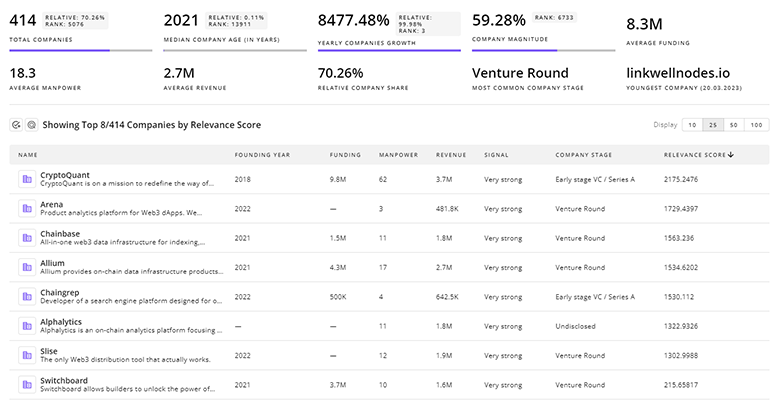
Identify and analyze 9.6K innovators and key players in Business Process Automation more easily with this feature.
9.6K Business Process Automation Companies
Discover Business Process Automation Companies, their Funding, Manpower, Revenues, Stages, and much more
Business Process Automation Investors
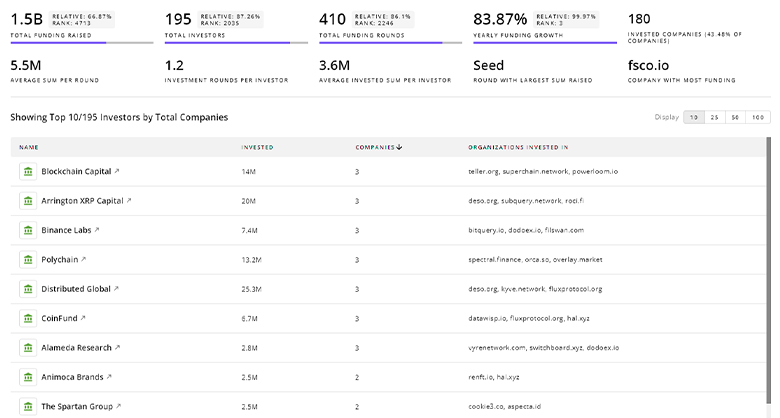
TrendFeedr’s investors tool offers a detailed view of investment activities that align with specific trends and technologies. This tool features comprehensive data on 1.6K Business Process Automation investors, funding rounds, and investment trends, providing an overview of market dynamics.
1.6K Business Process Automation Investors
Discover Business Process Automation Investors, Funding Rounds, Invested Amounts, and Funding Growth
Business Process Automation News
Stay informed and ahead of the curve with TrendFeedr’s News feature, which provides access to 3.4K Business Process Automation articles. The tool is tailored for professionals seeking to understand the historical trajectory and current momentum of changing market trends.
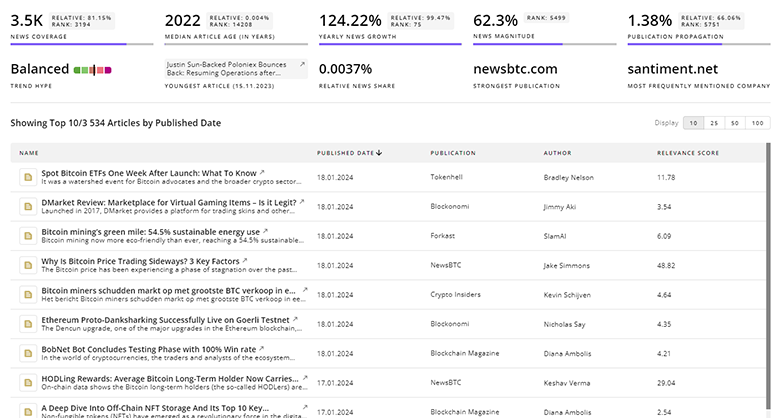
3.4K Business Process Automation News Articles
Discover Latest Business Process Automation Articles, News Magnitude, Publication Propagation, Yearly Growth, and Strongest Publications
Executive Summary
Executives should treat automation roadmaps as staged investments: start with process intelligence, secure data and governance, then build composable automation blocks that tie into enterprise decisioning. The most defensible vendor positions will be those that either control the orchestration layer at scale or own narrowly focused AI models that handle high-complexity tasks (document intelligence, regulatory validation). Procurement strategies should prioritize measurable first-use ROI, certification for regulated data flows, and integration patterns that preserve legacy investments while enabling incremental migration to cloud and agentic workflows. These choices will determine whether automation delivers recurring operational savings and faster customer experiences or becomes a fragmented cost center.
Interested in enhancing our coverage of trends and tech? We value insights from experts like you - reach out!