
Carbon Management Report
: Analysis on the Market, Trends, and TechnologiesThe carbon-management market now sits at a pivotal commercial inflection: global CMS revenue is estimated at *$16.11 billion* in 2025 and is forecast to reach $28.5 billion by 2030, reflecting a 12.1% compound annual growth rate that underpins rising enterprise demand for real-time emissions intelligence and removal services. Policy signals (expanded emissions trading and public R&D) and corporate net-zero commitments are pushing spend toward two distinct value pools: capital-intensive carbon removal infrastructure and software-led compliance & supply-chain accounting — creating immediate opportunity for firms that can combine high-fidelity measurement with verifiable assetization of removals Carbon Management System Global Market Report.
We updated this report 95 days ago. Noticed something’s off? Let’s make it right together — reach out!
Topic Dominance Index of Carbon Management
The Topic Dominance Index trendline combines the share of voice distributions of Carbon Management from 3 data sources: published articles, founded companies, and global search
Key Activities and Applications
- Real-time emissions monitoring: deploying IoT sensors, edge analytics and telemetry to capture facility and fleet Scope 1/2 signals for compliance and operational optimization.
- Enterprise carbon accounting (Scopes 1–3): automating inventory construction, factor libraries and value-chain data ingestion to produce auditable, finance-grade disclosures for regulators and investors.
- Carbon removal project development: engineering and financing Direct Air Capture (DAC), BECCS, mineralization and biochar sites that generate durable removal credits and long-term storage capacity.
- Carbon utilization / circular feedstocks (CCU): converting captured CO2 into building materials, fuels and chemicals to create revenue-coupled decarbonization pathways and improve project bankability.
- Transactional carbon infrastructure: tokenized registries, d-MRV and marketplace platforms that enable issuance, auctioning and retirement of high-quality removal credits for both voluntary and compliance buyers.
- Sector-specific compliance tooling: modules tuned to manufacturing, oil & gas, maritime and utilities to map operational processes into emissions performance and allowance management for ETS regimes Energy and Utility Carbon Management Systems Market Report.
Emergent Trends and Core Insights
- Software is maturing into infrastructure. AI-enabled accounting platforms now serve as indispensable workflow layers for compliance and procurement teams, increasing demand for seamless ERP and procurement integration.
- Market bifurcation: buyers differentiate between credit avoidance (short-term offsets) and durable removalsThe Global Carbon Dioxide Removal (CDR) Market 2025-2045.
- Policy is the immediate demand lever. Expansion of ETS coverage (including maritime) and higher disclosure requirements create a baseline payback for CMS deployments and raise the value of auditable MRV stacks 2025 Carbon Market Report.
- Measurement bottlenecks create moat opportunities. Firms that resolve Scope-3 data ingestion and supplier engagement friction — converting sparse supplier signals into verifiable emissions lines — will command the highest enterprise ARPU.
- Capital concentration toward removal infrastructure. Venture and corporate capital concentrate on scalable DAC, mineralization and BECCS plays while many reporting and consulting providers face margin compression as platforms consolidate.
Technologies and Methodologies
- AI-powered carbon accounting engines: automated factor mapping, anomaly detection and scenario forecasting that scale Scope-3 coverage.
- Digital MRV (d-MRV): satellites, drones, IoT and on-site sensors fused with ML models to produce auditable monitoring streams for removals and offsets.
- Modular DAC and solid-sorbent systems: fast-swing devices and sorbent regeneration methods that reduce energy intensity and enable retrofit use cases with available waste heat.
- Mineralization & accelerated carbonation: ex-situ and in-process mineral routes that permanently lock CO2 into materials (concrete aggregates, stabilized industrial by-products) to deliver high-durability credits.
- Blockchain and tokenization for registry integrity: smart contracts for issuance/retirement and ledgered provenance to reduce double counting across registries.
- Integrated CCUS-to-utilization stacks: process heat integration, membrane and sorbent improvements, and electrochemical conversion (CO2 → syngas/chemicals) to create co-product revenue that improves economics.
Carbon Management Funding
A total of 282 Carbon Management companies have received funding.
Overall, Carbon Management companies have raised $34.7B.
Companies within the Carbon Management domain have secured capital from 970 funding rounds.
The chart shows the funding trendline of Carbon Management companies over the last 5 years
Carbon Management Companies
- Carbmee — Carbmee focuses on supplier engagement platforms that aggregate product-level emissions and translate procurement data into verified Scope-3 inventories. The company pairs lightweight supplier onboarding with API connectors into common ERPs, enabling large buyers to reduce the time to an auditable baseline from months to weeks. Its product emphasizes change-management playbooks to secure supplier data flows.
- Carbondeck — Carbondeck offers a free, AI-assisted carbon management platform targeted at SMEs and mid-market buyers, lowering barrier to entry for audit-grade reporting. The platform automates baseline calculations and offers modular add-ons for d-MRV and credit retirement, positioning the company as a feeder for larger marketplace partners. Its low-cost model addresses a major adoption gap among smaller enterprises.
- Avarni — Avarni builds enterprise-grade Scope-3 workflows with a focus on high-volume supply chains (agriculture, forestry). The firm integrates satellite and soil-sampling MRV data with procurement records to produce tradable removal instruments for buyers demanding durable, nature-based credits. Its recent SOC 2 compliance and growth awards increase buyer confidence in its verification backbone.
- FootprintIQ — FootprintIQ specializes in automated emissions forecasting and scenario planning for manufacturing lines using digital-twin models and energy telemetry. The startup reduces embodied carbon uncertainty in product bills of materials and helps engineering teams assess abatement investment ROI in months rather than years. It addresses the high-value need to link design choices to measurable carbon outcomes.
- Terrascope — Terrascope provides satellite and remote sensing services that verify large-scale nature-based projects and support d-MRV for forest and soil credits. Its expansion into the United States reflects demand for high-integrity, geospatial verification layers that registries and buyers increasingly require to price credits appropriately. Terrascope positions itself as a verification partner for both marketplaces and project developers.
Gain a better understanding of 1.4K companies that drive Carbon Management, how mature and well-funded these companies are.
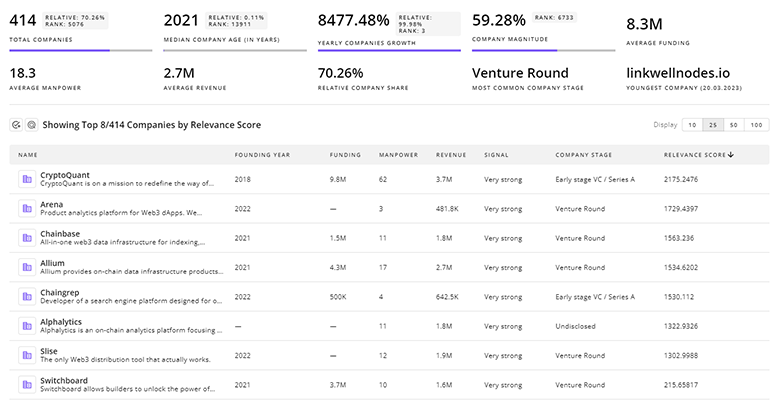
1.4K Carbon Management Companies
Discover Carbon Management Companies, their Funding, Manpower, Revenues, Stages, and much more
Carbon Management Investors
Gain insights into 1.3K Carbon Management investors and investment deals. TrendFeedr’s investors tool presents an overview of investment trends and activities, helping create better investment strategies and partnerships.
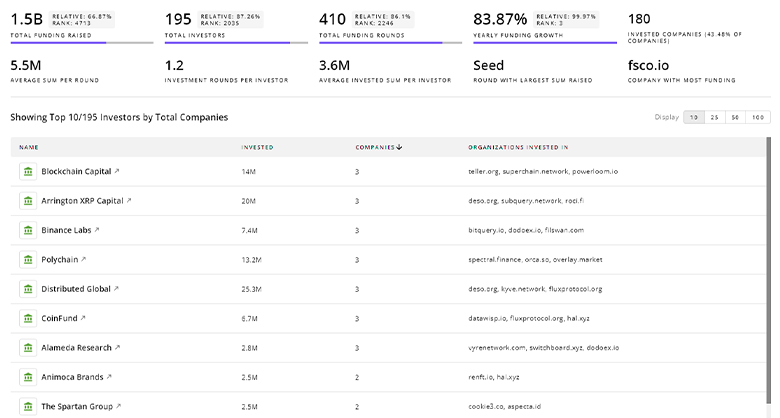
1.3K Carbon Management Investors
Discover Carbon Management Investors, Funding Rounds, Invested Amounts, and Funding Growth
Carbon Management News
Gain a competitive advantage with access to 1.7K Carbon Management articles with TrendFeedr's News feature. The tool offers an extensive database of articles covering recent trends and past events in Carbon Management. This enables innovators and market leaders to make well-informed fact-based decisions.
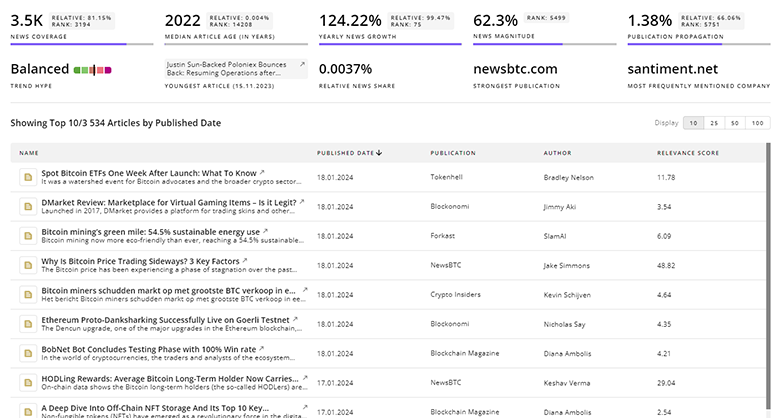
1.7K Carbon Management News Articles
Discover Latest Carbon Management Articles, News Magnitude, Publication Propagation, Yearly Growth, and Strongest Publications
Executive Summary
The carbon-management landscape now requires a two-track strategic approach: secure measurable, durable removal capacity or provide the indispensable data infrastructure that validates and transacts those removals. Companies that combine high-fidelity MRV, enterprise integration (ERP/procurement), and financialization capabilities for removals will capture the highest value. Short-term wins reside in delivering auditable Scope-1/2 automation and tightening Scope-3 pipelines; medium-term value accrues to those controlling removal supply or proprietary verification layers. For investors and strategists, the priority is clear: support platforms that reduce data friction and partner with removal developers that can demonstrate durable storage and credible offtake — that combination will determine which firms move from niche players to platform incumbents.
We seek partnerships with industry experts to deliver actionable insights into trends and tech. Interested? Let us know!