Collaborative Robotics Report
: Analysis on the Market, Trends, and TechnologiesThe collaborative robotics market is at a decisive scale-up point: the market size reached USD 3.7 Billion in 2024 and is projected to climb to USD 60.3 Billion by 2033. Inventory and logistics automation, higher-payload cobots, and AI-first software stacks are changing how companies capture value; software and data feedback loops are becoming the primary source of differentiation as hardware unit prices compress. Short-term shipment volatility (a market trough in 2024 with 13.8% shipment growth) signals normalization and a rebound in 2025, but average selling prices show downward pressure that will favor subscription and usage-based commercial models.
We updated this report 251 days ago. Noticed something’s off? Let’s make it right together — reach out!
Topic Dominance Index of Collaborative Robotics
The Topic Dominance Index trendline combines the share of voice distributions of Collaborative Robotics from 3 data sources: published articles, founded companies, and global search

Key Activities and Applications
- Logistics and warehousing (pick, pack, palletizing): Cobots and mobile collaborative manipulators are increasingly applied to e-commerce fulfillment to reduce order cycle times and improve throughput; logistics is one of the highest growth application areas referenced in market forecasts.
- High-mix assembly and micro-assembly: Small-payload, high-precision tasks (including micro-assembly tolerances down to ±0.5 µm) expand cobot reach into electronics and medical device production, where software-enabled vision and gripper intelligence matter more than raw payload.
- Material handling and machine tending: Medium-payload arms and mobile manipulators handle part transfers and machine loading, reducing repetitive strain for operators and enabling smaller batch runs market.us - Global Collaborative Robots Market.
- Surface treatment, finishing and welding: AI-augmented cells automate variable finishing tasks (sanding, polishing, automated welding) where perception and adaptive motion control produce measurable waste and rework reductions GrayMatter Robotics.
- Healthcare and assistive robotics: Cobots and assistive manipulators support surgical assistance, rehabilitation, and intralogistics in hospitals, widening market reach beyond traditional manufacturing.
- High-precision metrology and inspection: Integrated robot guidance and digital twin metrology enable in-process inspection and 3D validation in aerospace and heavy manufacturing, lowering rework risk and improving first-pass yield.
Emergent Trends and Core Insights
- Platformization and software moats: Investors and market signals favor companies building generalized autonomy and orchestration layers that control heterogeneous fleets; capital accumulation around software stacks will increasingly determine long-term margins.
- RaaS and consumption pricing: Usage-based models and Robots-as-a-Service reduce adoption friction for SMEs and mitigate ARPU erosion by shifting value capture to recurring services rather than unit sales Collaborative Robots and Automation Revolution.
- Payload diversification and multi-arm reach: Demand for >10 kg payload systems and 7-axis arms is rising to address heavier material handling tasks that previously required industrial robots, enabling cobots to enter new verticals Kassow Robots.
- AI-native control and VLM interfaces: Visual-language and AI skill libraries (LLM-driven programming) lower deployment time and enable non-expert operators to specify tasks in natural language, shifting value to pretrained skill markets T-ROBOTICS.
- Infrastructure-aided autonomy: Fixed-sensor, infrastructure-led guidance (Autonomy Through Infrastructure) improves fleet density and throughput in logistics hubs where onboard sensing alone struggles with occlusion and high traffic.
- Simulation, digital twins, and predeployment fidelity: The digital twin becomes the control plane for training, validation, and predictive maintenance; investment in twin fidelity reduces commissioning time and increases first-trial success in complex human-robot tasks.
Technologies and Methodologies
- Edge AI + Computer Vision: Real-time perception stacks on the edge enable adaptive grasping, defect detection, and intent prediction that materially raise utility in high-mix lines.
- Force/torque sensing and full-body haptics: Integrated torque sensing and variable stiffness actuators deliver safer, finer collaborative interactions and allow cobots to perform compliant manipulations without heavy external fixtures Agile Robots.
- Real-time multi-robot motion planning: Microsecond-scale planners enable collision-free coordination across several arms in shared cells and minimize cycle time in multi-robot installations Realtime Robotics motion planning interactanalysis - Collaborative robots’ revival forecast.
- Modular end-effectors and quick-change tool changers: Plug-and-play grippers, soft-robotic hands, and standardized tool-changer ecosystems reduce integration time and expand task sets per arm qbrobotics.
- Digital twin + metrology coupling: Coupling high-fidelity simulation with in-process metrology (0.1 mm adaptive twins) supports aerospace and large-volume assembly automation where geometric accuracy is critical.
- Low-code / no-code programming and demonstration learning: Point-and-click and demonstration-based offline programming reduce dependency on expert integrators and accelerate SME adoption Scalable Robotics.
Collaborative Robotics Funding
A total of 326 Collaborative Robotics companies have received funding.
Overall, Collaborative Robotics companies have raised $18.5B.
Companies within the Collaborative Robotics domain have secured capital from 1.2K funding rounds.
The chart shows the funding trendline of Collaborative Robotics companies over the last 5 years
Collaborative Robotics Companies
- Continuum Innovation — A small German team developing a continuum soft robot arm that combines sensor-based orientation and AI reinforcement learning to enable operation by untrained personnel; the mechanical approach targets delicate handling and safety-centric applications where rigid arms underperform, making the company a likely supplier of dexterous end-effectors for larger platforms.
- Percipio Robotics — A France-based deep-tech micro-assembly specialist whose patented grippers and flexible vision software achieve assembly accuracy to ±0.5 µm, positioning the firm for precision tasks in medical devices and micro-electronics that generalist cobots cannot serve without added tooling and vision intelligence.
- McFly Robot Teknolojileri — A Turkish R&D company focused on cobot arms and gripper innovation; by developing specialized EOATs the firm addresses the persistent integration bottleneck for small manufacturers seeking flexible end-effector intelligence without long custom-engineering cycles.
- True Position Robotics — A UK SME that couples high-accuracy metrology with adaptive digital twins to deliver 0.1 mm-level inspection and robot guidance for aerospace and large-structure assembly; their metrology-first approach reduces scrap and shortens qualification cycles for complex assemblies.
- OORB Open Organic Robotics — A Tunisian open-source cloud robotics platform and educational kit that uses AI-driven code generation (RAG+LLM over ROS) to let non-specialists produce working robot code and prototypes; the community and tooling model makes OORB a potential feeder of skilled integrators and low-cost customization for local markets.
Gain a better understanding of 3.2K companies that drive Collaborative Robotics, how mature and well-funded these companies are.
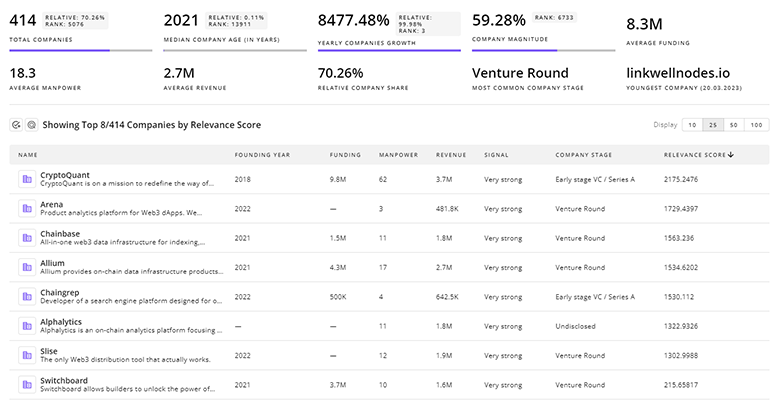
3.2K Collaborative Robotics Companies
Discover Collaborative Robotics Companies, their Funding, Manpower, Revenues, Stages, and much more
Collaborative Robotics Investors
Gain insights into 1.6K Collaborative Robotics investors and investment deals. TrendFeedr’s investors tool presents an overview of investment trends and activities, helping create better investment strategies and partnerships.
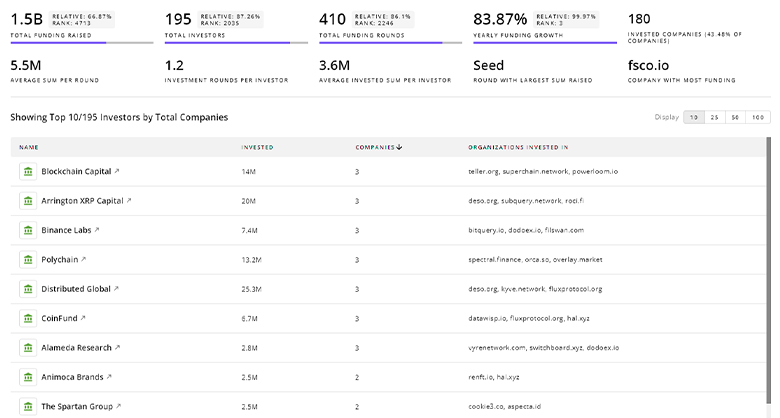
1.6K Collaborative Robotics Investors
Discover Collaborative Robotics Investors, Funding Rounds, Invested Amounts, and Funding Growth
Collaborative Robotics News
Gain a competitive advantage with access to 4.4K Collaborative Robotics articles with TrendFeedr's News feature. The tool offers an extensive database of articles covering recent trends and past events in Collaborative Robotics. This enables innovators and market leaders to make well-informed fact-based decisions.

4.4K Collaborative Robotics News Articles
Discover Latest Collaborative Robotics Articles, News Magnitude, Publication Propagation, Yearly Growth, and Strongest Publications
Executive Summary
The competitive advantage in collaborative robotics is shifting from isolated hardware features toward integrated software, data, and service models that monetize ongoing operational value. Market sizing from the core trend analysis shows a trajectory from USD 3.7 Billion in 2024 to USD 60.3 Billion by 2033, which implies that players who control the orchestration layer, deliver high-fidelity simulation and metrology, or offer easy access through consumption pricing will capture the majority of upside. For incumbents and new entrants alike, the strategic choices are clear: either become an indispensable, interoperable ingredient inside a dominant autonomy stack or own a narrow vertical stack with tight data feedback loops (for example, precision finishing, micro-assembly, or aerospace metrology). Investors and integrators should prioritize partnerships that link unique mechanical or sensing advantages into generalizable software ecosystems and should structure commercial models to favor recurring revenue as ARPU and unit-price pressures intensify IMARC Group - Collaborative Robot Market Report and Forecast.
We seek partnerships with industry experts to deliver actionable insights into trends and tech. Interested? Let us know!