Computer Vision Report
: Analysis on the Market, Trends, and TechnologiesThe computer vision market shows an accelerated commercial inflection: total market revenue was $25,410,000,000 in 2024 with a reported 27.6% market CAGR, signaling a near-term growth runway driven by edge deployment, data-efficient training pipelines, and vertical industrial adoption. Market forecasts and recent industry reports confirm a wide range of plausible long-term outcomes, but the consistent signal across sources is the same — capital and engineering effort are shifting from isolated models toward systems that make vision AI reliable, low-latency, and cheaper to operate at scale Computer Vision Market Report, 2025 – 2035.
We updated this report 285 days ago. Noticed something’s off? Let’s make it right together — reach out!
Topic Dominance Index of Computer Vision
The Topic Dominance Index trendline combines the share of voice distributions of Computer Vision from 3 data sources: published articles, founded companies, and global search
Key Activities and Applications
- Manufacturing quality control and automated inspection — production lines are adopting camera-based defect detection, in many cases replacing slow manual inspection with continuous, camera-driven checks that feed action into control systems.
- Embedded/edge vision for real-time analytics — deploying models on device to reduce latency and preserve privacy has become a primary implementation path for mission-critical systems such as ITS, robotics, and factory monitoring.
- Autonomy and robotic guidance — vision stacks for bin picking, collision avoidance, and odometry are central to robot automation and vehicle perception; 3D sensing and monocular 3D reconstruction are being commercialized for lower-cost autonomy solutions.
- Retail analytics and checkout-less commerce — shelf monitoring, shopper flow analytics, and automated checkout continue to generate ROI for large retailers and are accelerating pilot-to-scale projects in Asia and North America
- Healthcare imaging and intraoperative assistance — camera-based augmentation (real-time visualization, segmentation overlays) and automated image analysis are maturing into regulatory pathways, producing deployable clinical products.
- Security, behavioural recognition and public safety — contextual scene understanding (violence detection, crowd behavior) is moving from alerts to prioritized event scoring for operations centers.
Emergent Trends and Core Insights
- Edge-first deployments with event-sensing hardware are reducing data transmission costs and enabling always-on analytics for safety and automation; event-based sensors and neuromorphic approaches materially lower power and bandwidth requirements PROPHESEE.
- Large vision models and cross-modal stacks are gaining attention as a way to accelerate vertical deployments through pretraining and zero-shot transfer; platform vendors are packaging these capabilities into orchestration layers to shorten time-to-value Linker Vision.
- Synthetic and unsupervised data pipelines are emerging as a practical lever to cut labeling cost and speed model calibration for niche industrial defects and rare event detection; companies offering high-quality synthetic datasets or unsupervised workflows capture a direct cost advantage in scaling inspection use cases Computer Vision - Market Share Analysis.
- Non-deep-learning, geometry-centric approaches reappear as tactical alternatives where data is scarce or interpretability and certifiability matter (e.g. ADAS redundancy layers and certain industrial inspections) aidymo-cv.
- Privacy-first, edge-only sensors for civic deployments are becoming a procurement requirement for municipalities and large retailers; privacy-preserving hardware plus on-device aggregation reduces regulatory friction and procurement risk VizioSense.
- Investment pattern: a consolidation of funding toward platform and edge-processing vendors is apparent; speculative forecasts vary widely, but multiple market studies place medium-term CAGR estimates in the teens, reflecting both demand growth and different methodology assumptions Computer Vision Market Outlook 2025–2035.
Technologies and Methodologies
- Vision Transformers and foundation LVMs — transformer-based architectures and LVM variants extend cross-task generalization and enable fewer supervised labels for downstream tasks [DINOv2 / ViT reporting].
- Event-based and neuromorphic sensing — asynchronous sensors that emit changes rather than full frames enable high-speed, low-power pipelines for industrial sorting and AV perception.
- 3D reconstruction and monocular depth estimation — software Pseudo-LiDAR and stereo/ToF fusion reduce dependence on LiDAR and lower sensor costs for many autonomy and logistics applications Machine Can See.
- Quantization, pruning and MLSoC/NPUs for edge efficiency — hardware/software co-design (VPUs, NPUs, FPGA IP cores) is now standard for embedded vision stacks to meet power and latency targets INTELLIFUSION.
- Synthetic data, domain randomization, and self-supervised methods — these approaches reduce the human labeling bottleneck for narrow industrial tasks and for rare failure modes CVEDIA.
- No-code / low-code platforms and deployment orchestration — domain experts can configure solutions and push models to fleets of edge devices without deep ML engineering, shortening pilot cycles Chooch.
Computer Vision Funding
A total of 5.0K Computer Vision companies have received funding.
Overall, Computer Vision companies have raised $166.1B.
Companies within the Computer Vision domain have secured capital from 19.9K funding rounds.
The chart shows the funding trendline of Computer Vision companies over the last 5 years
Computer Vision Companies
- visionplatform.ai — A European no-code edge vision platform that emphasizes turning existing cameras into high-FPS AI sensors and streamlining global deployments. The company positions its stack for rapid, low-latency field rollouts and claims an end-to-end on-premises option that minimizes cloud dependency and preserves data privacy; this aligns with the market trend toward edge-first operational models
- Irida Labs — Embedded vision and AIoT specialist that sells an on-device software stack (PerCV.ai) optimized for people, vehicle and object detection and 3D pose estimation. Their partnerships with major silicon and camera vendors make them a practical partner for OEMs seeking validated embedded pipelines for Industry 4.0 and smart-city projects
- Visionairy — Focused on industrial visual inspection, Visionairy differentiates with unsupervised/low-data learning that the company reports can be trained with very small "OK" datasets, drastically lowering time-to-deployment for quality control use cases; that capability directly addresses the economics of defect detection in manufacturing lines
- DEEP IN SIGHT Co.Ltd — A South Korean systems vendor developing proprietary 3D ToF cameras and AI processing targeted at inventory and silo monitoring; they claim substantial cost and accuracy advantages for vertical industrial applications that require accurate volumetric sensing
- Compound Eye — A Palo Alto startup delivering passive-camera 3D perception for autonomous machines, pursuing a lower-cost alternative to LiDAR by extracting dense depth and spatial understanding from standard camera feeds; their product is relevant for heavy equipment, defense and autonomous mobility where cost and sensor redundancy matter
Gain a better understanding of 27.5K companies that drive Computer Vision, how mature and well-funded these companies are.
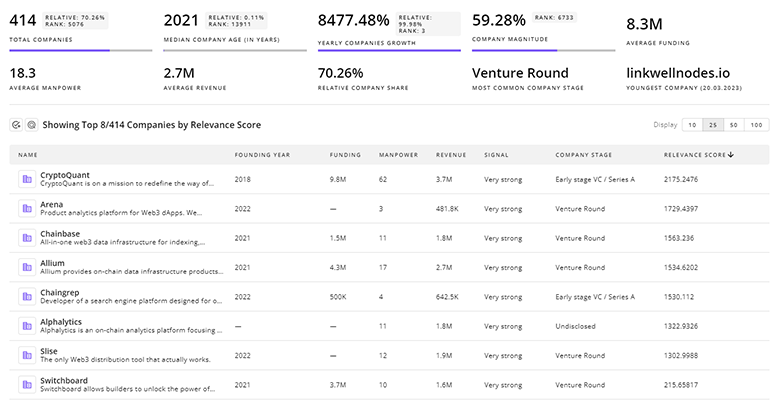
27.5K Computer Vision Companies
Discover Computer Vision Companies, their Funding, Manpower, Revenues, Stages, and much more
Computer Vision Investors
Gain insights into 17.4K Computer Vision investors and investment deals. TrendFeedr’s investors tool presents an overview of investment trends and activities, helping create better investment strategies and partnerships.
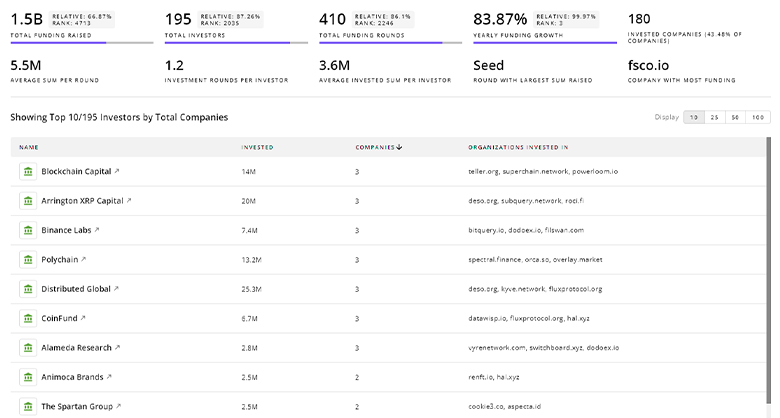
17.4K Computer Vision Investors
Discover Computer Vision Investors, Funding Rounds, Invested Amounts, and Funding Growth
Computer Vision News
Gain a competitive advantage with access to 31.9K Computer Vision articles with TrendFeedr's News feature. The tool offers an extensive database of articles covering recent trends and past events in Computer Vision. This enables innovators and market leaders to make well-informed fact-based decisions.
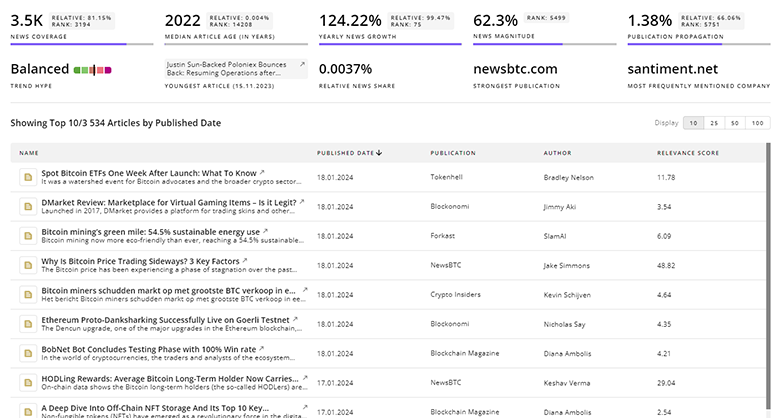
31.9K Computer Vision News Articles
Discover Latest Computer Vision Articles, News Magnitude, Publication Propagation, Yearly Growth, and Strongest Publications
Executive Summary
The computer vision market is shifting from isolated model accuracy contests toward systems that reduce total cost of ownership and shorten operational cycles. Companies that integrate three capabilities — edge processing efficiency, data-efficient training (synthetic/self-supervised), and domain-specific validation/compliance — will capture the largest share of enterprise spend. Strategic choices for incumbents and investors should therefore prioritize hardware-software co-design, partnerships that secure sensor supply chains, and product architectures that make privacy-preserving, on-device inference simple for customers. In parallel, specialist insurgents that eliminate data labeling or that provide verifiable non-deep-learning redundancy for safety-critical domains will remain high-value acquisition targets as platforms consolidate deployment and operations services.
We seek partnerships with industry experts to deliver actionable insights into trends and tech. Interested? Let us know!