
Decentralization Report
: Analysis on the Market, Trends, and TechnologiesThe decentralization market is scaling fast: the internal decentralization report records a 2024 market size of $22.7 billion and a projected CAGR of 41.1% that drives a forecast to $178.8 billion by 2030, signalling capital flows and product development concentrated on finance, identity, storage and infrastructure Decentralization Market Report 2025.
We updated this report 333 days ago. Noticed something’s off? Let’s make it right together — reach out!
Topic Dominance Index of Decentralization
The Topic Dominance Index trendline combines the share of voice distributions of Decentralization from 3 data sources: published articles, founded companies, and global search
Key Activities and Applications
Decentralized finance (DeFi) platforms: permissionless lending, automated market makers, yield protocols and tokenized real-world assets remain the highest-value application set, measured by capital deployed and protocol activity; DeFi market estimates and projected growth reflect strong investor interest and expanding product breadth, but regulatory uncertainty and smart-contract risk remain critical constraints Decentralized Finance Market Report 2025.
So what: Firms that reduce UX friction and deliver compliance-ready primitives (DID, KYT, ZK proofs) will unlock institutional capital and materially expand addressable markets.
Decentralized identity and verifiable credentials: self-sovereign identity, verifiable credentials and DID wallets that avoid centralized data stores address rising data-sovereignty demands and e-KYC initiatives.
So what: Enterprises facing regulator pressure and user privacy expectations will adopt interoperable DID stacks to reduce breach surface and to support cross-border services.
Decentralized data storage and streaming: distributed storage, proof-of-replication/space-time and publish/subscribe networks enable long-term archival, NFT/data provenance and real-time feeds for AI and Web3 apps.
So what: Companies that combine low-latency access, geo-redundancy and economic incentives for node operators can displace parts of the CDN and cloud backup markets.
Decentralized physical infrastructure (DePIN) and edge compute: tokenized incentive models for wireless, sensing and compute nodes are expanding—this ties real-world assets into protocol economies and reduces centralized single points of failure.
So what: Operators that lower onboarding friction for node providers and provide predictable revenue share win fast network growth.
Decentralized governance and decision platforms: DAOs, voting modules and community governance tools enable distributed decision-making in funding, research and civic contexts.
So what: Organizations that combine accountability primitives (verifiable credentials, transparent treasuries) with easy governance UX will convert pilot DAOs into operational organizations.
Emergent Trends and Core Insights
Interoperability as a business bottleneck and opportunity: multiple reports show interoperability is the single largest integration challenge; cross-chain bridges, universal transaction layers and oracle standardization are strategic priorities for protocols and integrators.
So what: Middleware and bridge services that reduce asset/call friction will capture recurring-revenue roles between protocols.
Progressive centralization-to-decentralization paths: projects commonly start centralized for velocity and gradually distribute control as governance and token models stabilize, creating a reproducible product-to-governance migration pattern Decentralized Full Report.
So what: Vendors who provide staged decentralization toolkits (permissioned → hybrid → permissionless) will accelerate enterprise adoption.
Privacy-plus-scalability convergence: adoption of zero-knowledge proofs, zk-rollups and TEEs is rising where transaction privacy and throughput matter (finance, health).
So what: Protocols that integrate ZK primitives into developer SDKs will lower cost and complexity of private on-chain applications.
Tokenized incentives tied to sustainability and physical utility: DePIN projects and proof-of-stake networks increasingly link token rewards to carbon credits, energy-efficient operations or physical service delivery.
So what: Market entrants that demonstrate measurable environmental or service KPIs will gain policy support and premium enterprise contracts.
Enterprise hybrid architectures ("Web 2.5"): a majority of large organizations prefer hybrid architectures that combine centralized control points with decentralized modules for specific functions (identity, settlement, provenance).
So what: Products that provide modular, API-first decentralization blocks will sell faster to enterprises than complete protocol swaps.
Technologies and Methodologies
Smart contracts and modular L1/L2 stacks: modular architectures, rollups and sharding remain primary scaling strategies for mass dApp adoption.
Significance: Choice of L1/L2 influences cost profile, composability and developer tools.
Zero-knowledge proofs and privacy-preserving cryptography: zk-SNARKs/zk-STARKs, threshold signatures and MPC underpin privacy-sensitive DeFi, identity, and health applications.
Significance: Mature ZK tooling reduces regulatory resistance and opens enterprise use cases that require confidentiality.
Distributed storage protocols and proofs (PoRep, PoSt): Filecoin, Arweave, IPFS patterns plus proof mechanisms provide economic guarantees for availability and immutability.
Significance: These primitives create stable marketplaces for long-term archival and provenance.
Federated learning and decentralized AI compute: distributed model training, GPU resource markets and federated pipelines enable privacy-aware AI and reduce central compute monopolies.
Significance: Firms that monetize idle compute and provide secure aggregation will compete with centralized cloud for specific workloads.
Peer-to-peer networking, DePIN and token economics: economic design (staking, slashing, reward curves) connects incentives to physical infrastructure and node operator economics.
Significance: Sound token models determine long-term network resilience and supplier participation.
Decentralization Funding
A total of 15.9K Decentralization companies have received funding.
Overall, Decentralization companies have raised $1.0T.
Companies within the Decentralization domain have secured capital from 42.6K funding rounds.
The chart shows the funding trendline of Decentralization companies over the last 5 years
Decentralization Companies
Decentral Iced — Decentral Iced sells tokenized ownership in energy and mining infrastructure and emphasizes green BTC mining to reduce carbon footprint; the company packages dividend-bearing tokens tied to renewable-backed mining assets and positions sustainability as a market differentiator.
Why it matters: It shows how tokenization can convert physical infrastructure into liquid investment products while answering ESG concerns.
DEFERENDUM — DEFERENDUM offers a mobile-first platform for decentralized decision-making that combines blockchain and AI to support inclusive voting and transparent outcomes; the product targets communities and organizations that require verifiable, auditable governance flows.
Why it matters: Practical governance tooling reduces friction for DAO-like operations and municipal pilots.
Dezh technologies — Dezh builds infrastructure and developer tools focused on durable decentralization with small-team, open-source tooling for applications that resist centralized shutdowns; the company emphasizes practical stacks and developer adoption.
Why it matters: Infrastructure-focused teams that prioritize developer ergonomics will enable the next wave of dApp innovation.
Decentralizers — Decentralizers is a boutique technology consultancy that builds cloud, ML and decentralized systems end-to-end; they package integration services that help North American clients move to hybrid decentralized architectures with predictable delivery models.
Why it matters: System integrators accelerate enterprise adoption by bridging legacy systems and new protocol primitives.
Gain a better understanding of 147.0K companies that drive Decentralization, how mature and well-funded these companies are.
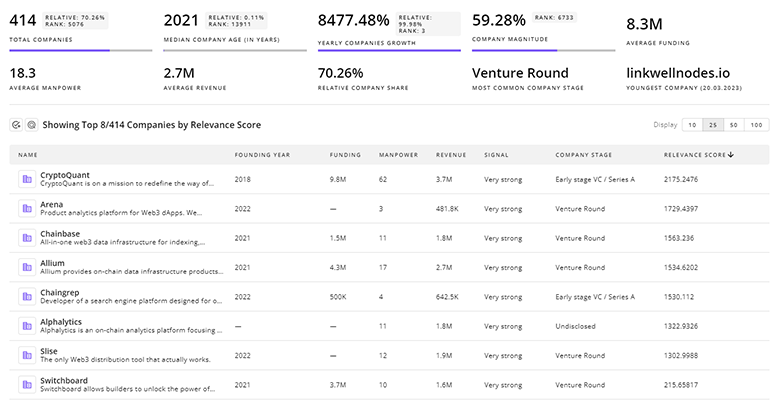
147.0K Decentralization Companies
Discover Decentralization Companies, their Funding, Manpower, Revenues, Stages, and much more
Decentralization Investors
Gain insights into 32.4K Decentralization investors and investment deals. TrendFeedr’s investors tool presents an overview of investment trends and activities, helping create better investment strategies and partnerships.
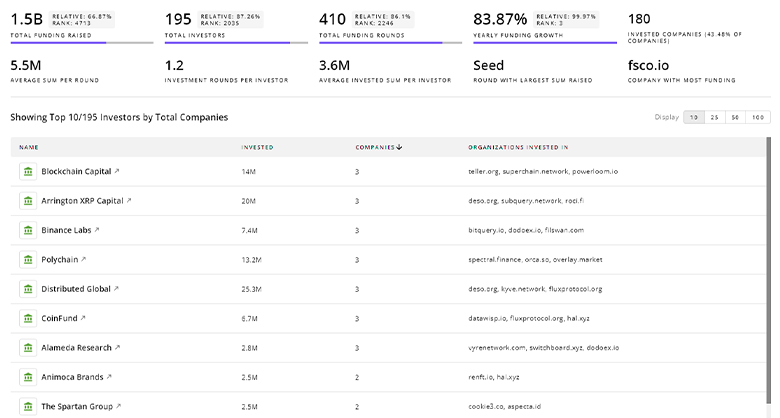
32.4K Decentralization Investors
Discover Decentralization Investors, Funding Rounds, Invested Amounts, and Funding Growth
Decentralization News
Gain a competitive advantage with access to 5.1K Decentralization articles with TrendFeedr's News feature. The tool offers an extensive database of articles covering recent trends and past events in Decentralization. This enables innovators and market leaders to make well-informed fact-based decisions.
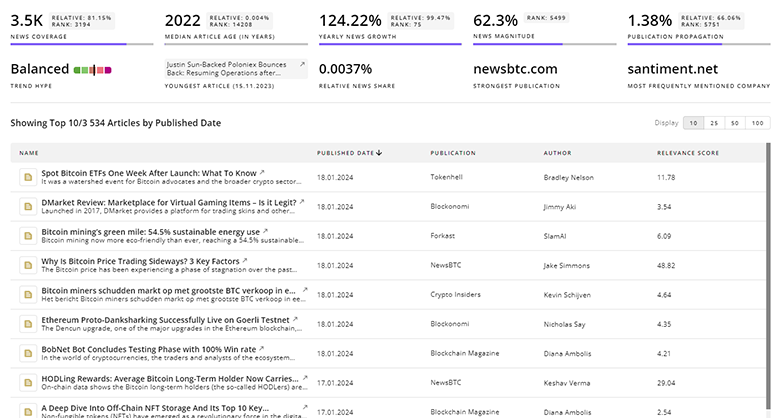
5.1K Decentralization News Articles
Discover Latest Decentralization Articles, News Magnitude, Publication Propagation, Yearly Growth, and Strongest Publications
Executive Summary
Decentralization now tracks measurable market economics: significant funding growth, concentrated technical progress in privacy and storage, and a move by enterprises toward hybrid deployments. The practical winners will not be pureprotocol ideologues but teams that combine interoperable primitives (DID, cross-chain messaging, ZK privacy), enterprise-grade UX, and credible token incentive designs that tie on-chain rewards to verifiable real-world value. For corporate buyers and investors, the near-term priority is composing decentralization: select modular building blocks that solve a specific business problem (identity, settlement, provenance), validate them in controlled pilots, and then migrate governance incrementally.
We seek partnerships with industry experts to deliver actionable insights into trends and tech. Interested? Let us know!