Dna Sequencing Report
: Analysis on the Market, Trends, and TechnologiesThe DNA sequencing market is accelerating: 2025 market size = $14,400,000,000, with a forecasted $50,040,000,000 by 2029 and a CAGR of 18.91%, driven by falling per-sample costs, rapid adoption of high-resolution modalities, and expanding clinical use in oncology and rare-disease diagnostics.
We updated this report 303 days ago. Noticed something’s off? Let’s make it right together — reach out!
Topic Dominance Index of Dna Sequencing
The Topic Dominance Index trendline combines the share of voice distributions of Dna Sequencing from 3 data sources: published articles, founded companies, and global search
Key Activities and Applications
- Clinical oncology diagnostics — Adoption of targeted panels, whole-exome, and whole-genome assays to guide therapy selection and monitor minimal residual disease; sequencing is now a core tool in companion-diagnostic development and clinical trials.
- Rare-disease and prenatal testing — Whole-genome and whole-exome sequencing shorten diagnostic odysseys and increase diagnostic yield in congenital disorders and prenatal screens.
- Infectious-disease surveillance and pathogen genomics — Real-time sequencing for outbreak tracing, antimicrobial resistance profiling, and veterinary surveillance using portable platforms and nanopore workflows.
- Single-cell and spatial biology in translational research — High-throughput single-cell transcriptomics and spatial multi-omics drive biomarker discovery and immune profiling in oncology and neuroscience.
- Agrigenomics and breeding — Genotyping, genome assembly, and trait mapping accelerate crop and livestock improvement programs, with sequencing centers scaling capacity for seed-industry CRO work ID Biotech.
- Quality controls and data integrity — Synthetic spike-ins and controls-as-a-service are becoming standard to validate workflows and compare runs across platforms.
Emergent Trends and Core Insights
- Resolution drives value capture — The market is bifurcating: commoditized, high-throughput platforms retain volume share while single-cell, long-read, and spatial modalities capture premium dollars and downstream IP for interpretation.
- Long-read and direct RNA methods move into clinics — Long-read platforms address structural variants and phasing limitations of short reads and are validated in clinical cohorts, increasing clinical adoption for complex genetic diagnoses Long-Read Clinical Validation.
- AI/ML shifts from annotation to prediction — Proprietary models and genomic language models convert raw sequence into clinically actionable predictions and variant prioritization; algorithmic layers constitute a growing economic moat.
- Sample prep and input-quality become strategic bottlenecks — Faster, lower-step library and purification systems reduce turnaround and error sources; vendors that reduce front-end complexity capture share across instrument ecosystems.
- Regulatory and reimbursement alignment accelerates clinical deployment — Targeted regulatory pathways for NGS diagnostics and national genomics initiatives drive demand from hospitals and public health programs.
- Data management and privacy remain structural constraints — Petabyte scale outputs and cross-border data governance limit seamless clinical scale-up, creating demand for secure, standardized informatics solutions.
Technologies and Methodologies
- Short-read NGS (Sequencing by Synthesis) — High throughput, low per-base cost; remains the backbone for large population studies and many clinical pipelines.
- Long-read sequencing (Nanopore, SMRT) — Enables structural-variant detection, full-length isoform characterization, and direct RNA/epigenetic reads; clinical validations increase its role in diagnostics.
- Single-molecule & direct-RNA approaches — Mass-spec RNA sequencing and direct nanopore RNA reads expand the epitranscriptomic and isoform landscape for biomarker discovery DirectSeq Biosciences.
- Automated sample-prep / purification platforms — End-to-end sample workflows (including ultra-low input and long-read compatible prep) reduce labor and error sources and shorten clinical turnaround.
- UMI-based digital sequencing and duplex strategies — Molecular barcodes and duplex consensus improve sensitivity for low-frequency variant detection in liquid biopsy and ctDNA assays.
- Cloud-native, AI-driven bioinformatics — Low-code interpretation stacks and genomic language models turn sequence into prioritized clinical hypotheses and reports.
Dna Sequencing Funding
A total of 529 Dna Sequencing companies have received funding.
Overall, Dna Sequencing companies have raised $53.8B.
Companies within the Dna Sequencing domain have secured capital from 2.3K funding rounds.
The chart shows the funding trendline of Dna Sequencing companies over the last 5 years
Dna Sequencing Companies
- M20 Genomics — M20 Genomics develops full-length single-cell and spatial transcriptomics using M20 Seq and M20 Spatial technologies; the company targets high-resolution cellular maps for oncology and developmental biology and positions its products to reduce the tradeoff between throughput and transcript completeness. Company size: ~50 employees</strong>; early-stage VC backing indicates rapid R&D focus.
- Wobble Genomics Ltd — Wobble Genomics offers the Level-Up biochemical approach for long-read RNA sequencing and pairs it with TAMA bioinformatics to recover low-abundance, full-length isoforms from blood; its product strategy emphasizes novel blood-based RNA biomarkers for oncology detection and monitoring. Funding raised: ~$12.67M</strong>; team ~27 employees.
- Sequins — Sequins supplies synthetic spike-in standards and integrated software that mirror real genomic features to validate runs and benchmark pipelines; this controls-as-a-service model reduces inter-run variability and supports regulatory validation of diagnostic assays. Team size: ~15 employees; focused on data quality for multi-platform labs.
- MicroPure Genomics Inc. — MicroPure Genomics develops a rapid, chemistry-level sample-preparation platform that works across ultra-long to short read workflows; by cutting library prep steps and hands-on time it addresses sample prep as a revenue and throughput bottleneck in many labs. Early-stage with grant funding and a very small team (~5) focused on commercialization.
- PathoSense — PathoSense provides end-to-end nanopore sequencing services for veterinary infectious-disease diagnostics and microbiome profiling and is an Oxford Nanopore Certified Services Provider; its platform emphasizes no-prior-assumption pathogen discovery and rapid turnaround for clinical decision support. Financials show improving EBITDA and asset base consistent with scale-up of service offerings.
Gain a better understanding of 1.9K companies that drive Dna Sequencing, how mature and well-funded these companies are.
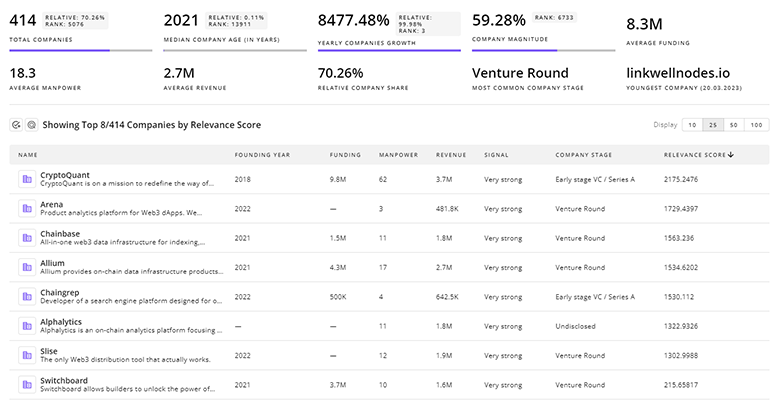
1.9K Dna Sequencing Companies
Discover Dna Sequencing Companies, their Funding, Manpower, Revenues, Stages, and much more
Dna Sequencing Investors
Gain insights into 2.7K Dna Sequencing investors and investment deals. TrendFeedr’s investors tool presents an overview of investment trends and activities, helping create better investment strategies and partnerships.
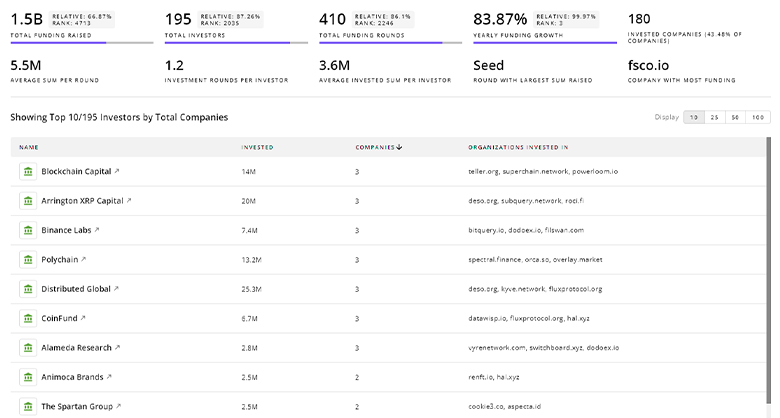
2.7K Dna Sequencing Investors
Discover Dna Sequencing Investors, Funding Rounds, Invested Amounts, and Funding Growth
Dna Sequencing News
Gain a competitive advantage with access to 13.7K Dna Sequencing articles with TrendFeedr's News feature. The tool offers an extensive database of articles covering recent trends and past events in Dna Sequencing. This enables innovators and market leaders to make well-informed fact-based decisions.
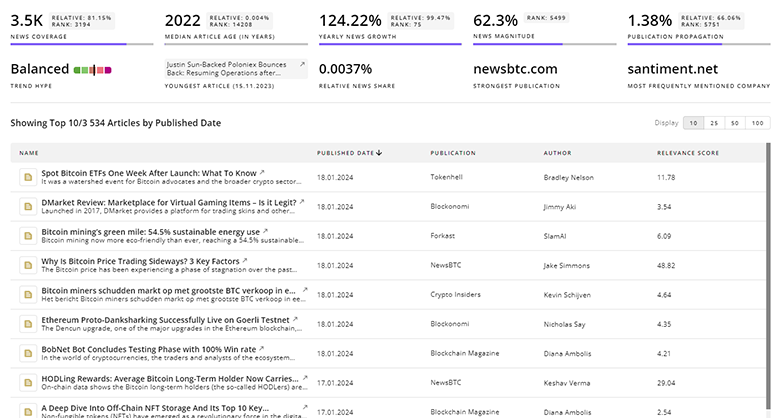
13.7K Dna Sequencing News Articles
Discover Latest Dna Sequencing Articles, News Magnitude, Publication Propagation, Yearly Growth, and Strongest Publications
Executive Summary
Sequencing is moving from volume-centric pricing toward premium, resolution-driven value. The largest near-term commercial opportunities lie with firms that convert richer raw data into actionable clinical insight and with those that reduce front-end friction in sample and reagent supply. Market projections vary, but internal trend analysis signals aggressive expansion through 2029</strong>; businesses that pair high-fidelity sequencing inputs, validated analytical layers, and targeted clinical pathways will capture the disproportionate share of growth.
We seek partnerships with industry experts to deliver actionable insights into trends and tech. Interested? Let us know!