Drones For Agriculture Report
: Analysis on the Market, Trends, and TechnologiesThe agriculture drone market sits at an operational inflection point where airborne sensing is becoming a direct input to automated on-farm action: market data shows USD 2,424,100,000 market size in 2023 with a 25.1% CAGR projection in the internal trend report, signalling rapid adoption of precision aerial services and Drone-as-a-Service models. Hardware growth (especially medium-payload platforms) continues to expand acreage coverage, while analytics and autonomous application systems are emerging as the principal value pools by converting imagery into prescriptive interventions.
We updated this report 73 days ago. Noticed something’s off? Let’s make it right together — reach out!
Topic Dominance Index of Drones For Agriculture
The Topic Dominance Index trendline combines the share of voice distributions of Drones For Agriculture from 3 data sources: published articles, founded companies, and global search
Key Activities and Applications
- Field Mapping & Spatial Intelligence — High-resolution multispectral and RTK-enabled surveys replace manual scouting for zonal prescriptions; field mapping remains the highest-volume application in most market studies researchandmarkets - Agriculture Drones Market, 2025.
- Variable-Rate/Prescriptive Application — Prescription maps generated from drone imagery drive spot spraying and variable fertiliser dosing; patents and product designs emphasize where to apply rather than blanket application.
- Precision Spraying & Material Delivery — Electronically controlled atomizers, electrostatic delivery and terrain-following flight control reduce drift and inputs for row and specialty crops; medium payload drones (10–25 kg) dominate commercial spraying use cases.
- Crop Scouting & Early-Warning Diagnostics — Multispectral, thermal and AI classifiers detect nutrient stress, pest outbreaks and disease before visible symptoms; service providers package this as recurring monitoring subscriptions.
- Aerial Seeding & Reforestation — High-payload seeding drones and aerial seed distribution reduce labour and enable access to rough terrain for reforestation and cover-crop establishment.
- Specialty Tasks: Pollination & Orchard Care — Automated pollination, canopy-level spraying and targeted pruning support high-value horticulture where per-plant interventions drive economics Global Agriculture Drones Industry.
Emergent Trends and Core Insights
- AI-first Prescriptive Workflows — Onboard and cloud AI move workflows from descriptive maps to prescriptive action plans; the monetizable asset shifts to models trained on executed application outcomes.
- DaaS & Rural Entrepreneurship — Drone-as-a-Service lowers capital barriers for smallholders, creating local operator networks and new rural revenue streams; public programs and subsidies amplify uptake in emerging markets.
- Autonomous fleet orchestration and ground/air synergy — Fleet coordination patents and robotic refill/charging stations indicate the next step: continuous missions that hand off tasks between aerial and ground systems to remove human chokepoints.
- Regulatory Tailwinds Where Policy Aligns — Countries that streamline certification and training see faster commercial adoption; regulatory clarity is a gating factor for BVLOS and scale operations thebusinessresearchcompany - Agriculture Drones Market, 2025.
- Crop- and Vertical-Specific Differentiation — Startups focusing on orchard, vineyard, greenhouse or pollination niches gain premium pricing because per-plant value justifies higher service fees.
- Sustainability Metrics as Market Signal — Proven reductions in chemical use and measurable ESG outcomes unlock subsidy, procurement and carbon-credit pathways—making quantified input reductions a commercial differentiator grandviewresearch - Agriculture Drones Market, 2025.
Technologies and Methodologies
- Multispectral / Hyperspectral Imaging + NDVI Workflows — Core sensors for stress detection and prescription generation; interoperability with GIS and VRT stacks is standard.
- RTK / PPK GNSS Navigation — Centimetre-level positioning underpins accurate spray swaths and per-plant operations for variable-rate systems New Drone Technologies in Agriculture.
- Edge AI & Onboard Inference — Running lightweight models at the edge reduces bandwidth and enables immediate in-flight decisions for selective spraying and obstacle avoidance marketresearch - Commercial Unmanned Aerial Systems in Agriculture, 2025.
- Electrostatic & Dual-Atomization Spraying Systems — Engineering focused on droplet charge and distribution to increase deposition and cut drift for low-volume, high-value applications.
- Autonomous Charging/Refill Stations & UAV Service Hubs — Ground infrastructure that enables multi-hour, operator-light operations and continuous field coverage.
- Swarm & Fleet Orchestration Protocols — Software stacks for task allocation, collision avoidance and heterogeneous vehicle scheduling to scale coverage on large farms.
- Synthetic Training Data for Computer Vision — Generative datasets that overcome scarcity of pixel-level annotations accelerate model accuracy for niche crop scenes.
Drones For Agriculture Funding
A total of 176 Drones For Agriculture companies have received funding.
Overall, Drones For Agriculture companies have raised $3.5B.
Companies within the Drones For Agriculture domain have secured capital from 620 funding rounds.
The chart shows the funding trendline of Drones For Agriculture companies over the last 5 years
Drones For Agriculture Companies
- AgriSynth — Small UK team creating synthetically generated, pixel-accurate image datasets to train agricultural vision models. Their capability addresses the core data bottleneck for plant-level detection and substantially shortens model development cycles for niche crops where real-world labels are scarce. AgriSynth's synthetic approach reduces dependency on costly annotation campaigns and enables faster deployment of perception stacks across specialty crops.
- Dropcopter — A US micro-startup commercializing drone pollination for orchards and high-value horticulture. Dropcopter's robotic pollination replaces seasonal labor and mitigates pollinator shortages; the company runs pilot deployments that demonstrate per-acre yield and quality improvements important to greenhouse and orchard economics.
- Aeroseeder — Iowa-based team building heavier seeding drones (≈25 lb platforms) that deliver high throughput (documented mission rates up to 30 acres/hour) for cover-crop and reforestation use cases; their model targets service operators and contractors rather than direct farmer sales.
- Kray Technologies — Compact Ukrainian developer focused on close-crop electrostatic and terrain-following spraying with high-frequency optical terrain estimation for low-altitude operations. Kray's platform emphasises high-precision, low-drift application suitable for vegetable and orchard systems where chemical savings and coverage uniformity directly translate to margin.
- SUIND — India-based AI+UAV integrator building vision-based navigation stacks and a cloud orchestration layer that fuses satellite monitoring with local drone telemetry. SUIND positions its stack as a platform-agnostic intelligence layer for large land managers seeking continuous surveillance and automated intervention guidance.
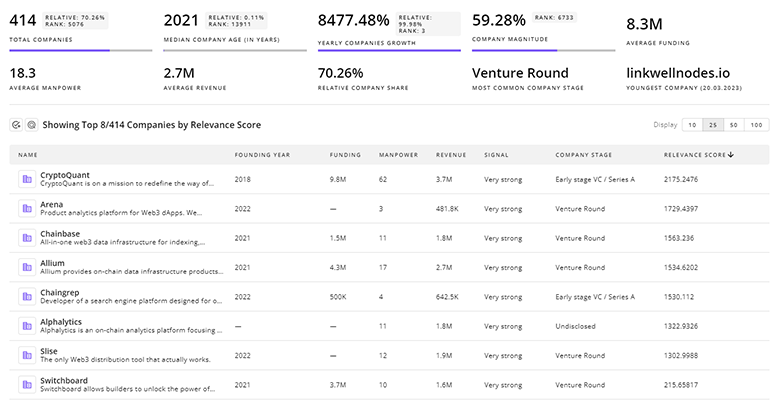
Gain a better understanding of 1.5K companies that drive Drones For Agriculture, how mature and well-funded these companies are.
1.5K Drones For Agriculture Companies
Discover Drones For Agriculture Companies, their Funding, Manpower, Revenues, Stages, and much more
Drones For Agriculture Investors
Gain insights into 814 Drones For Agriculture investors and investment deals. TrendFeedr’s investors tool presents an overview of investment trends and activities, helping create better investment strategies and partnerships.
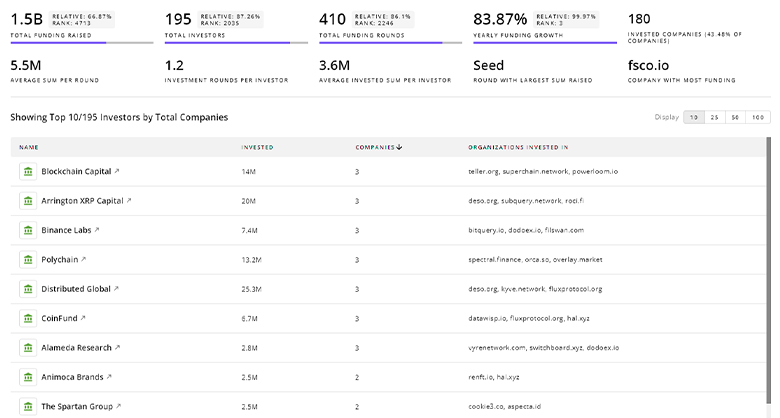
814 Drones For Agriculture Investors
Discover Drones For Agriculture Investors, Funding Rounds, Invested Amounts, and Funding Growth
Drones For Agriculture News
Gain a competitive advantage with access to 579 Drones For Agriculture articles with TrendFeedr's News feature. The tool offers an extensive database of articles covering recent trends and past events in Drones For Agriculture. This enables innovators and market leaders to make well-informed fact-based decisions.
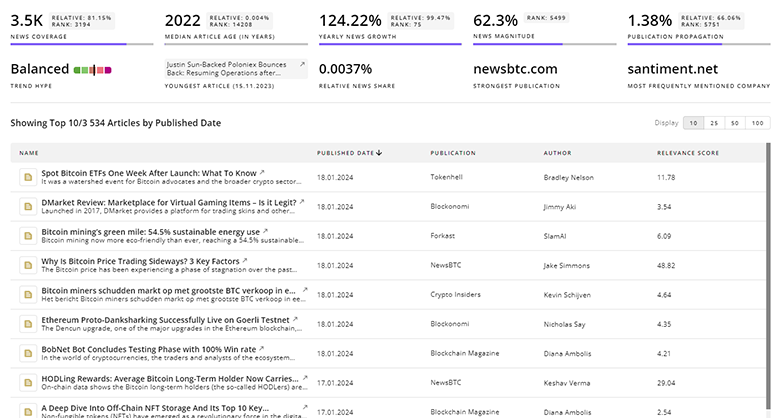
579 Drones For Agriculture News Articles
Discover Latest Drones For Agriculture Articles, News Magnitude, Publication Propagation, Yearly Growth, and Strongest Publications
Executive Summary
Drone adoption in agriculture now centers on converting aerial data into measurable, on-field action. The most valuable companies will be those that own closed-loop execution data: they not only map and detect but also execute and measure intervention outcomes. Near-term commercial winners will combine medium-payload hardware, RTK precision, on-board AI and reliable ground support (charging/refill) to offer continuous, measurable yield and input improvements. Investors and farm operators should prioritise partnerships and pilots that deliver per-acre economics (chemical reduction, labour substitution, yield uplift) with verifiable metrics, and place a strategic bet on companies that supply either the execution layer (autonomous ground or seeding/weeding systems) or indispensable AI ingredients (high-quality training data and validated prescriptive models).
We seek partnerships with industry experts to deliver actionable insights into trends and tech. Interested? Let us know!