Earth Orbit Leo Report
: Analysis on the Market, Trends, and TechnologiesThe LEO market is scaling quickly and unevenly: commercial Earth-imagery activity alone is a $5,640,000,000 market in 2025 and imaging services are projected to nearly double by 2030 as operators shift to lower-altitude constellations to improve revisit and resolution. This growth is supported by an adjacent Orbital Transfer market that is forecast to grow at 10.30% CAGR (2025–2030) and to reach $5,560,000,000 by 2030, indicating expanding demand for in-space logistics, life-extension, and debris-management services. Declining per-kg launch costs and concentrated investment into constellation data platforms are changing value capture: the immediate winners will be providers that combine low-cost access, precise on-orbit control, and real-time data products.
This article was last updated 271 days ago. If you find any info is missing, let us know!
Topic Dominance Index of Earth Orbit Leo
The Dominance Index of Earth Orbit Leo looks at the evolution of the sector through a combination of multiple data sources. We analyze the distribution of news articles that mention Earth Orbit Leo, the timeline of newly founded companies working in this sector, and the share of voice within the global search data
Key Activities and Applications
- Low-latency broadband and IoT backhaul — large constellations and direct-to-device connectivity remain primary revenue engines, driven by enterprise and mobility use cases in maritime, aviation, and remote industries Low Earth Orbit Satellite Market Size, Share, Trends, 2031 Report.
- High-revisit, high-resolution Earth observation — operators are migrating to VLEO/ULEO to deliver sub-meter optical and thermal products for agriculture, insurance, and disaster response; rapid revisit enables operational, near-real-time workflows.
- In-orbit servicing, refueling, and life extension — OTVs, rendezvous & capture, and wet-lease models are scaling to reduce replacement cadence and monetize satellite longevity for constellations.
- Space domain awareness and collision avoidance — commercial SDA is becoming mission-critical as orbital density rises; operators supply persistent tracking and conjunction warning to reduce insurance and operational risk.
- Edge processing and onboard analytics — movement of compute into LEO enables near-source data reduction (image triage, event detection) and lowers downlink costs while shortening customer decision cycles.
Emergent Trends and Core Insights
- Altitude as a product lever — Very Low Earth Orbit (VLEO/ULEO) is emerging as a differentiated product tier: closer orbits yield better link budgets and resolution but require continuous propulsion or air-breathing approaches to counter drag Skeyeon.
- Platformization of orbital services — market structure is bifurcating: a small set of platform players (data aggregation, logistics orchestration) capture high recurring revenue while ingredient specialists (propulsion, sensors, refueling) monetize as high-margin suppliers Kepler Communications Inc..
- Operational autonomy and distributed orbit determination — patents and deployments emphasize autonomous on-satellite orbit determination and ISL-enabled synchronization to reduce dependence on ground stations and improve SSA in congested regimes.
- Commercialization of sustainability — regulatory moves (e.g. faster deorbit requirements) plus customer willingness to pay for end-of-life services create a nascent but fast-growing market for debris removal and servicing contracts Regulatory actions and SDA contracts.
- Defense and government acceleration — dual-use demand (PNT augmentation, resilient comms) channels government budgets into commercial LEO suppliers, shortening commercialization paths for advanced architectures.
Technologies and Methodologies
- Optical inter-satellite links (OISL) — essential for constellation mesh networking and in-orbit data relay; OISL deployment changes ground station economics and enables space-native routing.
- Air-Breathing Electric Propulsion (ABEP) & VLEO station-keeping — enabling continuous operations below ~300 km</strong>; these propulsion approaches create the possibility of de-orbiting by design and lower debris persistence VLEO Developments.
- High-thrust electric and hybrid propulsion for OTVs — long-duration transfers and precise constellation insertion depend on scalable electric thrusters and hybrid chemical-electric concepts.
- Onboard Edge AI and micro data centers — LEO micro-data centers and hardened edge servers perform image triage, compression, and analytics to support real-time decisioning and reduce downlink costs OrbitsEdge, Inc.
- Autonomous rendezvous, capture, and robotic servicing — robotic manipulation and standard docking/refueling interfaces enable reuse, modular payload hosting, and remediation of failing assets.
- Standardized mission stacks and cloud-native ground control — cloud-based mission control and software-defined ground segments accelerate constellation integration and operational scaling.
Earth Orbit Leo Funding
A total of 213 Earth Orbit Leo companies have received funding.
Overall, Earth Orbit Leo companies have raised $59.2B.
Companies within the Earth Orbit Leo domain have secured capital from 1.2K funding rounds.
The chart shows the funding trendline of Earth Orbit Leo companies over the last 5 years
Earth Orbit Leo Companies
- NewOrbit Space
NewOrbit Space engineers satellites for Ultra-Low Earth Orbit (180–220 km) to deliver superior imaging and link budgets while minimizing debris lifetime; the firm positions lower altitude as a product differentiator that reduces downstream processing latency and improves spatial resolution. Its small team focuses on engineering across platform and operations to enable rapid revisit for commercial imaging and connectivity. Strategic value lies in a native sustainability argument: ultra-low satellites reenter quickly, lowering long-term orbital risk. - Kreios Space
Kreios Space develops an Air-Breathing Electric Propulsion system designed for VLEO station-keeping that aims to sustain operations using ambient atmospheric oxygen intake; this approach reduces onboard propellant mass and extends mission lifetimes at altitudes where passive reentry would otherwise occur. The company’s technical path addresses the core trade-off of VLEO—drag versus resolution—by supplying continuous, low-power thrust compatible with small satellites. Early funding and demonstration programs target customers seeking persistent, low-altitude imaging and high throughput downlinks. - Orbit Fab
Orbit Fab builds in-orbit refueling hardware and an operational supply chain (propellant depots, refuel interfaces) to extend satellite lifetimes and enable flexible mission profiles; their Gas Stations in Space™ model turns fuel into a recurring service and decouples satellite life from the launch ticket. The firm’s RAFTI interface and depot strategy directly reduce constellation churn and create optionality for operators to trade CAPEX for OPEX. Orbit Fab’s model accelerates a circular economy in LEO and is a core enabler of large, long-lived constellations. - EOI Space
EOI Space operates a VLEO optical imaging approach that targets 15 cm resolution and rapid tasking by combining low altitude with on-board processing to deliver near-instant, decision-ready imagery for defense, insurance, and emergency response customers. EOI’s stack emphasizes fast revisit and reduced latency from image capture to insight, enabling customers that require immediate situational awareness. The company’s product strategy centers on premium, time-sensitive analytics rather than commoditized archive imagery. - SatLeo Labs
SatLeo Labs builds a micro-satellite constellation for thermal imagery and near-real-time analytics aimed at agriculture, urban planning, and climate monitoring; thermal products provide a differentiated dataset (vegetation stress, night-time activity) that complements optical imagery and supports use cases where optical access is limited. Their approach pairs compact payloads with AI/ML pipelines to produce time-sensitive thermal indicators for commercial customers.
Uncover actionable market insights on 469 companies driving Earth Orbit Leo with TrendFeedr's Companies tool.
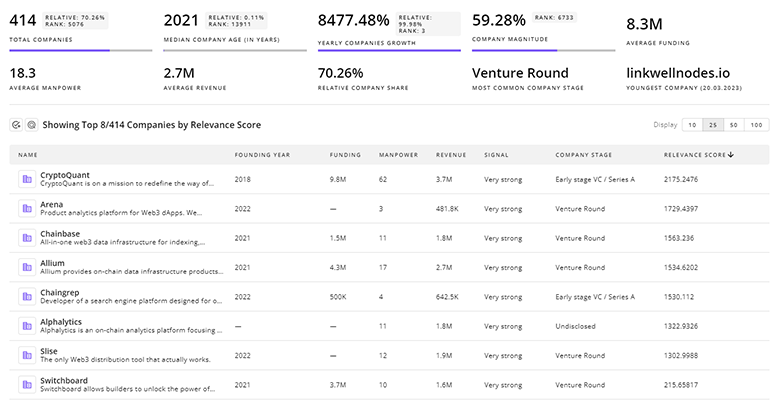
469 Earth Orbit Leo Companies
Discover Earth Orbit Leo Companies, their Funding, Manpower, Revenues, Stages, and much more
Earth Orbit Leo Investors
Get ahead with your investment strategy with insights into 1.9K Earth Orbit Leo investors. TrendFeedr’s investors tool is your go-to source for comprehensive analysis of investment activities and financial trends. The tool is tailored for navigating the investment world, offering insights for successful market positioning and partnerships within Earth Orbit Leo.
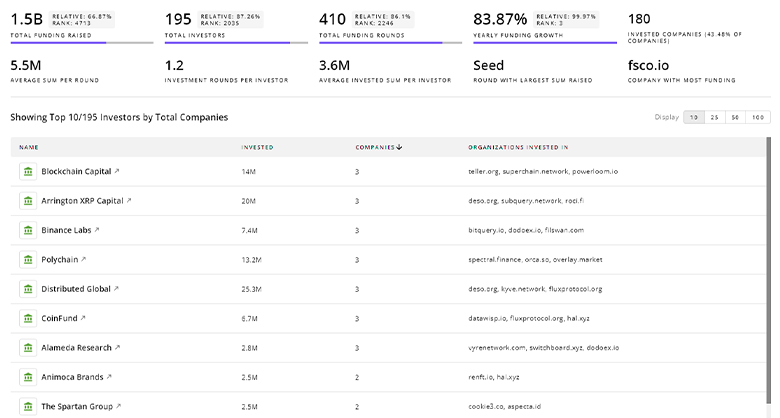
1.9K Earth Orbit Leo Investors
Discover Earth Orbit Leo Investors, Funding Rounds, Invested Amounts, and Funding Growth
Earth Orbit Leo News
TrendFeedr’s News feature offers access to 4.8K news articles on Earth Orbit Leo. The tool provides up-to-date news on trends, technologies, and companies, enabling effective trend and sentiment tracking.
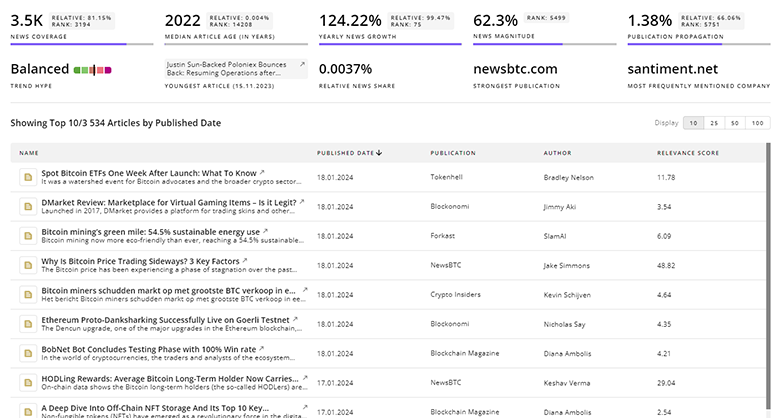
4.8K Earth Orbit Leo News Articles
Discover Latest Earth Orbit Leo Articles, News Magnitude, Publication Propagation, Yearly Growth, and Strongest Publications
Executive Summary
The LEO value chain is transitioning from discrete hardware plays to integrated service platforms that combine persistent sensing, in-space logistics, and on-orbit compute. Investors and operators should prioritize capital toward: (1) technologies that materially lower lifecycle cost (propulsion, refueling), (2) systems that reduce operational risk through improved SSA and autonomous orbit determination, and (3) data products that command recurring subscriptions through low-latency, decision-ready outputs. Regulatory alignment on debris mitigation and SSA standards will decide whether the market consolidates around a few platform utilities or fragments into costly, localized silos. In this environment, companies that secure standards-level interfaces (refueling, docking, ISL) or that can demonstrate clearly faster time-to-value for downstream customers will earn the premium margins and durable contracts that define long-term leadership.
Have expertise in trends or technology? Your input can enrich our content — consider collaborating with us!