Electrolyzers Report
: Analysis on the Market, Trends, and TechnologiesThe electrolyzer sector is shifting from pilot-heavy activity to scale-focused deployment as market data shows 1273 active companies and $53.03B in cumulative funding across the topic, evidence of intense capital concentration and investor interest. Industry forecasts reinforce rapid expansion: several market studies project multi-billion-dollar markets over the next decade, with one major forecast estimating a rise from USD 3.07B in 2025 to USD 9.48B by 2031 (CAGR 20.67%) Electrolyzers Market – Global Industry Size, Share, Trends, Opportunity, and Forecast, 2021-2031. The corpus of patent activity and company signals shows technology adoption accelerating even as new filings and company formation moderate, concentrating value toward scalable manufacturing, alternative (PGM-free) materials, and system integration.
This article was last updated yesterday. If you find any info is missing, let us know!
Topic Dominance Index of Electrolyzers
The Dominance Index of Electrolyzers looks at the evolution of the sector through a combination of multiple data sources. We analyze the distribution of news articles that mention Electrolyzers, the timeline of newly founded companies working in this sector, and the share of voice within the global search data
Key Activities and Applications
- Green hydrogen for industrial decarbonization — Electrolyzers supply hydrogen for steel, ammonia and chemical feedstocks and are being specified for large onsite replacements of fossil feedstock in heavy industry.
- Power-to-X (P2X) and energy storage — Converting curtailed renewable electricity into hydrogen for later use in power generation, transport fueling, or chemical synthesis remains a primary use case.
- On-site and modular hydrogen generation — Distributed electrolyzer systems serve refueling stations, industrial sites and remote energy needs; modular designs reduce engineering lead time and OPEX risk.
- Integration with wastewater and seawater feeds — R&D and pilots show practical pathways to use non-freshwater streams and industrial alkaline waste as feedstock, reducing desalination and water-supply costs where implemented Direct electrolysis systems.
- Electrochemical value-chain diversification — Systems tailored for producing higher-value chemicals (e.g. formate, methanol precursors) are emerging, expanding commercial options beyond commodity hydrogen
Emergent Trends and Core Insights
- Technology bifurcation: centralized high-efficiency SOEC vs. distributed AEM/Alkaline — Large industrial players pursue SOEC for heat-integrated, high-efficiency projects while agile entrants push AEM and advanced Alkaline for rapid, low-cost deployment.
- Material substitution and PGM avoidance as a strategic moat — Suppliers prioritize earth-abundant catalysts and alternative membranes to escape iridium/platinum supply risk and capex pressure; this is a central R&D and investment focus Low-cost cobalt-based catalyst for PEM electrolysis.
- Manufacturing scale and automation capture value — Economies of scale and automated stack assembly lines are driving a fall in per-kW capex; market studies record accelerated movement to gigawatt-scale factories to reach competitive cost curves
- System-level value shifts from stack IP to BoP and controls — As stack designs converge, differentiation moves to balance-of-plant, power electronics, and energy management platforms that raise uptime and lower LCOH.
- Feedstock flexibility and circular-economy linkages — Approaches that use off-gases, seawater or wastewater materially change project economics and regulatory positioning for industrial off-takers Utility.
Technologies and Methodologies
- Proton Exchange Membrane (PEM) — Favored for dynamic operation with variable renewables and high-purity hydrogen needs; industry forecasts show PEM gaining share in scenarios that prioritize dynamic grid coupling Electrolyzer Market.
- Alkaline Water Electrolysis (AWE) — Mature, low-cost approach that dominates large-volume baseload applications; recent stack and electrode advances raise current densities and durability.
- Anion Exchange Membrane (AEM) — Emerging as a cost-competitive alternative combining AWE durability with PEM flexibility, with PGM-free catalyst pathways a central value driver.
- Solid Oxide Electrolysis Cells (SOEC/SOEL) — High-temperature option that leverages waste heat in industrial sites to increase electrical efficiency; strategic fit for steel, chemicals and integrated process heat users Sunfire.
- Membrane-free and decoupled electrolysis methods — Designs that separate H2 and O2 evolution (membraneless or temporally decoupled processes) reduce materials cost and simplify BoP, lowering LCOH potential for certain deployments H2Pro.
- Stack component innovation (catalysts, MEAs, coatings) — Commercialization of advanced catalytic coatings and MEA manufacturing (PGM-free) is a high-leverage area; electrode coating scale-up is moving from lab to multi-GW factories Jolt Activated Electrodes.
- Digital control, AI and energy management — Predictive maintenance, cell-level control and integrated EMS reduce downtime and improve stack lifetime; these software and sensor layers are becoming required elements of competitive offers.
Electrolyzers Funding
A total of 294 Electrolyzers companies have received funding.
Overall, Electrolyzers companies have raised $53.0B.
Companies within the Electrolyzers domain have secured capital from 1.1K funding rounds.
The chart shows the funding trendline of Electrolyzers companies over the last 5 years
Electrolyzers Companies
- Newtrace — A systems-focused OEM developing membrane-less and advanced alkaline stacks (VoltaGen) designed for high current density and scalable manufacturing; the company highlights deployments with industrial clients such as BPCL and ONGC, and pursues a vertically integrated supply-chain simplification to lower CAPEX for gigawatt projects
- Hydroyal — Specializes in large-scale production of Membrane Electrode Assemblies (MEAs) for AEM and alkaline stacks using sustainable materials; by focusing on the MEA supply bottleneck, the company seeks to become a critical component supplier that reduces cost floor for AEM adopters
- Cipher Neutron — A North American AEM electrolyzer developer claiming early commercial AEM systems without PGM catalysts; the company positions its AEM stacks as a lower-cost alternative to PEM for distributed, high-pressure hydrogen production
- KERIONICS — A Spanish spin-off developing ceramic components and core SOEL/SOEC modules for high-temperature electrolysis; its ceramic-materials IP targets integration with industrial heat sources to reduce LCOH for heavy-duty process decarbonization
- Electro Carbon — Developer of industrial CO2 electrolyzers that convert captured CO2 into potassium formate and other specialty chemicals; the company's model monetizes both carbon removal and high-value chemical revenue, reducing dependence on hydrogen price support
Uncover actionable market insights on 1.3K companies driving Electrolyzers with TrendFeedr's Companies tool.
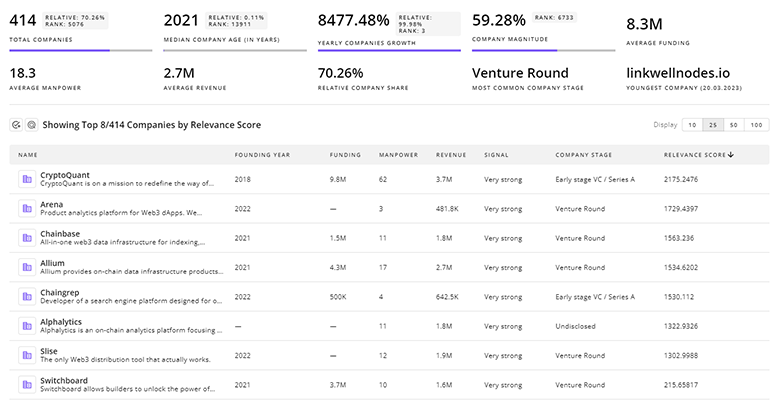
1.3K Electrolyzers Companies
Discover Electrolyzers Companies, their Funding, Manpower, Revenues, Stages, and much more
Electrolyzers Investors
Get ahead with your investment strategy with insights into 1.4K Electrolyzers investors. TrendFeedr’s investors tool is your go-to source for comprehensive analysis of investment activities and financial trends. The tool is tailored for navigating the investment world, offering insights for successful market positioning and partnerships within Electrolyzers.
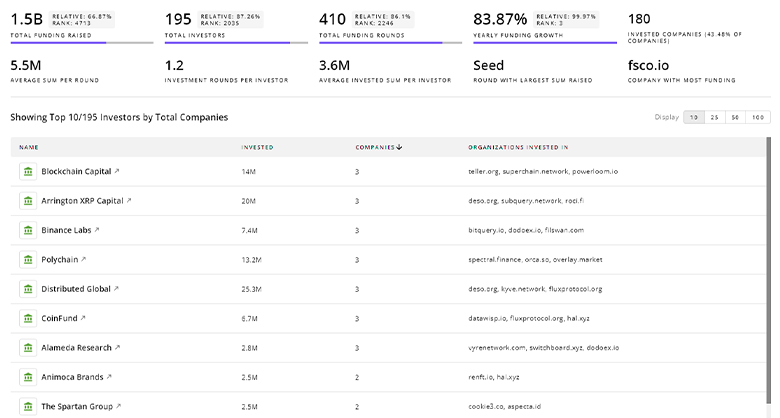
1.4K Electrolyzers Investors
Discover Electrolyzers Investors, Funding Rounds, Invested Amounts, and Funding Growth
Electrolyzers News
TrendFeedr’s News feature offers access to 2.2K news articles on Electrolyzers. The tool provides up-to-date news on trends, technologies, and companies, enabling effective trend and sentiment tracking.
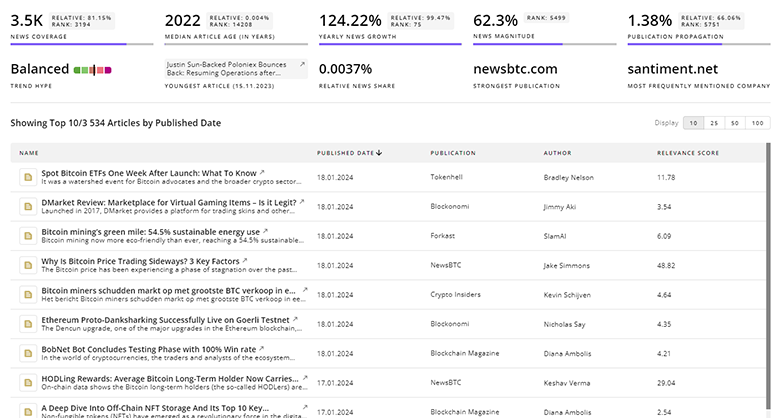
2.2K Electrolyzers News Articles
Discover Latest Electrolyzers Articles, News Magnitude, Publication Propagation, Yearly Growth, and Strongest Publications
Executive Summary
Electrolyzers now occupy a clear inflection point where technology maturation, supply-chain scale-up and public financing converge. Investment flows and media coverage indicate the sector will consolidate around a few manufacturing scale leaders while creating significant niches for component specialists (MEA, coatings, non-PGM catalysts), feedstock-flexible solutions (seawater, wastewater, off-gases), and industrial heat-integrated SOEC deployments. For investors and industrial buyers, priorities should be: secure supply-chain positions in critical stack components; evaluate projects by integrated LCOH (including feedstock, waste-heat and BoP); and prefer partners with demonstrated automated manufacturing roadmaps and proven field durability. Strategic partnerships that combine manufacturing scale with differentiated component IP and advanced O&M controls will command the most sustainable margins as the market moves from demonstration to multi-gigawatt commercial scale.
Have expertise in trends or technology? Your input can enrich our content — consider collaborating with us!