Energy Market Report
: Analysis on the Market, Trends, and TechnologiesThe energy market sits at a decisive inflection: the energy transition market was valued at USD 3.08 trillion in 2024 and is projected to reach USD 5.56 trillion by 2030, implying an implied growth trajectory consistent with a reported 10.3% CAGR for the transition segment — a scale that forces incumbents and entrants to prioritize integrated platforms that combine trading, asset optimisation, storage, and distributed resources rather than single-point solutions marketresearchfuture – 2025.
This article was last updated 121 days ago. If you find any info is missing, let us know!
Topic Dominance Index of Energy Market
The Dominance Index of Energy Market looks at the evolution of the sector through a combination of multiple data sources. We analyze the distribution of news articles that mention Energy Market, the timeline of newly founded companies working in this sector, and the share of voice within the global search data
Key Activities and Applications
- Grid-scale renewable integration: planning, dispatch, and market participation for solar, wind and co-located storage to firm output and monetize ancillary services.
- Energy trading and marketplace services: day-ahead, intraday and bilateral contract platforms that manage intermittency risk, environmental products and hedging for corporate offtakers researchandmarkets – 2025 marketresearch – 2025.
- Energy as a Service (EaaS) and behind-the-meter offerings: subscription or contract models that deliver project development, O&M and financed retrofits to remove upfront capex barriers for customers eEnergy.
- Distributed Energy Resource Management and Virtual Power Plants (VPPs): orchestration of DER fleets for market revenue, peak shaving and grid services marketresearchfuture – 2025.
- Demand-side flexibility for digital loads (data centers, EV fleets): real-time load shaping and flexibility monetization to reduce system balancing costs and avoid expensive network upgrades.
- Energy procurement, portfolio optimisation and price-risk management: software and advisory for PPAs, hedges and short-term exposure management.
Emergent Trends and Core Insights
- Solar and storage economics create a new cost frontier: falling solar LCOE and improving multi-hour storage economics shift investment toward solar-centric portfolios and merchant storage, increasing merchant exposure that trading platforms must manage Deloitte Renewable Energy Industry Outlook.
- Rapid growth in real-time demand from AI and digital infrastructure: grid operators forecast incremental megawatts driven by AI-heavy data centers and electrification; system operators and traders must design flexible procurement and hedging for these concentrated loads.
- Platform consolidation and data monetization: financial and operational value flows to entities that aggregate generation, storage, real-time telemetry and market access; data products (forecasting, capture pricing, emissions intensity) become high-value services Energy Aspects.
- Decentralized peer-to-peer (P2P) markets scale in constrained geographies: regulated sandbox pilots, combined with blockchain and smart-meter rollout, allow localized trading and community energy models to emerge as commercial experiments with meaningful upside in specific regions market_us – 2025.
- Risk management and ETRM growth: as intraday and intraregional flows increase, ETRM/CTRM and probabilistic forecasting become mandatory for market participants to control price and credit exposure marketresearchfuture – 2025.
- Regional divergence in transition paths: APAC and emerging markets will continue to rely on fossil and hybrid solutions in the near term, while Europe and parts of North America accelerate DER integration — this creates asymmetric opportunity and regulatory complexity for platform rollouts.
Technologies and Methodologies
- AI and probabilistic forecasting: hybrid models (neural nets + econometrics) for sub-hourly generation and price forecasts that directly feed trading engines and dispatch optimisation ForecastPower.
- DER orchestration and DERMS/DERMS-to-VPP stacks: software that performs aggregation, market bidding and technical dispatch for distributed assets.
- Blockchain and smart contracts for provenance and settlement: used where regulatory regimes permit P2P settlement and RE certificate tracking, reducing friction in local trading schemes GETenergy.
- Edge computing + market-based price signals for load flexibility: local controllers respond to scarcity signals to provide grid relief while maximizing owner revenue.
- Energy-as-a-Service operational stacks: integrated procurement, asset ops and financing layers that convert capex into contracted service revenue and ease customer adoption.
- Advanced ETRM and risk analytics: cloud-native risk platforms that embed value-at-risk, stress tests and scenario analysis for highly volatile short-term markets.
Energy Market Funding
A total of 562 Energy Market companies have received funding.
Overall, Energy Market companies have raised $100.1B.
Companies within the Energy Market domain have secured capital from 1.7K funding rounds.
The chart shows the funding trendline of Energy Market companies over the last 5 years
Energy Market Companies
- Energy Trade Centre — A small UK marketplace that uses financial models and AI to match renewable generators and offtakers; the company positions itself to shorten PPA creation time by up to 90% through automated matching and standardized contract frameworks, targeting corporates and distributed generators.
- Independent Energy Pool — A Swiss B2B energy pool that enables licence-free trading in emerging markets and integrates REC tracking and ESG reporting for trades; the platform targets energy-intensive users and small traders looking for standardised, balanced trades.
- FlexPower — A German short-term trader and engineering team that supplies market signals and liquidity for renewables and battery flexibility; the firm focuses on intraday and balancing revenues and sells forecasting and trading services to asset owners.
- Power2Peer Inc. — A US app-based P2P marketplace that targets community-scale solar prosumers and commercial buyers; the product emphasises local matching, resilience (islanding) and branded sustainability procurement for SMEs.
- Dynamic Grid — A US startup combining AI and edge controls to balance distribution networks locally using price signals; the system coordinates flexible loads and storage to delay capital-heavy grid upgrades and enable local market participation.
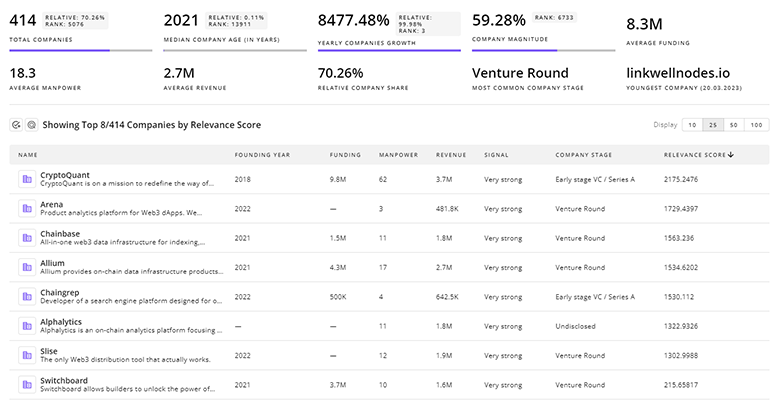
Uncover actionable market insights on 4.4K companies driving Energy Market with TrendFeedr's Companies tool.
4.4K Energy Market Companies
Discover Energy Market Companies, their Funding, Manpower, Revenues, Stages, and much more
Energy Market Investors
Get ahead with your investment strategy with insights into 1.6K Energy Market investors. TrendFeedr’s investors tool is your go-to source for comprehensive analysis of investment activities and financial trends. The tool is tailored for navigating the investment world, offering insights for successful market positioning and partnerships within Energy Market.
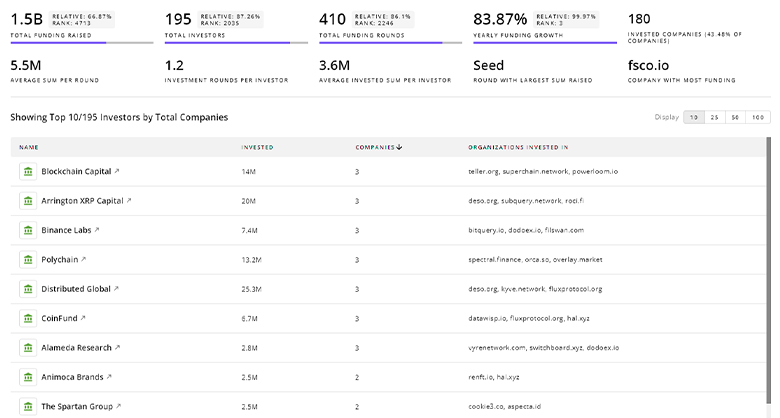
1.6K Energy Market Investors
Discover Energy Market Investors, Funding Rounds, Invested Amounts, and Funding Growth
Energy Market News
TrendFeedr’s News feature offers access to 14.9K news articles on Energy Market. The tool provides up-to-date news on trends, technologies, and companies, enabling effective trend and sentiment tracking.
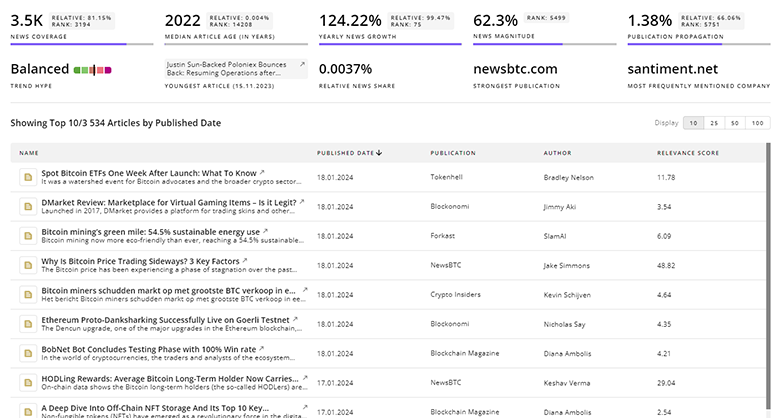
14.9K Energy Market News Articles
Discover Latest Energy Market Articles, News Magnitude, Publication Propagation, Yearly Growth, and Strongest Publications
Executive Summary
The available data shows a market where scale and integration matter: large addressable value (multi-trillion USD transition market) plus high CAGR expectations concentrate advantage in platforms that combine trading, DER orchestration, storage optimisation and risk management. Traders and platform providers should prioritize (1) deterministic, high-granularity forecasting and probabilistic risk tools to operate in intraday markets; (2) interoperable DERMS/VPP stacks and settlement rails so assets can feed market signals; and (3) modular commercial models (EaaS, PPAs, flexibility contracts) so customers avoid capex hurdles. Investors should prefer businesses that can demonstrate both market access (exchange/contract connectivity) and differentiated data products (capture price, emissions intensity, multi-hour arbitrage), while operators in regions with immature grids can pursue P2P and microgrid pilots where regulatory sandboxes permit rapid scaling.
Have expertise in trends or technology? Your input can enrich our content — consider collaborating with us!