Enterprise Saas Report
: Analysis on the Market, Trends, and TechnologiesThe enterprise SaaS market is at a decisive inflection where adoption and governance priorities are reshaping buying and build strategies: anchored by the internal trend report that registers a CAGR of 13.7% for enterprise SaaS growth, vendors that demonstrate measurable operational ROI and prescriptive compliance controls capture procurement momentum.
This article was last updated 241 days ago. If you find any info is missing, let us know!
Topic Dominance Index of Enterprise Saas
The Dominance Index of Enterprise Saas looks at the evolution of the sector through a combination of multiple data sources. We analyze the distribution of news articles that mention Enterprise Saas, the timeline of newly founded companies working in this sector, and the share of voice within the global search data
Key Activities and Applications
- Customer Relationship Management (CRM) — Continues as a high-spend category used to centralize customer data, automate sales workflows and link analytics to revenue operations; CRM remains a primary SaaS entry point for large accounts and is widely cited as a top application area.
- Enterprise Resource Planning (ERP) Modernization — Large organizations migrate legacy ERP components into cloud-native or hybrid SaaS models to reduce infrastructure overhead and speed feature delivery; cloud ERP market size data underscores continued investment in modular, multi-tenant ERP platforms.
- AI-Powered Automation & Analytics — Embedding ML/AI into finance, HR and supply-chain workflows to automate repetitive tasks and surface predictive recommendations is now core to product roadmaps; these capabilities are explicitly listed as priority application areas in market data.
- SaaS Management and Governance (SMG) — Centralized discovery, license optimization and lifecycle automation for sprawling app portfolios reduce spend and operational risk; SMG platforms are being adopted to counter SaaS sprawl and provide procurement leverage.
- Security, Compliance and Identity Risk Management — Data residency, auditability and identity posture drive private/hybrid deployment choices and pre-sales checklists for enterprise procurement.
- Vertical, Industry-Specific Solutions — Tailored SaaS for sectors such as BFSI, healthcare, logistics and government (e.g. local government finance platforms) accelerate adoption where regulatory and workflow specificity matter.
Emergent Trends and Core Insights
- AI becomes a gating purchase criterion — Buyers evaluate AI not as a marketing line-item but by demonstrable labor savings and accuracy improvements in domain workflows; market evidence shows AI/ML integration listed as a primary driver for enterprise SaaS adoption.
- Standardization of SaaS governance — Organizations force vendor compliance and telemetry into procurement flows, making SSPM and vendor-risk signals mandatory pre-sales items rather than post-sale projects.
- Integration-first buying — Rather than replacing point solutions, many successful vendors monetize as the integration layer or orchestration fabric (iPaaS/BIS), capturing value by making disparate ecosystems interoperable APPSeCONNECT.
- Hybrid and private-cloud preference for regulated workloads — Sensitive data and sovereignty requirements push regulated verticals to private or hybrid deployment footprints while still consuming SaaS capabilities.
- Consumption and outcome-based commercial experiments — Finance teams and vendors pilot usage/metric-based contracts to move beyond seat licensing toward measurable business outcomes; governance tech is evolving to support this billing model.
- Platform consolidation vs. best-of-breed tension — IT teams increasingly require unified control planes for security and cost, but product teams still prefer best-in-class specialized tools, producing procurement decisions weighted toward integration and governance capability.
Technologies and Methodologies
- Composable, API-first architectures — Headless and GraphQL-first approaches allow enterprises to stitch capabilities without monolithic migration; this pattern is evident in modern commerce and service platforms
- AI/ML embedded services for operations — Predictive analytics, anomaly detection and automated routing are now embedded into core workflows rather than offered as add-ons.
- Low-code / No-code configuration layers — Accelerate deployment and reduce dependency on professional services by putting safe, governed customization in the hands of business users EASA.
- Identity-first security for agentic and API-driven interactions — Modern platforms require identity stacks that address machine-to-machine and agent interactions as first-class use cases Frontegg
- FinOps and SaaS cost governance — Automated spend telemetry, benchmarking and lifecycle actions (harvesting, renegotiation) embed procurement discipline into product usage monitoring Sastrify.
- Event-driven and streaming data fabrics — Real-time observability and reaction capability underpin modern analytics and operational automation in enterprise SaaS.
Enterprise Saas Funding
A total of 468 Enterprise Saas companies have received funding.
Overall, Enterprise Saas companies have raised $43.0B.
Companies within the Enterprise Saas domain have secured capital from 1.8K funding rounds.
The chart shows the funding trendline of Enterprise Saas companies over the last 5 years
Enterprise Saas Companies
- CloudEagle.ai — CloudEagle.ai provides a unified SaaS management and governance platform that centralizes application discovery, license and spend visibility and automates lifecycle workflows; the vendor claims customers realize 10–30% savings on software spend and reports having processed over $2bn of spend through its platform, positioning it as a procurement-leverage engine for IT and security teams
- Scalekit — Scalekit builds an authentication and delegated-consent stack purpose-built for agentic AI and tool-calling use cases; by delivering production-ready OAuth 2.1 flows, dynamic client registration and secure token vaulting, the startup shortens time-to-enterprise for agentic applications and reduces brittle integration work for engineering teams
- SAASTEPS — SAASTEPS provides Salesforce-native revenue lifecycle automation (eCommerce, CPQ, billing, renewals) aimed at reducing integration complexity and accelerating go-live cycles; its no-code, single-platform approach targets SaaS and ecommerce teams that want rapid implementation inside an existing CRM investment
- Saleor Commerce — Saleor Commerce is an enterprise-grade, open-source headless commerce platform (GraphQL-first) that lets teams decouple frontend experience from commerce logic; the architecture supports composable commerce strategies and is attractive where bespoke UX plus enterprise controls are required
- Everest Systems — Everest Systems positions an AI-native cloud ERP for subscription, multi-entity consolidations and complex revenue recognition, offering features such as an interactive Live Sandbox™ for risk-free modeling and automated finance workflows, useful for fast-growing digital-first enterprises looking to reduce reconciliation and close cycle friction
Uncover actionable market insights on 1.9K companies driving Enterprise Saas with TrendFeedr's Companies tool.
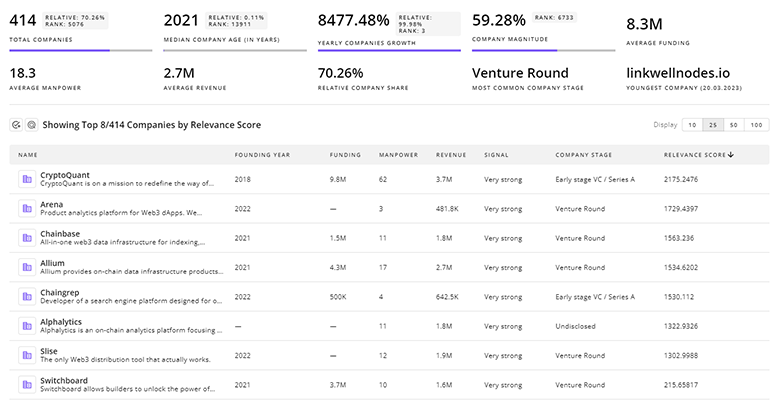
1.9K Enterprise Saas Companies
Discover Enterprise Saas Companies, their Funding, Manpower, Revenues, Stages, and much more
Enterprise Saas Investors
Get ahead with your investment strategy with insights into 2.1K Enterprise Saas investors. TrendFeedr’s investors tool is your go-to source for comprehensive analysis of investment activities and financial trends. The tool is tailored for navigating the investment world, offering insights for successful market positioning and partnerships within Enterprise Saas.
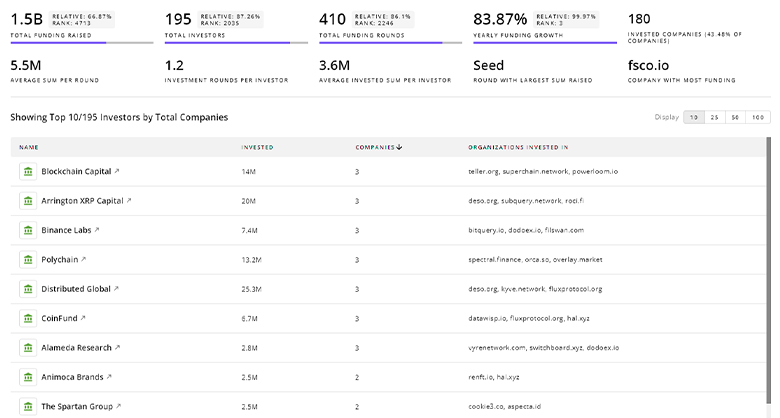
2.1K Enterprise Saas Investors
Discover Enterprise Saas Investors, Funding Rounds, Invested Amounts, and Funding Growth
Enterprise Saas News
TrendFeedr’s News feature offers access to 2.5K news articles on Enterprise Saas. The tool provides up-to-date news on trends, technologies, and companies, enabling effective trend and sentiment tracking.
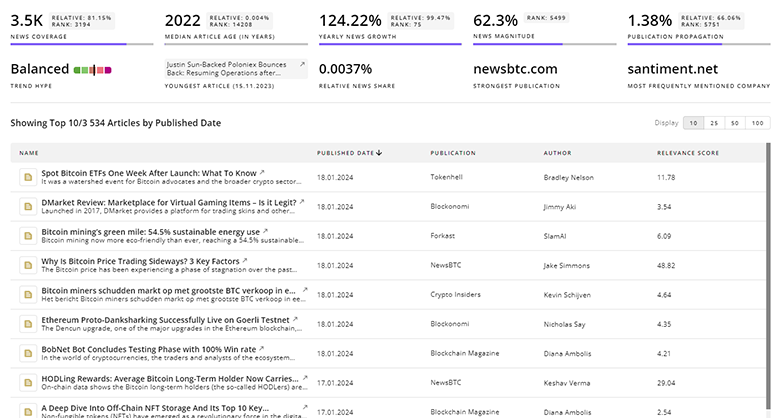
2.5K Enterprise Saas News Articles
Discover Latest Enterprise Saas Articles, News Magnitude, Publication Propagation, Yearly Growth, and Strongest Publications
Executive Summary
Enterprise SaaS decisions now hinge on two measurable vectors: operational impact and governance readiness. Vendors that combine clear, auditable cost- and time-savings with embedded compliance and identity controls win procurement conversations; those that merely add features without integration or governance signals face elongated procurement and limited scale. For buyers, the play is to prioritize platforms that provide fast discoverability of risk and spend metrics, real-time operational automation and flexible identity controls so SaaS portfolios can be managed as financial and security assets rather than a collection of disconnected tools.
Have expertise in trends or technology? Your input can enrich our content — consider collaborating with us!