
Entrepreneurship Report
: Analysis on the Market, Trends, and TechnologiesThe entrepreneurship sector is in a moment of selective expansion where technology-led services and education capture demand while public attention and company counts decline; the internal entrepreneurship trend report shows a CAGR of 11.3% for the market and a projected $42,900,000,000 market by 2032. This report finds that founders’ intent to start (notably 23% of U.S. consumers considering new ventures) and rapid adoption of AI coaching, no-code tooling, D2C/subscription business models, and faster fulfillment are the levers shaping practical support services for entrepreneurs Intuit QuickBooks.
This article was last updated 81 days ago. If you find any info is missing, let us know!
Topic Dominance Index of Entrepreneurship
The Dominance Index of Entrepreneurship looks at the evolution of the sector through a combination of multiple data sources. We analyze the distribution of news articles that mention Entrepreneurship, the timeline of newly founded companies working in this sector, and the share of voice within the global search data

Key Activities and Applications
- Entrepreneurship education and onboarding: structured curricula, simulations, and junior programs that turn intent into practice; these programs scale via gamified platforms and online academies to reach youth and underserved groups.
- Founder assessment and de-risking: psychometric and behavioral scoring to validate readiness and match founders with tailored support, used by lenders, incubators, and training providers.
- Incubation-as-a-service and remote accelerators: program bundles that combine mentorship, legal/finance templates, and investor introductions to compress time-to-market.
- Localized community activation: micro-networks and language/geography-specific communities that create deal flow and talent pipelines outside major hubs.
- Subscription and D2C commercialization playbooks: converting one-off sales into recurring revenue and direct customer relationships to improve unit economics and retention Unbox Success.
- Simulation and experiential learning: business simulations and risk-free experiments that raise survival rates by teaching decision-making under realistic constraints.
Emergent Trends and Core Insights
- AI-enabled continuous coaching replaces episodic mentorship: conversational agents and LLM frameworks provide 24/7 guidance and scale individualized learning, creating measurable progress metrics for funders and program managers.
- Platform bifurcation: mass aggregators versus outcome-driven specialists: large, platformized providers supply broad content and tooling while small specialists capture value by tying services to verified outcomes (survival, revenue, follow-on investment).
- Talent pipeline widening but media attention shrinking: despite a ~12.3% five-year rise in companies active on the topic, news coverage has declined, shifting influence from mainstream press to community channels and niche platforms.
- Regional models diverge from Silicon Valley orthodoxy: frontier ecosystems adapt business models to local constraints (e.g. super-apps, multi-service driver platforms), changing what success looks like for investors and service providers Center for Strategic & International Studies.
- Education-to-market pipeline becomes strategic priority: universities, alumni networks, and regional grants are now primary feeders of validated ventures, pushing programs to emphasize commercialization metrics not only teaching.
Technologies and Methodologies
- AI conversational coaches and progress analytics: LLM-enabled agents combined with program dashboards that track tasks, milestones, and coach interventions to produce continuous performance signals.
- Founder assessment engines: psychometric, behavioral, and network-data fusion tools that score entrepreneurial fit and predict retention/survival under different models.
- Gamified simulation platforms: multi-round, decision-driven simulations that mimic fundraising, hiring, and go-to-market choices to accelerate learning with low financial risk STARTUP WARS.
- No-code/low-code rapid prototyping: composable app modules and marketplaces that reduce build time and enable founder experimentation across product/market fits Exploding Topics.
- Data-driven incubation frameworks: combining ERP and operational signals with growth metrics to shift funding from milestone-based tranches to continuous performance triggers.
Entrepreneurship Funding
A total of 6.7K Entrepreneurship companies have received funding.
Overall, Entrepreneurship companies have raised $457.1B.
Companies within the Entrepreneurship domain have secured capital from 18.1K funding rounds.
The chart shows the funding trendline of Entrepreneurship companies over the last 5 years
Entrepreneurship Companies
Edventures — Edventures builds an AI-driven coaching stack (a conversational coach, gamified learning, and a coaching management dashboard) that targets youth and underserved entrepreneurs and measures progress with embedded metrics, addressing the large exclusion of aspiring founders from traditional programs. The product is designed to scale mentoring capacity while generating data attractive to funders and program managers. The company frames its mission around increasing access and retention for early-stage entrepreneurs.
Bridge for Billions — Bridge for Billions operates a digital incubation model focused on inclusion, pairing mentors with entrepreneurs in low-opportunity geographies and using a structured curriculum adapted from leading university methods; the model emphasizes measurable survival improvements and revenue outcomes for cohorts. Their scale in multiple countries demonstrates how standardized curricula plus mentorship can deliver consistent results across contexts. The organization positions itself as a partner for corporations and grants seeking verified impact.
Kidpreneurs — Kidpreneurs builds early pipeline through books, gamified online academies, and educator programs that teach children entrepreneurship fundamentals and financial literacy; the organization reports substantial reach among young learners and converts awareness into local entrepreneurship centers. Their model secures long-term behavioral change by normalizing entrepreneurial thinking from childhood, which increases the future pool of prepared founders. This upstream channel offers a defendable position in talent development pipelines.
Key illustrative pattern: program architectures that combine founder assessment, AI coaching, and measurable go-to-market milestones capture both program revenue and investor attention because they turn soft outcomes (learning, confidence) into verifiable performance signals for capital allocation.
Uncover actionable market insights on 70.1K companies driving Entrepreneurship with TrendFeedr's Companies tool.
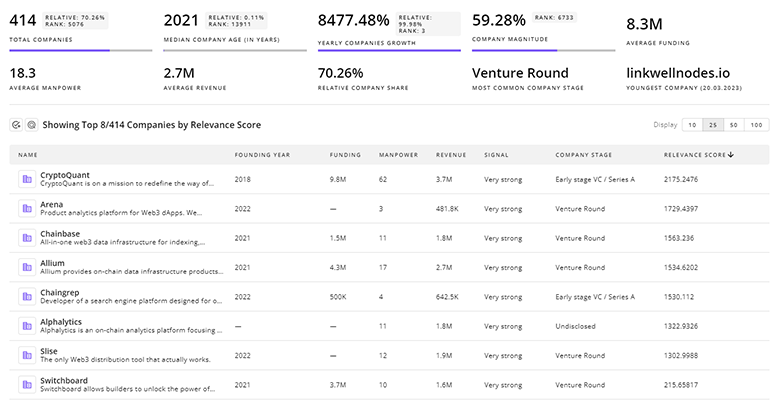
70.1K Entrepreneurship Companies
Discover Entrepreneurship Companies, their Funding, Manpower, Revenues, Stages, and much more
Entrepreneurship Investors
Get ahead with your investment strategy with insights into 16.4K Entrepreneurship investors. TrendFeedr’s investors tool is your go-to source for comprehensive analysis of investment activities and financial trends. The tool is tailored for navigating the investment world, offering insights for successful market positioning and partnerships within Entrepreneurship.
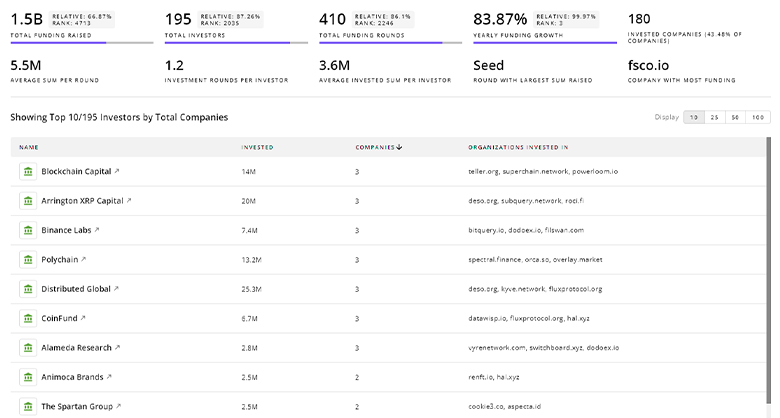
16.4K Entrepreneurship Investors
Discover Entrepreneurship Investors, Funding Rounds, Invested Amounts, and Funding Growth
Entrepreneurship News
TrendFeedr’s News feature offers access to 54.9K news articles on Entrepreneurship. The tool provides up-to-date news on trends, technologies, and companies, enabling effective trend and sentiment tracking.
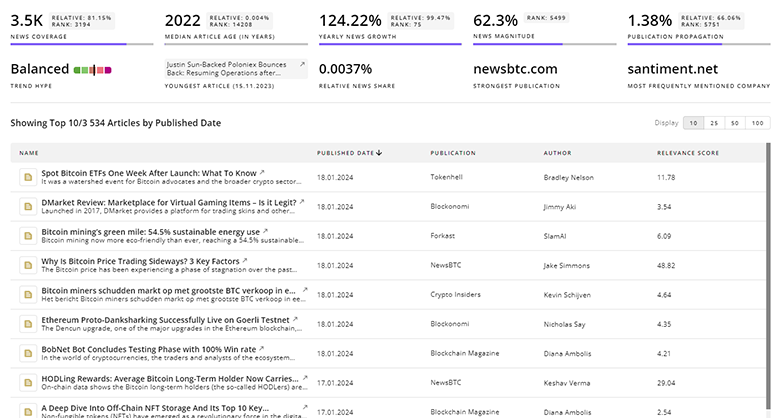
54.9K Entrepreneurship News Articles
Discover Latest Entrepreneurship Articles, News Magnitude, Publication Propagation, Yearly Growth, and Strongest Publications
Executive Summary
Successful strategies for the business community will emphasize measurable outcomes across the education-to-investment pipeline: prioritize tools that convert founder intent into validated readiness signals, scale coaching with AI while preserving targeted human mentorship, and build local communities that feed verified deal flow into capital channels. Investors should favor program models that tie disbursements to continuous performance data rather than static plans. Program operators should integrate assessment engines, simulation-based learning, and D2C/commercialization playbooks to improve survival and revenue metrics. Policymakers and regional funders should direct grants toward interventions that demonstrably increase survival and growth, rather than broad promotional activities, to generate higher returns in jobs and economic inclusion.
Have expertise in trends or technology? Your input can enrich our content — consider collaborating with us!