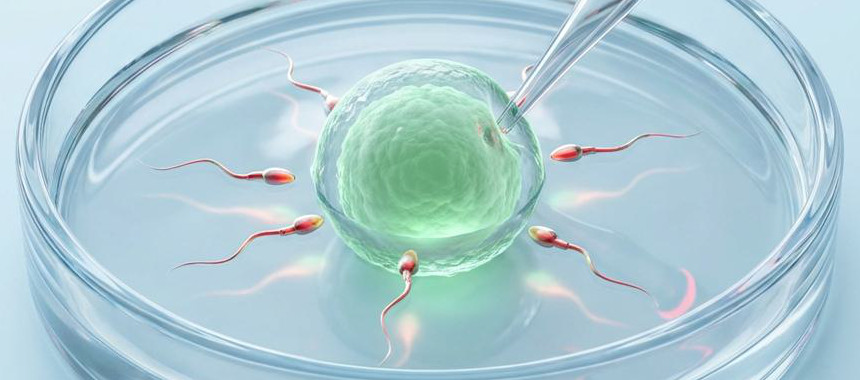
In Vitro Fertilization Report
: Analysis on the Market, Trends, and TechnologiesThe IVF market sits at a decisive inflection: current market analysis reports a market size of $20.2B with a 5.7% projected CAGR through 2032, signaling sustained commercial momentum around diagnostic-led, automation-enabled gains in cycle efficiency.
The last update of this report was 252 days ago. If you spot incomplete or incorrect info, please let us know.
Topic Dominance Index of In Vitro Fertilization
The Topic Dominance Index analyzes the time series distribution of published articles, founded companies, and global search data to identify the trajectory of In Vitro Fertilization relative to all known Trends and Technologies.
Key Activities and Applications
- Oocyte retrieval and maturation — clinics optimize stimulation protocols and investigate in vitro maturation to increase usable oocyte yield; improvements in media chemistry and handling target measurable uplifts in blastocyst formation.
- Embryo culture and selection — objective, biomarker and data-driven selection (time-lapse imaging + AI scoring + secretome/metabolomics) is replacing subjective grading to lift first-transfer pregnancy rates; these activities are central to company product roadmaps and clinic procurement choices In Vitro Fertilization Market - Future Market Insights.
- Cryopreservation and banking — vitrification and automated cryostorage are scaling as fertility preservation (elective and oncofertility) becomes standard service lines, creating recurring revenue from long-term storage and logistics.
- Genetic screening (PGT/PGS/niPGT) — preimplantation genetic testing integrates with embryo selection and banking to reduce miscarriage risk and accelerate viable live births per cycle; non-invasive testing of culture media is an active R&D and commercialization focus.
- Access & delivery innovation (clinic networks, decentralization, medical tourism) — large clinic networks scale volume and procurement efficiency while low-cost regional providers and emerging at-home or intravaginal incubation methods expand addressable demand and medical-tourism flows In-Vitro Fertilization Market Size, Share and Forecast 2034.
Emergent Trends and Core Insights
- AI-first embryo and oocyte assessment — artificial intelligence for single-image oocyte scoring and multi-modal embryo scoring is moving from pilot to routine clinical decision support; algorithms report high predictive performance and are becoming procurement priorities for labs In-Vitro Fertilization Industry Report 2025-2033.
- Shift to molecular and secretome biomarkers — non-morphological markers (secretome, miRNA, cfDNA from culture media) are gaining clinical validation as less invasive predictors of implantation potential, promising to reduce unnecessary cycles and improve per-cycle live birth rates.
- Microfluidics and robotics for process standardization — microfluidic sperm sorting, automated ICSI/ICSI-adjacent robotics, and cartridgeized disposables are lowering operator variability and labor cost per cycle, enabling higher throughput at networked clinics BAIBYS™ Fertility.
- Endometrial receptivity and transfer optimization — validated tools for Window of Implantation timing and semi-automated embryo transfer devices are emerging as high-leverage interventions because failed implantation after a successful fertilization remains a dominant cause of cycle failure Inti Labs.
- Commercial consolidation with tech licensing — clinic networks are pursuing M&A to internalize diagnostics or secure exclusive technology partnerships; technology vendors pursue licensing to become indispensable "ingredient" providers to high-volume platforms.
Technologies and Methodologies
- Time-lapse embryo imaging and morphokinetics — continuous monitoring enables morphokinetic feature extraction for ML models that outperform single-timepoint assessment; clinics pair these systems with AI scoring to standardize selection workflows.
- AI-based single-image oocyte scoring — non-invasive image analysis that predicts fertilization and blastocyst potential from a single microscope image reduces lab time and supports tailored stimulation strategies.
- Microfluidic sperm selection and low-volume handling — lab-scale chips and cartridges concentrate motile, DNA-intact sperm without centrifugation, lowering oxidative damage and improving ICSI inputs Fertilis.
- Advanced vitrification and automated cryostorage — ultra-rapid freezing protocols plus automated inventory & retrieval platforms support scaled fertility preservation services and cross-border cryo logistics.
- Semi-automated embryo transfer & optical-microfluidic catheters — devices that standardize placement reduce procedural operator variability and target improved implantation per transfer.
In Vitro Fertilization Funding
A total of 278 In Vitro Fertilization companies have received funding.
Overall, In Vitro Fertilization companies have raised $33.2B.
Companies within the In Vitro Fertilization domain have secured capital from 889 funding rounds.
The chart shows the funding trendline of In Vitro Fertilization companies over the last 5 years
In Vitro Fertilization Companies
- Carmel Diagnostics — Carmel Diagnostics develops a non-invasive embryo viability analyzer (Fertissimo TCL) that uses oxidative-stress biomarkers to stratify embryos and reported clinical trial signals of up to a 20% increase in successful pregnancies per tested cycle; the firm's pay-per-test model targets rapid clinic adoption with disposable consumables and low device price points.
- Future Fertility — Future Fertility commercializes AI tools (VIOLET™, MAGENTA™) that predict oocyte fertilization with ~90% accuracy from a single light-microscope image and are deployed in over 180 clinics
- Fertiga — Fertiga markets the Aurora Test, a cumulus-cell analysis intended to identify the highest-potential oocyte before fertilization, targeting a "first-transfer success" commercial value proposition and licensing opportunities with clinic networks.
- Manina Medtech — Manina Medtech develops Seedchrony, an endometrial receptivity device aimed at optimizing transfer timing; the company emphasizes measurable implantation improvements and positions its product for integration into transfer protocols used by mid-sized clinic groups.
- Ovelle — Ovelle pursues human in vitro oogenesis by directing iPSCs toward meiotic germline lineages; this is a high-risk biological innovation with the potential to reshape egg supply economics if scientific and regulatory hurdles are cleared, making Ovelle an attractive strategic target for platform players in the long term.
TrendFeedr’s Companies tool is an exhaustive resource for in-depth analysis of 2.1K In Vitro Fertilization companies.
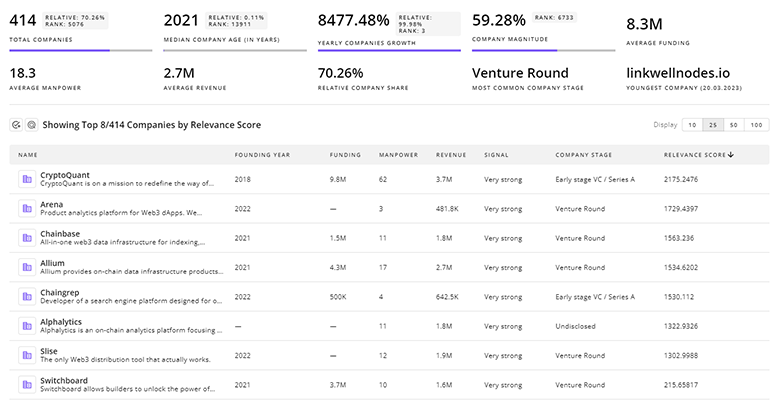
2.1K In Vitro Fertilization Companies
Discover In Vitro Fertilization Companies, their Funding, Manpower, Revenues, Stages, and much more
In Vitro Fertilization Investors
The TrendFeedr’s investors tool features data on 1.1K investors and funding activities within In Vitro Fertilization. This tool makes it easier to analyze complex investment patterns and assess market potential with thorough and up-to-date financial insights.
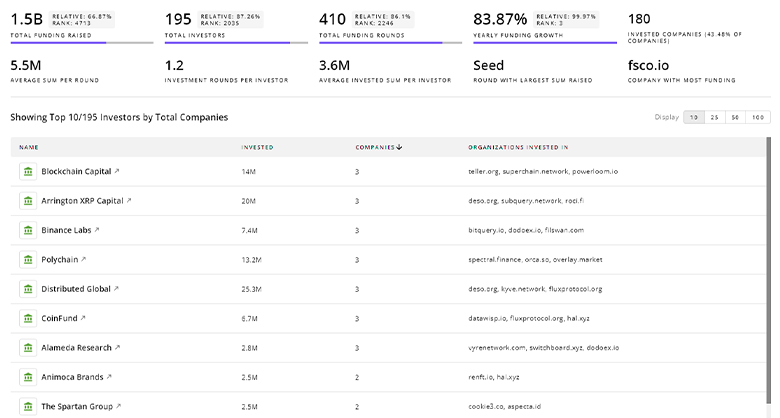
1.1K In Vitro Fertilization Investors
Discover In Vitro Fertilization Investors, Funding Rounds, Invested Amounts, and Funding Growth
In Vitro Fertilization News
Stay ahead of the curve with Trendfeedr’s News feature. The tool provides access to 2.8K In Vitro Fertilization. Navigate the current business landscape with historical and current In Vitro Fertilization data at your fingertips.

2.8K In Vitro Fertilization News Articles
Discover Latest In Vitro Fertilization Articles, News Magnitude, Publication Propagation, Yearly Growth, and Strongest Publications
Executive Summary
Investment and innovation in IVF concentrate on interventions that change the numerator of success: better selection, more reliable implantation, and lower cycle-to-cycle variability. Market forecasts and clinic behavior indicate that outcomes-driven diagnostics (AI, molecular biomarkers, endometrial timing) plus automation (microfluidics, robotics, semi-automated transfer) will define where clinical premium accrues. For investors and operator executives, the pragmatic near-term play is to partner with or license validated diagnostic modules that measurably increase first-transfer live birth probability while building operational pathways to deploy automation at scale. Long-term strategic hedges should include exposure to biological supply innovations that reduce dependence on donor eggs and on complex stimulation workflows.
If you’re an expert in trends or emerging tech, we invite you to contribute to our insights.