Iot Connectivity Report
: Analysis on the Market, Trends, and TechnologiesThe IoT connectivity landscape is entering a phase of strategic divergence: infrastructure-grade interconnects and platform-driven connectivity management now capture the largest portions of capital and technical effort, supported by $74.16B in aggregate sector funding. Wi-Fi remained the largest revenue contributor in 2024 with a 39.5% share, while cellular chipsets tied to 5G show rapid upside, projecting a 23% CAGR to 2030 Global Internet of Things (IoT) Connectivity Market Size, … – Data Bridge Market Research.
The last update of this report was 299 days ago. If you spot incomplete or incorrect info, please let us know.
Topic Dominance Index of Iot Connectivity
The Topic Dominance Index analyzes the time series distribution of published articles, founded companies, and global search data to identify the trajectory of Iot Connectivity relative to all known Trends and Technologies.
Key Activities and Applications
- Industrial IoT orchestration and asset monitoring — Enterprises deploy multi-protocol gateways and AI-enabled edge appliances to convert legacy equipment into managed assets for predictive maintenance and optimization; industrial connectivity market sizing highlights $14.96B in 2025 with an 8.6% CAGR to 2032.
- Managed global cellular connectivity — Operators and MVNE/MVNO platforms provide carrier-agnostic SIM orchestration, eSIM and multi-IMSI solutions to remove multi-country friction and lower roaming costs for large fleets.
- Vehicle data ecosystems and digital-twin services — Connected-car platforms integrate OEM telematics, OTA management and vehicle APIs to monetize lifecycle services and fleet operations; in-vehicle connectivity spending is forecasted to grow at ~19.2% CAGR in relevant segments.
- Resilient mesh and constrained-environment networks — Bluetooth Mesh and decentralized self-routing architectures target use cases where uplink is scarce (basements, tunnels, mines), improving local availability and lowering uplink costs.
- Remote patient monitoring and clinical interoperability — Medical device connectivity and cellular-enabled RPM devices are being adopted to support continuous care and reduce hospital readmissions; wireless medical connectivity is driving significant healthcare investment Medical Device Connectivity Market Size (GMI)
Emergent Trends and Core Insights
- Platform consolidation toward Connectivity-as-a-Service — Providers shift from selling airtime to delivering outcome-based connectivity, bundling lifecycle management, cost optimization and security into subscription models; managed connectivity benchmarking shows rising adoption of platforms that support multi-technology portfolios Frost Radar™: Internet of Things Managed Connectivity Platforms, 2023.
- 5G and private cellular for low-latency industrial workflows — Private 5G and 5G-enabled campus networks are prioritized in process industries where deterministic performance matters, pushing project economics toward denser deployments and higher CapEx intensity Top Trends in Enterprise Connectivity for 2025.
- Multi-radio device architectures become standard — Product designs increasingly embed Wi-Fi, Bluetooth and cellular radios to ensure coverage and application-level QoS; analysts report nearly 80% of connections in 2025 come from those three technologies combined Number of connected IoT devices growing 14% to 21.1 billion – IoT-Analytics.
- Application-aware connectivity management is emerging — Patent and product activity shows momentum toward solutions that allocate connectivity by application criticality and predicted session continuity, reducing outages in mobile environments (vehicles, remote assets).
- Regulatory and data-sovereignty pressure shapes architecture — Cross-border deployments now require connectivity topologies that respect data locality while maintaining seamless device management, increasing demand for distributed cloud and edge controls.
Technologies and Methodologies
- eSIM and multi-IMSI orchestration — Enables remote operator switching and cost-aware routing for global fleets; zero-touch provisioning reduces onsite intervention and simplifies rollouts.
- LPWAN variants (NB-IoT, LTE-M, LoRaWAN) — Continue to serve low-data, long-life sensors in utilities, agriculture and environmental monitoring where power and coverage dominate design tradeoffs.
- Edge compute + AI for connectivity optimization — Edge gateways with AutoML and telemetry analytics enable local decisioning and preemptive network switching to preserve application SLAs.
- Optical and terahertz interconnects for AI clusters — Chip-to-chip optical links and novel terahertz signaling address the bandwidth limitations of traditional electrical interconnects in hyperscale AI systems.
- Decentralized Bluetooth mesh and SON (self-organizing networks) — Self-healing topologies and local routing reduce dependence on continuous cloud connectivity in dense or subterranean deployments.
Iot Connectivity Funding
A total of 233 Iot Connectivity companies have received funding.
Overall, Iot Connectivity companies have raised $74.4B.
Companies within the Iot Connectivity domain have secured capital from 1.1K funding rounds.
The chart shows the funding trendline of Iot Connectivity companies over the last 5 years
Iot Connectivity Companies
- Bleedio Tech — Bleedio Tech develops the netMESH decentralized BLE mesh platform that runs without a central hub and offers "Network in Advance" provisioning to preconfigure thousands of devices remotely. The product targets logistics, smart buildings and underground installations where uplink is intermittent; the company reports deployment cost reductions and a small, agile team structure that favors rapid iteration.
- Cobira — Cobira provides an MVNE platform focused on global IoT/M2M resale, enabling partners to offer MVNO/MVNE services without owning core operator agreements. Their proposition reduces operational complexity for resellers and enterprises that require multi-country cellular coverage and billing controls.
- Conekt.ai — Conekt.ai offers a single-pane connectivity orchestration dashboard managing devices across hundreds of MNOs and major carriers; the platform emphasizes cost visibility, usage control and rapid troubleshooting for enterprise and automotive fleets, improving procurement and operational agility for device fleets.
- SmartConnect IoT — SmartConnect IoT ships the SmartBoitier edge appliance with no-code secure edge capture, protocol translation and streaming to cloud targets. The product shortens RFP response cycles and reduces integration time for system integrators and utilities pursuing Industry 4.0 projects.
- ALWAYS CONNECT AI — ALWAYS CONNECT AI develops real-time multi-orbit satellite traffic management and a Seamless Connectivity SDK to reduce latency and disconnection risk across LEO/MEO/GEO channels. Their stack targets satellite operators and service providers looking to stabilize service and control costs for mobility and remote infrastructure users.
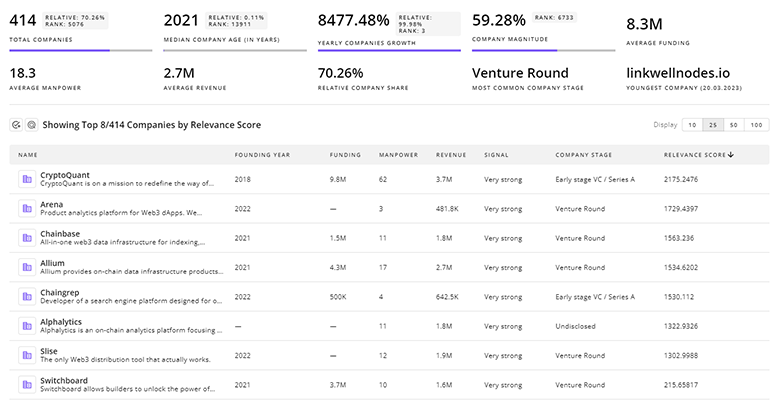
TrendFeedr’s Companies tool is an exhaustive resource for in-depth analysis of 1.4K Iot Connectivity companies.
1.4K Iot Connectivity Companies
Discover Iot Connectivity Companies, their Funding, Manpower, Revenues, Stages, and much more
Iot Connectivity Investors
The TrendFeedr’s investors tool features data on 1.2K investors and funding activities within Iot Connectivity. This tool makes it easier to analyze complex investment patterns and assess market potential with thorough and up-to-date financial insights.
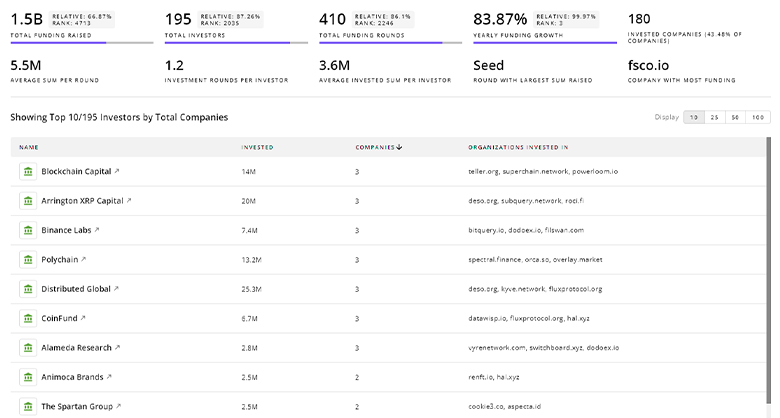
1.2K Iot Connectivity Investors
Discover Iot Connectivity Investors, Funding Rounds, Invested Amounts, and Funding Growth
Iot Connectivity News
Stay ahead of the curve with Trendfeedr’s News feature. The tool provides access to 4.9K Iot Connectivity. Navigate the current business landscape with historical and current Iot Connectivity data at your fingertips.
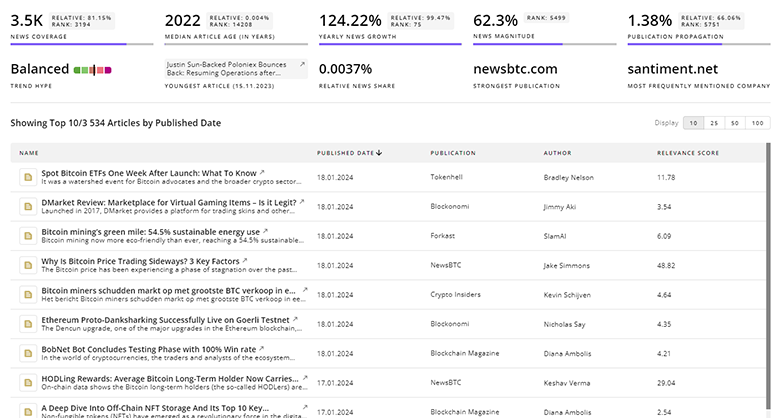
4.9K Iot Connectivity News Articles
Discover Latest Iot Connectivity Articles, News Magnitude, Publication Propagation, Yearly Growth, and Strongest Publications
Executive Summary
Market dynamics now reward players that move beyond connectivity as a commodity and instead deliver value through orchestration, application alignment and infrastructure performance. The capital environment and device growth figures signal large opportunity windows at both ends of the stack: deep-tech interconnect and platformized Connectivity-as-a-Service. Organizations that pair application-aware connectivity controls, strong edge processing, and clear regulatory/compliance wiring will secure the highest-margin contracts and avoid costly retrofit cycles.
If you’re an expert in trends or emerging tech, we invite you to contribute to our insights.