Lidar Report
: Analysis on the Market, Trends, and TechnologiesThe LIDAR market sits at an inflection where high growth and tightening unit economics collide: market size in 2024 is estimated at $1,300,000,000 with a projected CAGR of 23.9%, and a U.S. forecast of $2,350,000,000 by 2030 — figures that highlight both near-term commercialization and heavy dependence on cost reduction for scale. Market reports corroborate double-digit expansion across segments, with differing horizon estimates (mid-single to high-teens CAGRs) driven by automotive ADAS/autonomy, smart-city programs, and aerial/drone mapping.
Our latest update of this report was 66 days ago. If you found a mistake or missing information, tell us!
Topic Dominance Index of Lidar
The Topic Dominance Index evaluates Lidar's significance by analyzing data on the distribution of news articles that mention Lidar, the timeline of newly founded companies working in this sector, and global search trends
Key Activities and Applications
- Automotive perception & ADAS — integration of long-range and high-resolution sensors into vehicle safety stacks; priority activity for OEM qualification and automotive-grade manufacturing LiDAR Market 2025: Detailed Insights into Market Size and Future Growth.
- Drone/UAV mapping & corridor surveying — aerial LiDAR for topography, forestry, bathymetry and construction progress monitoring; modular, lightweight payloads expand commercial missions and reduce flight cycles LiDAR Service Market Research Report.
- Industrial automation & robotics — compact solid-state sensors and 3D perception engines for AGVs, AMRs and factory safety zones; emphasis on deterministic latency and low CPU footprint for embedded perception.
- High-precision terrestrial mapping & digital twin/BIM — mobile and static terrestrial laser scanning for as-built documentation, tunnel and bridge monitoring, and Scan-to-BIM workflows that shorten engineering cycles.
- Environmental monitoring & renewables — offshore and floating LIDAR for wind resource assessment, forest canopy and flood modeling; specialized platforms create bankable measurement products for investors EOLOS Floating Lidar Solutions.
- Emissions & niche sensing (gas detection) — quantum and spectroscopic LIDAR approaches for methane and greenhouse-gas monitoring; monetizable in regulatory and energy portfolios.
Emergent Trends and Core Insights
- Solid-state + FMCW acceleration — the industry is shifting from mechanical ToF toward solid-state MEMS/OPA and FMCW architectures that deliver range, velocity and interference resistance needed for automotive L3+ and industrial deployments.
- 4D sensing (range + instantaneous velocity) is becoming a key differentiator for moving-object handling in autonomy; vendors that embed velocity into point clouds reduce downstream compute demands and increase tracking quality Aeva.
- Price thresholds gate OEM adoption — unit cost compression to the low hundreds of dollars (or sub-$500 for certain sensor classes) is repeatedly cited as the enabler for ADAS volume fits; silicon photonics and VCSEL/SPAD advances are central to that trajectory LIDAR Market Size to Hit USD 15.83 Billion by 2034.
- Data-first differentiation — value is migrating from raw sensor hardware to perception and point-cloud analytics (semantic segmentation, change detection, asset scoring); companies offering low-CPU, certifiable stacks win recurring revenue pools.
- Regional manufacturing and supply concentration creates geopolitical supply risk; North America leads share while Asia-Pacific shows the fastest CAGR due to smart-city and infrastructure programs LiDAR Market Size, By Component (Laser Scanners, Navigation and Positioning Systems).
- Ecosystem breadth increases M&A optionality — >650 startups and >3,200 companies (patent pool ~75k) signal many niche plays that become acquisition targets for platform players looking to secure IP or vertical relationships Lidar Report 2024 – StartUs Insights.
Technologies and Methodologies
- FMCW (Frequency-Modulated Continuous Wave) LIDAR — provides simultaneous range and velocity with coherent detection, improving interference immunity and enabling 4D products; central in high-end automotive roadmaps.
- Silicon photonics & LiDAR-on-a-chip — integration of lasers, beam steering and detectors on wafer-scale platforms to lower unit cost and enable automotive qualification LightIC Technologies, Inc..
- MEMS, OPA and flash solid-state scanning — multiple approaches coexist: MEMS for high-resolution compact scanning, OPA for beam steering without moving parts, flash for snapshot imaging; choice depends on FOV, range and thermal/packaging constraints.
- SPAD arrays and single-photon detection — enable low-power long-range detection and airborne single-photon imaging; important for satellite/space and night/bathymetric missions.
- Edge AI + real-time sensor fusion — embedding perception at sensor level (hardware pre-fusion, low-latency segmentation) reduces bandwidth and supports safety-critical certifications required by automotive OEMs.
- Interference & crosstalk mitigation methods — coded pulses, spread-spectrum sequences and unique emission schemes to ensure multi-unit coexistence in dense deployments.
Lidar Funding
A total of 786 Lidar companies have received funding.
Overall, Lidar companies have raised $40.2B.
Companies within the Lidar domain have secured capital from 3.1K funding rounds.
The chart shows the funding trendline of Lidar companies over the last 5 years
Lidar Companies
- Opsys Technologies — Opsys commercializes fully addressable VCSEL emitter arrays paired with CMOS SPAD receivers to deliver mass-producible, pure solid-state scanning sensors marketed for automotive, smart city and industrial use; the company reports mass production and $272.10M raised to date, positioning it as a pragmatic low-cost solid-state supplier with platform customization options.
- Scantinel Photonics — Scantinel focuses on single-chip FMCW solutions, integrating coherent detection and photonics for automotive mobility; with venture backing and $19.25M reported funding, the firm targets integration into automated mobility stacks where velocity sensing and interference immunity matter.
- Makalu Optics — Makalu Optics develops long-range 4D LiDAR architectures (x,y,z,velocity) with an eye-safe 1550nm design and no moving parts; its product roadmap targets detection of low-reflectance targets at ~300m, addressing OEM range requirements with a compact mechanical profile and focused cost strategy.
- QLM Technology — QLM brings a distinct physics play with Quantum Gas Lidar for continuous greenhouse-gas monitoring and quantification; the company's specialization converts sensing into regulatory compliance and high-margin, contracted services for energy and industrial customers.
- Lidarvisor — Lidarvisor supplies a browser-based SaaS stack that automates classification, rasterization and vectorization for aerial point clouds; the firm attacks the data-workflow bottleneck, turning high-volume drone LiDAR output into fast, auditable deliverables for surveying teams and GIS customers.
Explore comprehensive profiles of 5.9K companies shaping the future of Lidar with TrendFeedr's Companies feature.
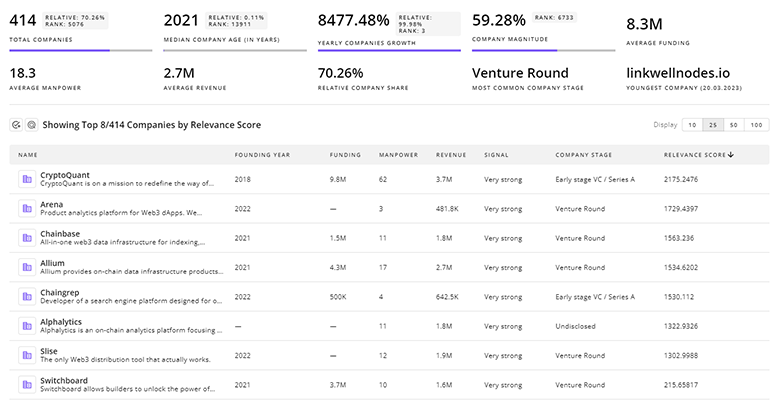
5.9K Lidar Companies
Discover Lidar Companies, their Funding, Manpower, Revenues, Stages, and much more
Lidar Investors
TrendFeedr’s Investors tool allows you to explore detailed investment activities and trends based on 3.6K Lidar investors. This tool provides an in-depth analysis of funding rounds and market dynamics to make informed investment decisions.
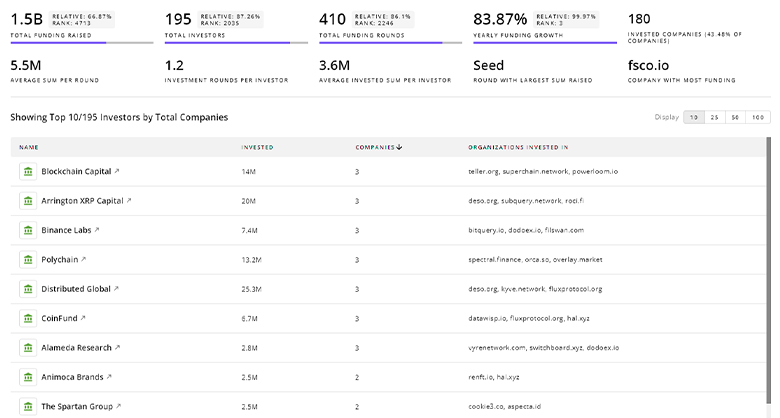
3.6K Lidar Investors
Discover Lidar Investors, Funding Rounds, Invested Amounts, and Funding Growth
Lidar News
Stay updated with TrendFeedr’s News feature, which offers you access to 32.2K Lidar articles. This tool provides you with a comprehensive understanding of the historical and current trends shaping the market.
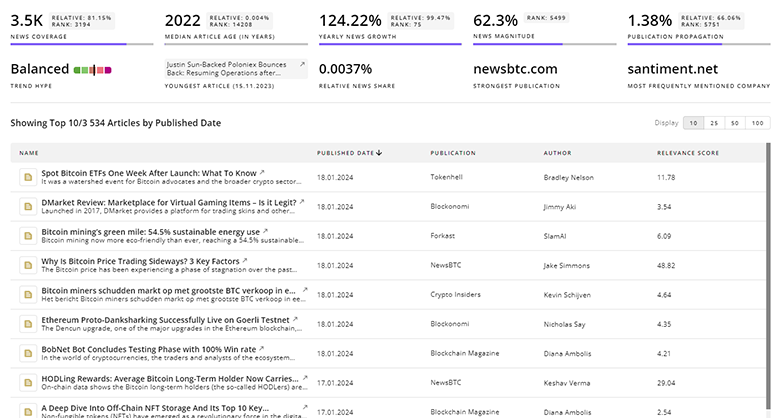
32.2K Lidar News Articles
Discover Latest Lidar Articles, News Magnitude, Publication Propagation, Yearly Growth, and Strongest Publications
Executive Summary
Adopters and investors must treat LIDAR as a two-dimensional market: one axis is hardware where silicon photonics and FMCW will drive long-term supply advantages; the other axis is software and perception where recurring revenue and certification bring durable value. Short-term winners will be those who combine a clear cost roadmap to reach OEM price thresholds with a defensible perception stack that reduces integration friction. For industrial buyers, the most attractive opportunities sit where LIDAR turns into a verifiable service (wind resource, emissions measurement, infrastructure inspection) that replaces expensive manual workflows. Decision makers should prioritize partnerships or acquisitions that secure either scalable chip-level manufacturing or low-latency, certifiable perception software, and build dual-sourced supply chains to mitigate concentration risk in Asia while preserving access to advanced photonics capacity.
We’re keen to partner with subject matter experts to enrich our coverage. Think you can help? Let us know.