Location Data Report
: Analysis on the Market, Trends, and TechnologiesThe location-data ecosystem has shifted from breadth to precision and context, with cumulative investor activity amounting to $21.20B in total funding across the topic — a clear signal that capital flows favor specialized, high-fidelity plays over generic POI aggregation. Market forecasts for analytics solutions show sustained expansion, with core segments growing at a ~14.3% CAGR in the coming decade, reinforcing that organizations must convert spatial signals into operational decisions to capture value.
Our latest update of this report was 77 days ago. If you found a mistake or missing information, tell us!
Topic Dominance Index of Location Data
The Topic Dominance Index evaluates Location Data's significance by analyzing data on the distribution of news articles that mention Location Data, the timeline of newly founded companies working in this sector, and global search trends
Key Activities and Applications
- High-precision asset tracking and operational validation — centimeter-level RTLS and 3D location feeds are used to instrument warehouses, factories, and critical infrastructure to reduce loss, validate processes, and automate compliance checks.
- Retail site selection, trade-area and footfall analytics — location streams and visit attribution inform catchment definitions, competitive leakage, and campaign attribution for store networks and landlords ChainXY.
- Urban mobility and infrastructure planning — anonymized movement matrices and origin-destination models support transport planning, digital twin simulations, and evacuation modelling for cities and large venues citi logik.
- Insurance and location-aware risk scoring — peril-level geocoding and parcel/POI enrichment feed exposure models used for underwriting and claims triage Insurdata.
- Privacy-first data marketplaces and provenance verification — decentralized and auditable exchanges supply aggregated mobility products while embedding consent and provenance as competitive differentiators.
Emergent Trends and Core Insights
- Precision becomes the primary differentiator: buyers pay for sub-meter or centimeter accuracy where operational ROI is measurable; generalized coverage loses value unless coupled with domain context.
- Semantic enrichment and predictive mobility — firms shift from storing coordinates to labelling places, dwell behaviour, and intent signals so models can forecast flows and recommend actions rather than only report history.
- Indoor/outdoor continuity and vertical stacking — seamless transition across GNSS, UWB, BLE and sensor fusion is now required for use cases that span the yard to the shelf to the high-rise rooftop.
- Privacy as product: provenance and anonymity are value levers — marketplaces and enterprise buyers increasingly demand verifiable consent, differential anonymization and auditable lineages when licensing movement data.
- Platform stratification: infrastructure versus vertical feature providers — a two-tier market is emerging where global infrastructure owners compete with focused engines that solve narrow, high-value problems (e.g. insurance geocoding, indoor logistics) UNL GLOBAL.
Technologies and Methodologies
- Ultra-Wideband (UWB) and multi-modal sensor fusion for sub-meter indoor positioning and reliable vertical (Z-axis) estimation where GNSS fails.
- Terrestrial GPS alternatives and GNSS augmentation (centimeter-class solutions) for sovereign or GNSS-challenged environments to guarantee positioning for defense and critical infrastructure LOCATA.
- 3D GeoHashing and lightweight spatial keys to index altitude-aware digital twins and accelerate multi-attribute spatial queries in real time 3D GeoHash-Based Geocoding Algorithm.
- Cloud-native geospatial DaaS and APIs that combine parcel, POI, mobility and remote sensing feeds for rapid integration into BI and decision systems Regrid.
- Privacy-preserving aggregation and provenance tooling (consent registries, differential privacy applied to spatio-temporal streams) to provide usable insights while reducing re-identification risk.
- AI/ML mobility engines and semantic POI inference that convert raw trajectories into labelled journeys, habitual POIs, and demand forecasts for retail, logistics, and urban planning.
Location Data Funding
A total of 257 Location Data companies have received funding.
Overall, Location Data companies have raised $20.8B.
Companies within the Location Data domain have secured capital from 1.0K funding rounds.
The chart shows the funding trendline of Location Data companies over the last 5 years
Location Data Companies
- LoconIQ — LoconIQ provides real-time 3D tracking with sensor intelligence aimed at creating continuous operational truth for assets and workflows; its approach pairs centimeter-level localization with environmental sensors to enable traceability and process validation in logistics and regulated industries.
- Fysical Technologies — Fysical Technologies operates a decentralized location-data exchange that prioritizes consumer privacy and provenance; the platform aggregates billions of monthly points while exposing consent and lineage metadata to buyers, positioning privacy as a commercial asset.
- UrbanDataLab AG — UrbanDataLab AG packages AI-driven location analytics (revenue prediction, site scoring) for property and retail decision-makers; by integrating diverse geodata and predictive models it translates mobility signals into monetizable site insights for planners and investors.
- Breadcrumb Data Limited — Breadcrumb Data Limited focuses on live indoor location to improve operational performance in venues and workplaces; its toolkit helps operations teams extract measurable workflow improvements from indoor movement data while keeping deployment lightweight.
Explore comprehensive profiles of 1.5K companies shaping the future of Location Data with TrendFeedr's Companies feature.
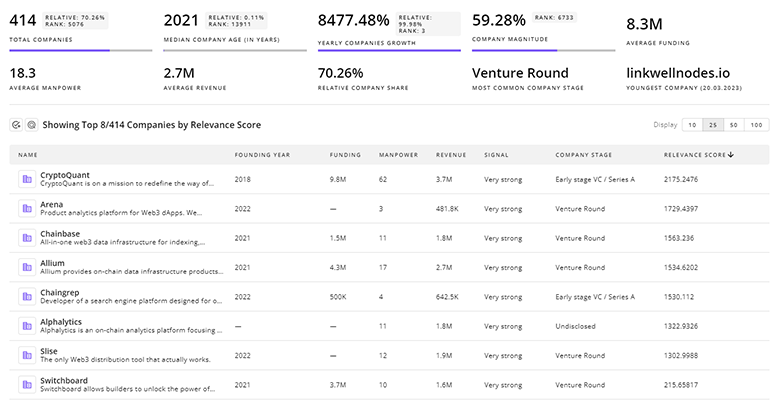
1.5K Location Data Companies
Discover Location Data Companies, their Funding, Manpower, Revenues, Stages, and much more
Location Data Investors
TrendFeedr’s Investors tool allows you to explore detailed investment activities and trends based on 1.2K Location Data investors. This tool provides an in-depth analysis of funding rounds and market dynamics to make informed investment decisions.
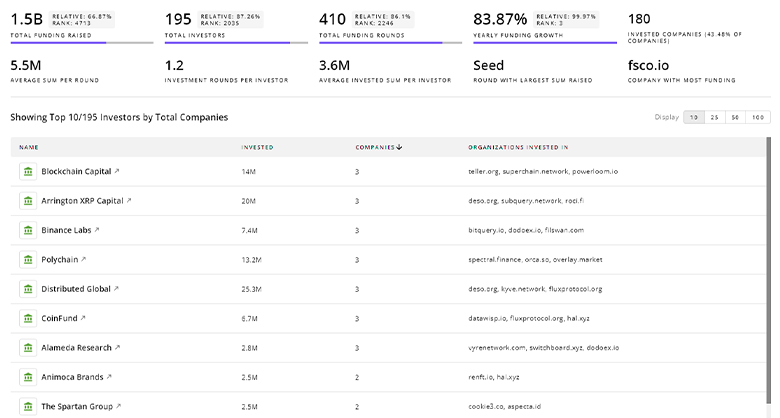
1.2K Location Data Investors
Discover Location Data Investors, Funding Rounds, Invested Amounts, and Funding Growth
Location Data News
Stay updated with TrendFeedr’s News feature, which offers you access to 11.0K Location Data articles. This tool provides you with a comprehensive understanding of the historical and current trends shaping the market.
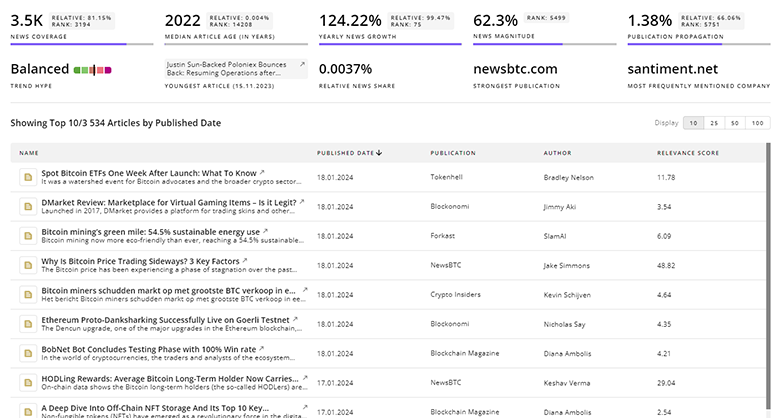
11.0K Location Data News Articles
Discover Latest Location Data Articles, News Magnitude, Publication Propagation, Yearly Growth, and Strongest Publications
Executive Summary
Location data no longer competes on coverage alone; it competes on accuracy, context, and trustworthy provenance. Companies that can deliver verified, privacy-aware feeds with verticalized analytic models will capture the highest margins: think insurance geocoding, industrial RTLS, parcel-level risk scoring and urban mobility engines. For buyers, the priority is practical: select providers whose measurement precision and semantic labelling align with the decision being automated, and insist on auditable privacy controls as part of commercial terms. For investors and strategists, the highest-return opportunities lie in technologies and platforms that turn spatial signals into deterministic business outcomes — not broader, untethered maps.
We’re keen to partner with subject matter experts to enrich our coverage. Think you can help? Let us know.