Metal 3D Printing Report
: Analysis on the Market, Trends, and TechnologiesThe metal 3D printing market is accelerating from specialized prototyping toward qualified industrial production, driven by rapid technology diversification and concentrated material innovation: market analysis records US $459,250,000 in 2023 and a projected market of US $3,428,380,000 by 2029 with a reported 39.8% CAGR. Growth concentrates where throughput, feedstock control, and digital process assurance converge, shifting economic value to firms that own either the material ingredient or the production outcome (autonomous factory + QA) rather than to commoditized job shops Wevolver – Metal 3D Printing Technology Report.
We last updated this report 257 days ago. Tell us if you find something’s not quite right!
Topic Dominance Index of Metal 3D Printing
To gauge the impact of Metal 3D Printing, the Topic Dominance Index integrates time series data from three key sources: published articles, number of newly founded startups in the sector, and global search popularity.
Key Activities and Applications
- Aerospace component production — qualification of lightweight structural parts, engine brackets, and conformal cooling features where repeatable material properties justify premium pricing MarketsandMarkets - 3D Printing Metals Market.
- Medical implants and patient-specific devices — titanium and titanium-alloy additive flows for implants, driven by biocompatibility and customized porous structures for osseointegration.
- Tooling and hardened molds — on-demand production of tool steels and conformal-cooled inserts that compress lead times for tooling programs and reduce buy-to-fly ratios Mantle.
- Large-format structural parts and repairs — DED/WAAM/EBAM used for ship, energy, and engine liners where size and rapid deposition beat PBF economics FAMAERO.
- On-site spare parts for heavy industry and defense — field-deployable printing reduces downtime for critical assets and shortens logistics chains, with real examples of days-rather-than-weeks repair cycles Forbes - The Scale-Up Of Defense 3D Printing.
- High-throughput contract production (binder jetting / area printing) — service fabs and scale players pursue sub-$25/kg finished-part targets by removing laser step bottlenecks.
Emergent Trends and Core Insights
- Process integration becomes the economic gate — firms that couple printing, automated post-processing, and closed-loop quality data capture convert AM from a design tool into a predictable production route, making digital traceability a commercial differentiator Freeform.
- Shift away from pure PBF economics — alternative deposition methods (cold spray, wire feed, blown-powder DED, binder jetting) are scaling for cost and speed, creating distinct value pools for large parts and volume tooling MarketResearchFuture - 3D Printing Metal Market.
- Material feedstock control as a moat — companies that supply qualified powders, wires, or engineered alloys (including MMCs) enable certification pathways and reduce variability, forcing OEMs to prefer upstream-locked suppliers for mission-critical production ELEMENTUM 3D.
- Binder jetting and area/parallel printing unlock cost curves — forecasts highlight binder jetting and high-throughput area printing as primary levers to reach mass-production unit economics in the next five years Seurat Technologies.
- Sustainability and ESG metrics influence procurement — manufacturers evaluate energy per kilogram and powder recyclability; firms marketing lower emissions and recyclable feedstock gain RFP preference.
- Micro-precision and new process families open niche moats — micro-metal printing and lithography-based metal methods establish defensible positions in sensors, probes, and precision microcomponents Incus GmbH.
Technologies and Methodologies
- Powder Bed Fusion (PBF / LPBF / SLM) — remains dominant for certified aerospace/medical parts where fine features and material qualification matter, but faces throughput and powder cost pressure Future Market Insights - 3D Printing Metal Market.
- Binder Jetting — maturing fast for volume metal parts when paired with sintering and densification steps; favorable for cost per part and multi-nozzle parallelization MarketDataForecast - Global 3D Printing Metals Market.
- Directed Energy Deposition (DED) & Blown-Powder DED — enables very large parts, repairs, and material mixing; producers report 3x or more productivity advantages for large components vs PBF DM3D.
- Wire Arc Additive Manufacturing (WAAM / WAM®) — uses wire feedstock to cut material cost and environmental footprint for large structural pieces, with near-net shapes and limited need for powder handling AML3D.
- Cold spray / Cold fusion processes — deposit metal without melting, reducing thermal distortion and enabling alloy systems otherwise challenging for laser melting SPEE3D.
- Hydrogel / liquid templating and low-temperature chemical routes — emerging lab→industry pathways that could dramatically lower energy per part and expand printable metals beyond powder constraints.
- Hybrid additive-subtractive production cells — integrate in-line machining, heat treatment, and NDT to meet serial tolerances in one production cell IDTechEx - Metal 3D Printing: Domestic and Global Trends.
- AI / closed-loop process control and simulation — crucial for minimizing scrap and enabling first-pass acceptance in regulated sectors; software and sensor stacks become differentiators for factory-scale adoption AdditiveLab.
Metal 3D Printing Funding
A total of 233 Metal 3D Printing companies have received funding.
Overall, Metal 3D Printing companies have raised $16.8B.
Companies within the Metal 3D Printing domain have secured capital from 968 funding rounds.
The chart shows the funding trendline of Metal 3D Printing companies over the last 5 years
Metal 3D Printing Companies
- METALPINE — Specializes in high-quality, highly spherical metal powders produced via wire-based gas atomization to reduce porosity and improve recyclability for industrial metal AM. The company targets titanium, copper, tool steels, stainless steels, and nickel alloys and positions feedstock quality as the primary lever for process repeatability in PBF and binder-jet systems.
- 3D in Metal — Operates as a digital foundry and integrated service provider focused on large-format, fast deposition technologies using powder, rod, and wire feedstocks. The firm packages equipment, software, and contract manufacturing to serve industrial clients seeking scale for large parts and repairs, bridging the gap between bespoke service bureaus and in-house production.
- Exaddon — Develops micro-scale metal printing systems for wafer probing and micro-mechanical components, delivering sub-micrometer features that remove the compromise between fine resolution and metal performance. This niche capability suits semiconductor testing and precision sensor markets where PBF cannot compete on scale or precision.
- ValCUN — Builds molten metal deposition machines optimized for aluminum additive production using welding wire as feedstock to cut feedstock cost and enable deployable systems. The approach targets aerospace and automotive structural parts where recycled wire and high deposition rates materially change unit economics for medium volumes.
- Foundry Lab — Commercializes digital metal casting that produces production-quality cast metal parts in hours by combining printed molds with accelerated thermal processing; the method presents a practical alternative to slow PBF for mid-volume metal components and tooling while reducing energy and lead time.
Enhance your understanding of market leadership and innovation patterns in your business domain.
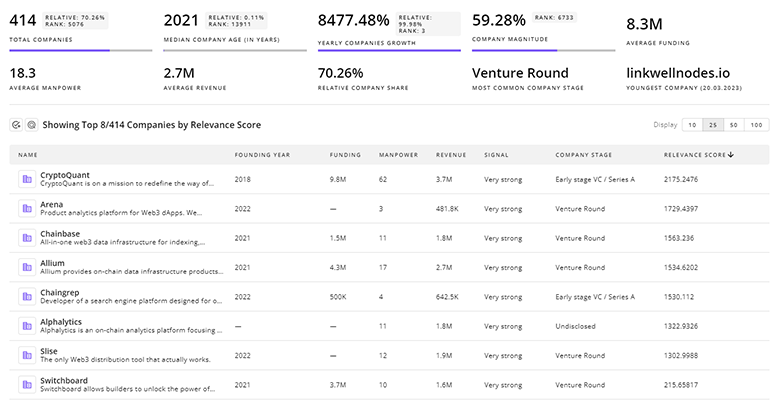
2.0K Metal 3D Printing Companies
Discover Metal 3D Printing Companies, their Funding, Manpower, Revenues, Stages, and much more
Metal 3D Printing Investors
TrendFeedr’s Investors tool offers comprehensive insights into 1.1K Metal 3D Printing investors by examining funding patterns and investment trends. This enables you to strategize effectively and identify opportunities in the Metal 3D Printing sector.
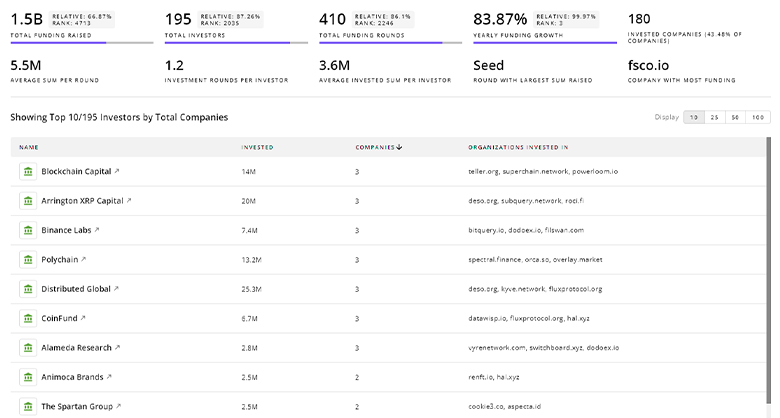
1.1K Metal 3D Printing Investors
Discover Metal 3D Printing Investors, Funding Rounds, Invested Amounts, and Funding Growth
Metal 3D Printing News
TrendFeedr’s News feature provides access to 8.2K Metal 3D Printing articles. This extensive database covers both historical and recent developments, enabling innovators and leaders to stay informed.
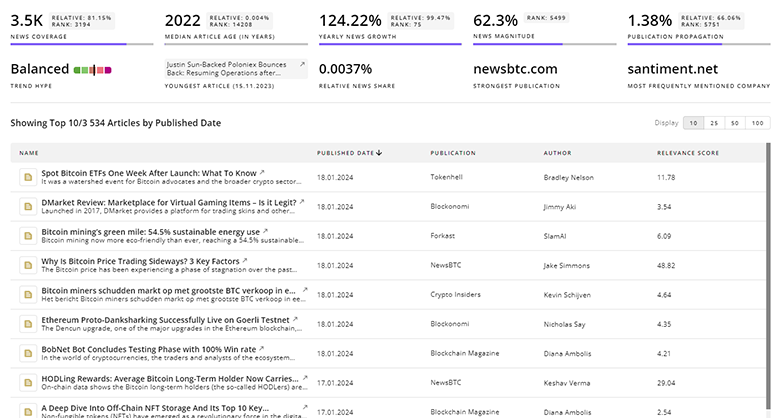
8.2K Metal 3D Printing News Articles
Discover Latest Metal 3D Printing Articles, News Magnitude, Publication Propagation, Yearly Growth, and Strongest Publications
Executive Summary
Metal 3D printing has moved into a phase where process economics and material qualification determine winners. The sector will not be decided by incremental laser performance alone but by which companies secure the feedstock-to-finished-part workflow: qualified alloys, high-throughput non-PBF deposition, automated post-processing, and digital traceability. For manufacturers and investors, three practical priorities emerge: invest in materials and feedstock control to shorten qualification cycles; adopt or partner for high-throughput processes (binder jetting, DED, wire methods) where volume or size matters; and require demonstrable closed-loop quality data as a procurement condition so that AM replaces, rather than supplements, legacy supply chains.
We value collaboration with industry professionals to offer even better insights. Interested in contributing? Get in touch!