
Optical Communications Report
: Analysis on the Market, Trends, and TechnologiesThe optical communications market is at a clear inflection where capacity scaling and system-level integration govern commercial success: the market registered $12,500,000,000 in 2023. Rapid demand from AI clusters is driving short-reach and pluggable optics growth (Ethernet transceiver sales projected to rise 40% in 2024) while free-space and satellite optical links expand high-value adjacencies (North America FSO forecast CAGR 27.8% to 2032) Optical Communications Market Snapshot, Q2 2024. These forces prioritize silicon photonics, coherent optics, and line-of-sight optical wireless as the three commercial vectors that will determine winners across data centers, carriers, and space/defense supply chains.
The last time we updated this report was 282 days ago. If there’s something missing or off, your tips are welcome!
Topic Dominance Index of Optical Communications
The Dominance Index for Optical Communications merges timelines of published articles, newly founded companies, and global search data to provide a comprehensive perspective into the topic.
Key Activities and Applications
- High-density data-center interconnects (400G/800G and beyond) — Development and deployment of pluggable and co-packaged optics to support AI/ML fabrics, driven by volume purchases of 400G/800G modules and ongoing lane-rate advances.
- Free-space optical (FSO) links for terrestrial and space use — Rapid pilots and volume designs for ground-to-satellite, inter-satellite, and last-mile backhaul where fiber is unavailable; FSO pilots emphasize adaptive tracking and turbulence mitigation to meet reliability targets.
- Optical transport and DWDM/OTN modernization — Upgrades to dense WDM, ROADMs and coherent line systems to carry ever larger trunk volumes; OTN markets are sizable (OTN market ~$19.42B in 2024) and central to carrier and wholesale strategies.
- Access upgrades and FTTH/PON evolution — Continued FTTH and PON rollouts extend fiber deeper into the local loop; cost-effective PON variants and passive approaches reduce OPEX for operators Optical Networking and Communications Market (2025).
- Optical interconnects inside compute systems — Development of chip-to-chip and board-level photonic interconnects to remove electrical bottlenecks in AI servers and HPC racks; vendors target low power per bit and plug-compatible form factors.
- Security-sensitive, short-latency links (defense, finance, government) — Layer-1 encryption, low-signature FSO, and hardened fiber solutions for mission critical networks Optical Transport and Ground Terminals growth signals.
Emergent Trends and Core Insights
- AI workloads convert optics from cost center to strategic asset. The throughput and latency constraints of clustered accelerator fabrics make optical interconnect architecture a primary determinant of system performance; this is accelerating investment in co-packaged optics and high-density optical engines April 2024 Market Forecast.
- Coherent technology is moving down-market. Coherent detection, once restricted to long haul, now appears in metro and DCI pluggables (ZR/ZR+), expanding the addressable market for coherent DSPs and DCO modules Optical Networking And Communications Market Size & Forecast.
- FSO and optical satellite communications industrialize in parallel. Market forecasts show strong CAGR for FSO and OSC segments (FSO North America CAGR 27.8%2032), creating supplier demand for compact terminals, PAT systems, and ground-station networks North America Free Space Optical Communication Market Optical Satellite Communication Market Size, Share.
- Supply-chain and geopolitical visibility drive sourcing strategies. Manufacturing concentration in Asia plus critical laser and PIC component sourcing force operators to build dual supply paths or on-shore capabilities for defense and national infrastructure Optical Networking and Communications Market report.
- Packaging and coupling are the hidden multiplier. Wafer-level coupling and automated alignment lower per-unit cost for silicon photonics at scale; companies solving high-volume passive coupling capture value across multiple platform players.
- Network automation and SDN bring optical resources into service orchestration. SDN/automation applied to ROADMs, OTN and optical switches reduces service lead times and softens integration risk for multi-vendor fabrics.
Technologies and Methodologies
- Silicon Photonics (SiPh) and Photonic Integrated Circuits (PICs) — Central to cost and power improvements for high-density transceivers and co-packaged optics; foundry and packaging readiness determine time-to-scale Optical Fiber / PIC foundry.
- Coherent DSPs and High-order Modulation (PAM4, QAM variants) — DSP evolution increases spectral efficiency across DCI and metro segments; PAM4 accounts for an expanding share of optical chipsets and supports higher per-lane rates PAM4 DSP chipset projections.
- All-optical switching and optical circuit switching (OCS) — MEMS and low-loss matrix switches enable sub-microsecond reconfiguration and optical virtualization for cloud fabrics; OCS is already shipping at scale for specialized low-latency applications Calient.AI.
- Adaptive optics and AI for FSO/PAT — Real-time atmospheric estimation, ML-driven correction, and chip-scale beam steering improve link availability and enable commercial FSO deployments in urban and space links Aircision.
- High-precision wafer-level optical coupling and automated packaging — Passive, collective wafer coupling and self-aligning couplers reduce assembly cost and increase yield for PICs and SiPh devices.
- Layer-1 optical encryption and quantum key distribution (QKD) integration — Emergent requirement for secure transport in defense and financial verticals; demonstrations of QKD over DWDM indicate commercial integration paths PacketLight.
Optical Communications Funding
A total of 310 Optical Communications companies have received funding.
Overall, Optical Communications companies have raised $29.6B.
Companies within the Optical Communications domain have secured capital from 1.3K funding rounds.
The chart shows the funding trendline of Optical Communications companies over the last 5 years
Optical Communications Companies
- Nubis Communications — Nubis develops a high-density optical engine (XT1600) delivering 1.6 Tbps per engine optimized for direct-drive operation into ASIC SerDes, a design choice that reduces latency and removes power-hungry retiming stages; the approach targets AI datacenter interconnects where density and power per bit determine TCO, and recent acquisition interest validates the architecture.
- ICON Photonics — ICON Photonics supplies 3D wafer-level optical coupling and passive beam-shaping that materially lowers fiber-to-chip loss; their packaging capability is a bottleneck solver for PIC makers and a leverage point for volume SiPh adoption across data-center and FSO products.
- Teramount — Teramount commercializes a patented Universal Photonic Coupler that uses standard semiconductor packaging flows to connect many fibers to silicon photonics without active alignment; the product directly addresses a primary manufacturing barrier for co-packaged optics and offers a path to scale for fabless SiPh players.
- Transcelestial — Transcelestial produces compact laser-based building-to-building and cell-edge devices (CENTAURI) that deliver fibre-like 1 Gbps and 10 Gbps duplex links without civil works; their mass-production focus and ground trials position them as a practical alternative for rapid last-mile and campus deployments.
- Modular Photonics — Modular Photonics offers passive, plug-and-play components that emulate single-mode performance on multimode LANs, enabling operators to upgrade to 40G (and beyond) without recabling; this product targets the large installed base of multimode fiber in enterprises and significantly reduces upgrade capital requirements.
Delve into the corporate landscape of Optical Communications with TrendFeedr’s Companies tool
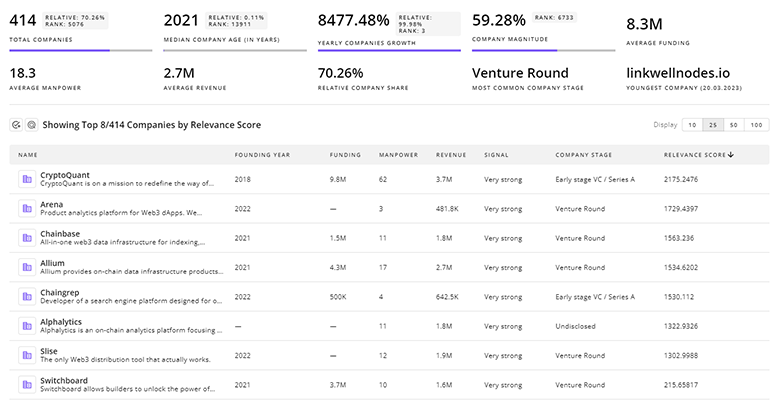
2.1K Optical Communications Companies
Discover Optical Communications Companies, their Funding, Manpower, Revenues, Stages, and much more
Optical Communications Investors
TrendFeedr’s Investors tool provides insights into 1.6K Optical Communications investors for you to keep ahead of the curve. This resource is critical for analyzing investment activities, funding trends, and market potential within the Optical Communications industry.
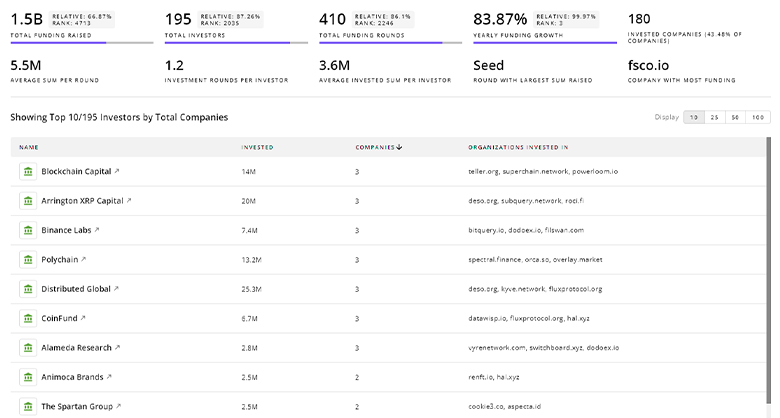
1.6K Optical Communications Investors
Discover Optical Communications Investors, Funding Rounds, Invested Amounts, and Funding Growth
Optical Communications News
TrendFeedr’s News feature offers you access to 3.4K articles on Optical Communications. Stay informed about the latest trends, technologies, and market shifts to enhance your strategic planning and decision-making.
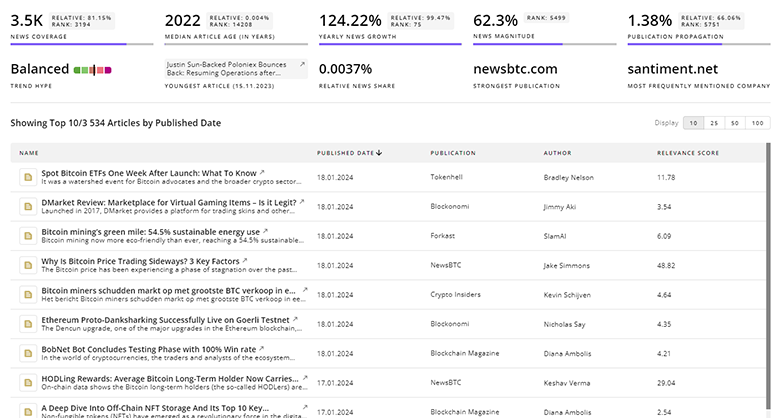
3.4K Optical Communications News Articles
Discover Latest Optical Communications Articles, News Magnitude, Publication Propagation, Yearly Growth, and Strongest Publications
Executive Summary
Optical communications now sits at the intersection of compute architecture and network economics. Where capacity and latency requirements align with AI and hyperscale needs, silicon photonics, coherent pluggables, and advanced packaging capture the largest share of strategic value. Parallel opportunities in free-space and satellite optical links create new verticals for high-value terminals and ground infrastructure. For incumbents, the imperative is clear: secure packaging and coupling IP, integrate optics with control-plane automation, and de-risk component sourcing. For investors and operators, the practical playbook combines targeted bets on wafer-level coupling and coherent engine startups with procurement strategies that balance near-term transceiver volume needs against longer-term co-packaged investments.
Are you an insider in the trends or tech industry? We’d love for you to contribute to our content.