
Optical Semiconductor Report
: Analysis on the Market, Trends, and TechnologiesThe optical semiconductor sector stands at an inflection where capital, patents and platform engineering are converging to force a structural reallocation of value: total industry funding of $19.63B and 19,886 patents underpin an expansion that coincides with external market forecasts projecting growth from $64.68B (2025) to $112.02B (2030) at a 11.7% CAGR Opto Semiconductors Market Report 2026-2030 & 2035 – Yahoo Finance. The strategic implication is clear: firms that own integrated silicon photonics stacks (light source + SiPh + packaging) and foundry-access will capture disproportionate margin uplift, while traditional discrete transceiver suppliers face increasing margin pressure Opto Semiconductor Market Size, Share & Analysis Report, 2034 – GMI Insights.
The last time we updated this report was 12 days ago. If there’s something missing or off, your tips are welcome!
Topic Dominance Index of Optical Semiconductor
The Dominance Index for Optical Semiconductor merges timelines of published articles, newly founded companies, and global search data to provide a comprehensive perspective into the topic.
Key Activities and Applications
Overview
These activities are the operational heart of the industry; each item below links a technical capability to a near-term commercial use case and cites the data source immediately.
- Data-center optical interconnects and co-packaged optics (CPO) — Development and deployment of silicon photonics platforms and integrated laser sources to meet AI/datacenter I/O density requirements; modular migration from pluggable 400G/800G transceivers toward co-packaged and O-band integrated solutions.
- Automotive sensing and LiDAR — Integration of VCSEL and PCSEL arrays, and solid-state beam-steering chips, to reduce size, increase reliability and lower cost for ADAS and robotic perception.
- High-power laser diodes and industrial processing — GaN/InGaN high-power emitters for material processing and industrial automation where thermal design and epitaxial control determine product reliability.
- Medical imaging and diagnostics — Compact SLEDs, VCSEL arrays and integrated photonic spectrometers used in OCT, point-of-care photonic biosensors and non-invasive monitoring.
- Optical switching and network fabrics — Deployment of low-latency Optical Circuit Switches (OCS) for AI clusters and reconfigurable data fabrics that reduce electrical conversion overhead.
Emergent Trends and Core Insights
- Platform consolidation around silicon photonics. Large pools of capital and patents are funneling toward companies that integrate lasers and amplifiers on silicon, shifting value from module assembly to chip-level IP and foundry access
- Material heterogeneity is strategic. Heterogeneous integration of III-V materials (GaAs, InP) and emerging oxides onto silicon substrates is a dominant R&D path to reconcile silicon manufacturability with high quantum efficiency; patent activity shows Japanese and Asian leadership in process refinements and quantum-well architectures.
- Thermal and packaging engineering defines winners. As integration density rises, thermal conduction and advanced photonic packaging (wafer-level fan-out, co-packaged thermal solutions) determine real-world performance and reliability.
- Optical switching as a systemic lever. Companies commercializing low-latency OCS present an alternate path to performance gains by rearchitecting data-center fabrics rather than only increasing per-link bandwidth.
- Niche laser architectures gain traction. Photonic Crystal Surface Emitting Lasers (PCSELs) and quantum-dot multi-wavelength sources offer power and wavelength scalability that directly attack the power-per-bit problem for Tb/s class interconnects
Technologies and Methodologies
- Silicon photonics (SiPh) with integrated lasers — Heterogeneous bonding and wafer-scale processes that place light sources, modulators and detectors onto silicon to lower power-per-bit and enable wafer-scale economics.
- Photonic Crystal Surface Emitting Lasers (PCSEL) — Surface-emitting lasers combining high power, narrow linewidth and easy top-side packaging for PCB and module integration
- VCSEL and PCSEL arrays for LiDAR and sensing — Wafer-scale array manufacturing and semi-polar GaN epitaxy improve performance for TOF and imaging applications.
- Advanced epitaxy and substrate engineering — Proprietary MOCVD/MBE processes, semi-polar GaN surfaces and oxide pseudo-substrates to enable new material stacks on CMOS wafers La Luce Cristallina Launches CMOS-Compatible Oxide Pseudo-Substrate.
- Non-volatile photonic switching and PCMs — Phase change materials and MEMS approaches deliver low-power, stateful optical switching useful for reconfigurable photonic circuits.
- Advanced photonic packaging and Universal Couplers — Solutions that remove active alignment and connect high-fiber counts to SiPh die using standard OSAT flows are essential to scale co-packaged and wafer-scale optics
Optical Semiconductor Funding
A total of 433 Optical Semiconductor companies have received funding.
Overall, Optical Semiconductor companies have raised $19.6B.
Companies within the Optical Semiconductor domain have secured capital from 1.5K funding rounds.
The chart shows the funding trendline of Optical Semiconductor companies over the last 5 years
Optical Semiconductor Companies
- Skorpios Technologies — Skorpios operates a wafer-scale silicon photonics platform (Tru-SiPh™) targeting Ethernet pluggables, co-packaged optics and LiDAR. The company combines proprietary silicon foundry processes with active-gain materials and targets direct integration of tunable lasers and coherent transceivers. Its strategy centers on providing a manufacturable photonics platform that reduces integration friction for OEMs. Skorpios has raised $109.92M and maintains in-house wafer capabilities that position it as a platform supplier rather than a component assembler
- Quintessent Inc. — Quintessent develops O-band quantum dot lasers and silicon photonic integrated circuits to place optical connectivity physically closer to compute elements, addressing the communication bottleneck in large AI systems. The company couples novel quantum-dot light sources with SiPh architectures to lower power-per-bit for intra-rack and intra-node links. With $47.28M in funding and a compact team, Quintessent focuses on integration and architecture co-design for hyperscaler workloads
- Vector Photonics — Vector Photonics commercializes PCSEL technology that targets datacenter optics and high-speed sensing with a device class that combines the packaging ease of VCSELs and the power of edge-emitters. The company's small team pursues wafer-scale PCSEL arrays that can directly feed silicon photonics and reduce module count for high-density applications. Their emphasis on manufacturability and supply-chain compatibility makes Vector Photonics a strategic supplier for platform integrators
- SCINTIL Photonics — SCINTIL is a fabless silicon photonics innovator with an integrated-laser approach (SHIP™) aimed at AI datacenter interconnects; the company markets dense multi-wavelength laser sources and SiPh PICs designed for low latency and power efficiency. Its capital base ($140.62M raised) and focus on heterogeneous integration position SCINTIL to supply dense laser arrays and coherent building blocks to hyperscalers and switch vendors
- Teramount — Teramount supplies packaging enablers (Universal Photonic Coupler) that aim to remove active alignment constraints in SiPh assembly and enable standard semiconductor packaging flows for photonics. By making high-fiber-count coupling compatible with OSAT processes, Teramount addresses a practical bottleneck that otherwise slows CPO and wafer-scale optical adoption. Its IP and process-level focus make it a quiet but essential partner for large SiPh adopters
Delve into the corporate landscape of Optical Semiconductor with TrendFeedr’s Companies tool
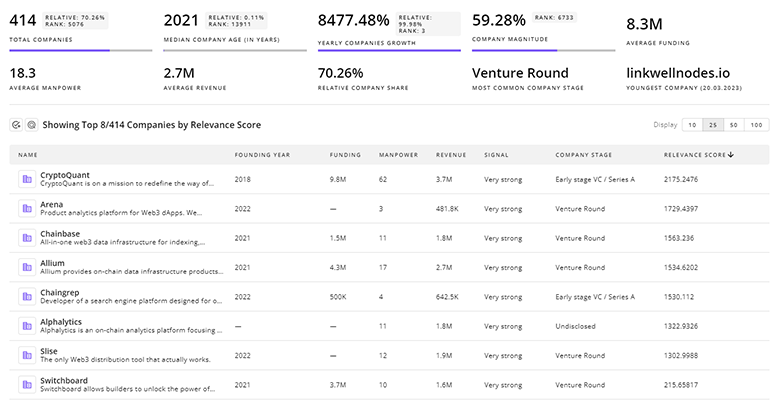
3.9K Optical Semiconductor Companies
Discover Optical Semiconductor Companies, their Funding, Manpower, Revenues, Stages, and much more
Optical Semiconductor Investors
TrendFeedr’s Investors tool provides insights into 1.6K Optical Semiconductor investors for you to keep ahead of the curve. This resource is critical for analyzing investment activities, funding trends, and market potential within the Optical Semiconductor industry.
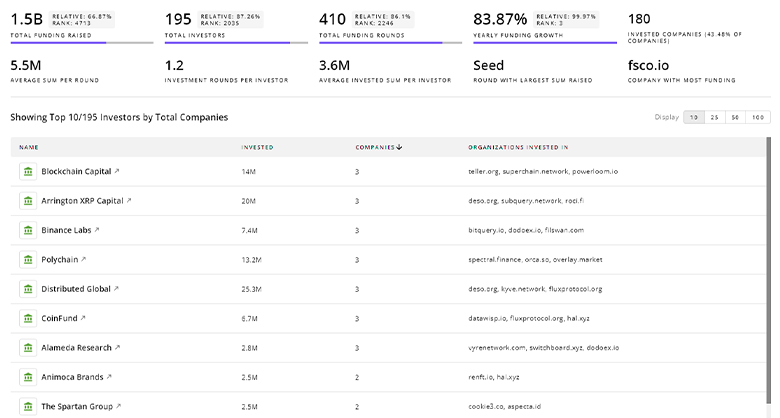
1.6K Optical Semiconductor Investors
Discover Optical Semiconductor Investors, Funding Rounds, Invested Amounts, and Funding Growth
Optical Semiconductor News
TrendFeedr’s News feature offers you access to 24.4K articles on Optical Semiconductor. Stay informed about the latest trends, technologies, and market shifts to enhance your strategic planning and decision-making.
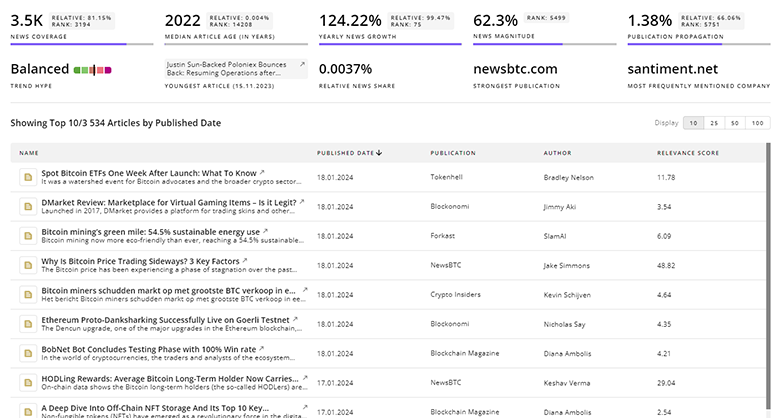
24.4K Optical Semiconductor News Articles
Discover Latest Optical Semiconductor Articles, News Magnitude, Publication Propagation, Yearly Growth, and Strongest Publications
Executive Summary
Optical semiconductors are transitioning from a landscape dominated by discrete parts to one where platform ownership—foundry access, integrated light sources and photonic packaging—captures most upside. Market forecasts and internal funding patterns show strong capital concentration toward integration plays and advanced materials. Firms that pair scalable wafer-level integration with solutions to thermal and fiber-coupling challenges will extract the highest margins; conversely, high-volume discrete transceiver suppliers will face commoditization unless they build platform moats. Strategic priorities for business leaders include securing foundry partnerships or in-house wafer capacity, protecting heterogeneous integration IP, and prioritizing photonic packaging innovations that enable mass adoption of co-packaged optics and dense SiPh fabrics.
Are you an insider in the trends or tech industry? We’d love for you to contribute to our content.