
Optical Sensing Report
: Analysis on the Market, Trends, and TechnologiesThe optical sensing market recorded USD 3.47 billion in 2023 and shows a sustained high-growth profile with a 15.47% CAGR reported in core trend analysis, which frames the sector as a priority target for investors and industrial adopters given fast advances in fiber-based monitoring and chip-scale photonics. Recent market forecasts reinforce this momentum with alternate estimates placing global revenue above USD 25 billion—and in some models over USD 44 billion—by the late 2020s, driven primarily by fiber-optic deployments, automotive sensing, and medical optical diagnostics Optical Sensor Market – Size, Share & Industry Trends 2025-2030.
The last time we updated this report was 284 days ago. If there’s something missing or off, your tips are welcome!
Topic Dominance Index of Optical Sensing
The Dominance Index for Optical Sensing merges timelines of published articles, newly founded companies, and global search data to provide a comprehensive perspective into the topic.
Key Activities and Applications
- Distributed infrastructure monitoring (DAS/DFOS) for pipelines, power cables, subsea umbilicals and long-span civil structures — continuous, long-range acoustic/temperature/strain mapping with single-fiber interrogation is used for leak detection, intrusion and structural health monitoring.
- Structural health and industrial process control — fiber Bragg gratings and interrogators deployed for temperature and strain mapping to reduce downtime and extend asset life across rail, wind turbines and bridges.
- Automotive perception and ADAS / Lidar — compact Lidar-on-chip and PIC-based sensors offer size, weight and power improvements for collision avoidance, parking and autonomy stacks Voyant Photonics.
- Non-invasive medical diagnostics and monitoring — optical coherence tomography, point-of-care optical biosensors and contact-free ocular scanning target chronic disease screening and real-time patient monitoring.
- Miniaturized spectroscopy and on-device material sensing — chip-scale hyperspectral and multispectral sensors for food, agriculture and consumer electronics enable in-line quality control and embedded analysis Spectricity.
Emergent Trends and Core Insights
- Edge integration of AI/ML with sensor demodulation is standard practice to raise detection reliability and reduce false positives in DFOS and DAS analytics Optical Frequency Domain Reflectometry-Based High-Performance Distributed Sensing.
- Wafer-level and on-chip spectroscopy is migrating from R&D into product roadmaps, enabling low-cost, embedded spectral analysis for consumer and industrial OEMs Optical Sensor Market, by Type (Extrinsic, Intrinsic) 2025-2032.
- Silicon photonics-based interrogators are appearing as the scalable path to reduce interrogator size and cost for DFOS, shifting capital intensity from fiber deployment to on-chip interrogator manufacturing SENTEA Fiber Optic Sensing.
- Hybridization of sensing modalities (TOF + imaging + spectral) on single modules increases contextual fidelity for autonomous systems and for multi-parameter health diagnostics Optical Sensing Market Size, Share | Industry Trend & Forecast 2030.
- Niche manufacturing advantages (femtosecond inscription, specialized thin-film deposition) are creating defensible component moats; firms owning these capabilities control critical cost and performance levers for high-value sensors AlbaSense.
Technologies and Methodologies
- Fiber Bragg Grating (FBG) arrays for point and distributed strain/temperature sensing, with increased adoption in structural health programs.
- Distributed Acoustic Sensing (DAS) / Brillouin & Rayleigh interrogation as the backbone for long-range vibration and leak detection, with recent product launches focused on higher sampling speed and extended range.
- Silicon Photonics / Photonic Integrated Circuits (PICs) enabling interrogator-on-chip and Lidar-on-chip solutions that lower SWaP and unit cost for volume markets.
- MEMS beam-steering and micro-scanning for compact Lidar and projection engines; MEMS imposes new supplier and testing requirements but reduces moving parts and energy consumption OQmented.
- Femtosecond laser inscription and on-fiber manufacturing for high-density, low-cost FBG production and integrated diffractive elements—important for embedding sensing into products during manufacture.
- Label-free optical biosensing (SPR / photonic crystal / evanescent field) and miniaturized spectrometers for point-of-care diagnostics and environmental monitoring.
Optical Sensing Funding
A total of 312 Optical Sensing companies have received funding.
Overall, Optical Sensing companies have raised $10.3B.
Companies within the Optical Sensing domain have secured capital from 1.3K funding rounds.
The chart shows the funding trendline of Optical Sensing companies over the last 5 years
Optical Sensing Companies
- FiSens — FiSens GmbH industrializes Fiber Bragg Grating (FBG) production using a proprietary femtosecond laser process that prints gratings and diffraction structures directly into standard telecom fiber cores, which enables low-profile sensing fibers that integrate into structures and products; this approach reduces assembly complexity for distributed strain and temperature mapping and targets industrial embedding and OEM supply chains.
- FEBUS Optics — FEBUS Optics produces a full suite of DTS / DSS / DAS distributed fiber sensing systems and emphasizes single-ended, long-range deployments with high sampling rates (dynamic Brillouin up to 100 Hz) for pipeline, subsea and infrastructure customers; their product positioning reduces field complexity and supports long-line surveillance use cases.
- Sensible Photonics — Sensible Photonics targets the electrical utilities market with low-cost fiber solutions for distribution transformer thermal monitoring and predictive maintenance; the company’s proposition focuses on sharply lower unit cost versus incumbent approaches to enable broad rollouts across constrained grid assets.
- MantiSpectra — MantiSpectra develops wafer-scale, solid-state hyperspectral chips (ChipSense™) that integrate photodetectors and spectral filters for embedded spectral sensing in consumer and industrial devices; their model reduces size and unit cost to permit in-device material analysis in agriculture, food safety and product authentication.
- OPTOI — OPTOI is a vertically integrated microsystems specialist producing silicon components, packaged smart optical sensors and vision/measurement modules; by controlling wafer fabrication through packaging, OPTOI offers rapid customization for aerospace and Industry 4.0 applications where supply consistency and integration speed matter.
Delve into the corporate landscape of Optical Sensing with TrendFeedr’s Companies tool
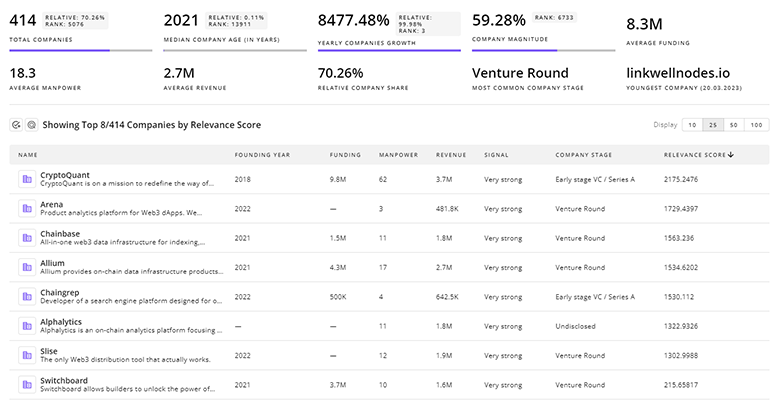
1.7K Optical Sensing Companies
Discover Optical Sensing Companies, their Funding, Manpower, Revenues, Stages, and much more
Optical Sensing Investors
TrendFeedr’s Investors tool provides insights into 1.2K Optical Sensing investors for you to keep ahead of the curve. This resource is critical for analyzing investment activities, funding trends, and market potential within the Optical Sensing industry.
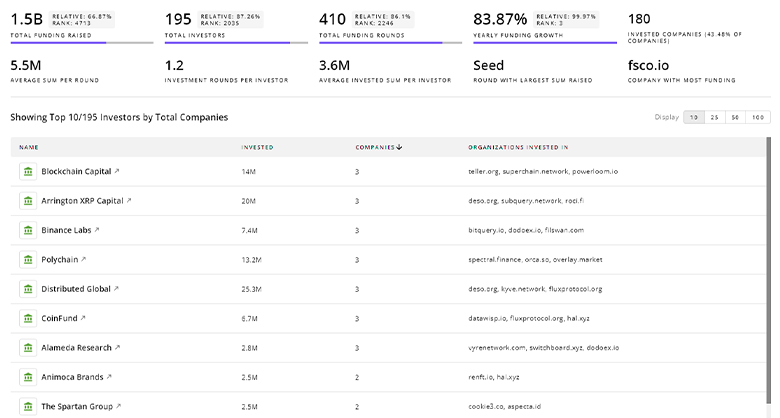
1.2K Optical Sensing Investors
Discover Optical Sensing Investors, Funding Rounds, Invested Amounts, and Funding Growth
Optical Sensing News
TrendFeedr’s News feature offers you access to 4.8K articles on Optical Sensing. Stay informed about the latest trends, technologies, and market shifts to enhance your strategic planning and decision-making.
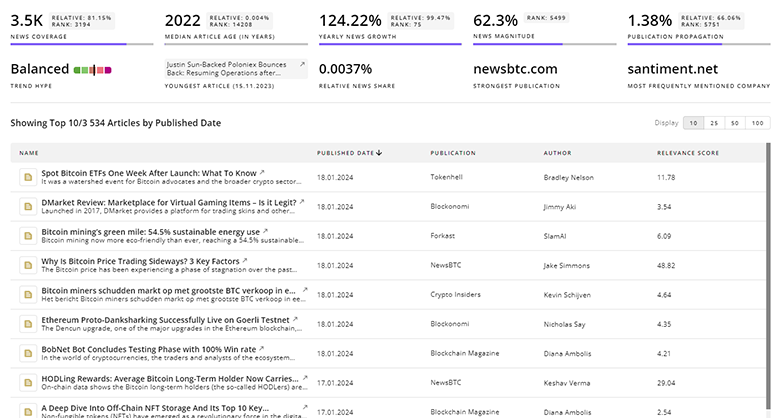
4.8K Optical Sensing News Articles
Discover Latest Optical Sensing Articles, News Magnitude, Publication Propagation, Yearly Growth, and Strongest Publications
Executive Summary
Optical sensing sits at a pragmatic tipping point: the technology base matured in fiber and interferometric measurement now meets economies of scale enabled by silicon photonics and integrated MEMS. Commercial winners will be the organizations that convert technical advantage into repeatable manufacturing and field service playbooks: scale interrogator cost down to commodity levels for infrastructure monitoring, or secure defensible material and process IP for precision, low-volume medical and metrology niches. Investors and operators should prioritize three vectors: ownership of high-throughput production techniques (on-chip or on-fiber), embedding sensor + analytics into customer workflows to justify subscription models, and geographic diversification of critical manufacturing to mitigate supply-chain concentration.
Are you an insider in the trends or tech industry? We’d love for you to contribute to our content.