
Perovskite Solar Cell Report
: Analysis on the Market, Trends, and TechnologiesThe perovskite solar cell sector has moved from laboratory breakthroughs to a commercialization sprint, driven by rapid funding and an internal reported market CAGR of 58.94% that signals aggressive near-term scale ambitions. Market forecasts vary, but multiple market reports show sub-billion dollar revenues today and multi-billion dollar potential within a decade as tandem architectures, roll-to-roll manufacture, and niche low-light applications create differentiated commercial entry points Perovskite Market Size – By Material Type, Application, End Use Industry Analysis, Share, Growth Forecast, 2025 – 2034 Perovskite Solar Cell Market Size, Share, Competitive Landscape and Trend Analysis Report, by Structure, by Product, by Method, by End Use: Global Opportunity Analysis and Industry Forecast, 2024-2028.
The last time we updated this report was 102 days ago. If there’s something missing or off, your tips are welcome!
Topic Dominance Index of Perovskite Solar Cell
The Dominance Index for Perovskite Solar Cell merges timelines of published articles, newly founded companies, and global search data to provide a comprehensive perspective into the topic.

Key Activities and Applications
- Perovskite-on-silicon tandem cells for utility and rooftop upgrades — industry players push tandem stacks to exceed single-junction silicon efficiency and create an immediate retrofit upgrade path for existing module makers Perovskite Solar Cell Market Analysis 2025: Comprehensive Overview & Emerging Opportunities.
- Building-integrated photovoltaics (BIPV) and semi-transparent façades — development of semi-transparent and colored modules targets architectural integration where appearance and weight matter .
- Low-light and indoor power for IoT / edge devices — perovskite formulations that perform in dim conditions open an addressable market for battery displacement in sensors and small devices .
- Flexible, printed modules for mobility and wearables — inkjet and roll-to-roll printed perovskite films enable lightweight panels for automotive roofs, vehicle-integrated PV, and consumer electronics Perovskite Solar Cells.
- Module assembly and encapsulation engineering — industrial R&D concentrates on encapsulation, edge sealing, and module interconnection to meet IEC-level field lifetimes The race to get next-generation solar technology on the market.
Emergent Trends and Core Insights
- Tandems as the fastest path to market — companies and consortia prioritize perovskite top cells on silicon to deliver >30% module efficiencies, which creates a clear commercial upgrade route for silicon incumbents .
- Manufacturing methodology defines moats — transition from lab techniques (spin coating) to continuous printing and roll-to-roll deposition determines cost parity; companies that demonstrate stable R2R lines capture margin advantage .
- Stability becomes the primary investment filter — financiers and utilities require IEC-grade lifetime evidence, so R&D weight shifts to encapsulation, interface passivation, and accelerated aging validation .
- Geographic concentration and supply-chain geopolitics — Asia, led by China, dominates IP filings and early scale lines; that creates strategic incentives for Western firms to secure domestic IP and pilot capacity .
- Alternative chemistries and lead-mitigation — active R&D targets tin or lead-reduced formulations and 2D/3D heterostructures that slow ion migration and improve ambient stability .
Technologies and Methodologies
- Solution printing and inkjet deposition for flexible substrates — enables patterning, low thermal budget processing, and compatibility with roll-to-roll manufacturing Saule Technologies Inc..
- Vapor deposition and vacuum processing for high-performance top cells — used when film uniformity and high bandgap perovskites are required for tandem stacking .
- Interface passivation and 2D/3D layering — molecular passivators and 2D capping layers reduce defect density and ion migration to improve operational lifetime .
- Encapsulation and module engineering — polymer barrier films, edge seals, and module interconnect strategies target IEC qualification and long outdoor life .
- High-fidelity simulation and automated R&D platforms — optical/electrical modelling and robotic deposition accelerate optimization cycles and reduce time to pilot FLUXiM AG.
Perovskite Solar Cell Funding
A total of 59 Perovskite Solar Cell companies have received funding.
Overall, Perovskite Solar Cell companies have raised $2.2B.
Companies within the Perovskite Solar Cell domain have secured capital from 252 funding rounds.
The chart shows the funding trendline of Perovskite Solar Cell companies over the last 5 years
Perovskite Solar Cell Companies
PEROVSKIA SOLAR AG
PEROVSKIA uses digital printing chemistry to make design-free perovskite cells aimed at device integration and small-format power generation; the model focuses on customizing cell shape and optics for consumer and industrial electronics. The firm reports a planned printing capacity that targets distributed, product-embedded PV rather than utility scale, positioning it for high-margin B2B partnerships. Its strategy addresses the need for application-specific manufacturing that bypasses the long outdoor validation cycle required for large PV projects.SolAround
SolAround develops high-efficiency, low-cost bifacial cells and industrial cell prototypes with an emphasis on cell-level improvements that feed into module manufacturers. The company signals rapid product-feasibility moves and small-scale manufacturing demonstrations designed to prove front-cell efficiency improvements relative to PERC architectures. Its seed funding and small team reflect a technical-first commercialization path that targets cell OEMs rather than end-users.Sofab Inks
Sofab supplies specialized nanoparticle inks formulated for perovskite deposition and process control, addressing a critical materials gap for scalable printed perovskite manufacture. By providing inks engineered for manufacturing tolerance and uniformity, the company reduces a key barrier to roll-to-roll yield and module reproducibility. Its product focus targets both startup fabs and pilot lines that require repeatable precursor chemistries.Halocell Energy
Halocell concentrates on indoor and low-light perovskite devices for IoT and embedded electronics, claiming very high dim-light energy conversion that displaces small batteries in sensors. The company combines specialized halide chemistries with small-volume manufacturing to serve a high-margin, near-term commercial niche while outdoor stability validation proceeds across the sector. That route shortens time to revenue and funds longer outdoor product development.SCIPRIOS GmbH
SCIPRIOS builds automated robotic platforms for deposition and inline characterization used by perovskite R&D and pilot production teams. Its tools accelerate iterative process development, reduce manual variability, and enable tighter process control—capabilities that directly lower technology transfer risk from lab to pilot line. Manufacturers and research organizations use such automation to compress scale-up timelines and improve reproducibility.
Delve into the corporate landscape of Perovskite Solar Cell with TrendFeedr’s Companies tool
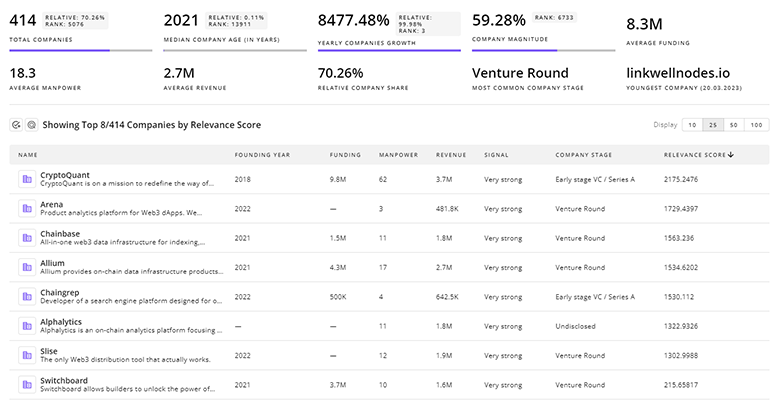
276 Perovskite Solar Cell Companies
Discover Perovskite Solar Cell Companies, their Funding, Manpower, Revenues, Stages, and much more
Perovskite Solar Cell Investors
TrendFeedr’s Investors tool provides insights into 397 Perovskite Solar Cell investors for you to keep ahead of the curve. This resource is critical for analyzing investment activities, funding trends, and market potential within the Perovskite Solar Cell industry.
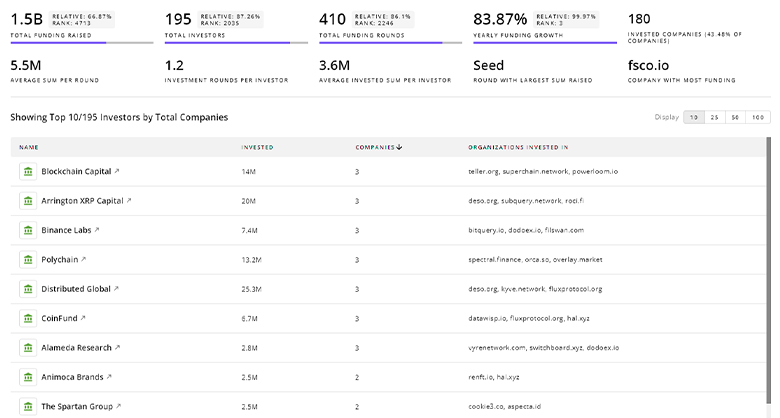
397 Perovskite Solar Cell Investors
Discover Perovskite Solar Cell Investors, Funding Rounds, Invested Amounts, and Funding Growth
Perovskite Solar Cell News
TrendFeedr’s News feature offers you access to 2.6K articles on Perovskite Solar Cell. Stay informed about the latest trends, technologies, and market shifts to enhance your strategic planning and decision-making.

2.6K Perovskite Solar Cell News Articles
Discover Latest Perovskite Solar Cell Articles, News Magnitude, Publication Propagation, Yearly Growth, and Strongest Publications
Executive Summary
Perovskite solar cells now sit at a practical crossroads: the science has reached efficiencies that matter commercially, while the business challenge centers on converting those efficiencies into bankable, long-lived products. Short to medium term, perovskite-on-silicon tandems and indoor/IoT niches provide the clearest revenue pathways. The companies that win will combine validated module lifetimes, scalable deposition methods (notably roll-to-roll or compatible vacuum processes), and supply-chain strategies that mitigate chemical and geopolitical risk. Investors should prefer teams that pair materials IP with manufacturable process control and independent IEC-style validation data; corporates should target partnerships that supply perovskite top-cell capability into existing silicon value chains. Operational focus on encapsulation, interfacial engineering, and standardized field testing will determine which firms graduate from pilot lines to multi-GW industrial players.
Are you an insider in the trends or tech industry? We’d love for you to contribute to our content.