
Photovoltaics Report
: Analysis on the Market, Trends, and TechnologiesThe photovoltaics sector shows clear momentum: global market estimates vary, yet internal trend data records a market size of $96,600,000,000 with a CAGR of 6.0% through the forecast horizon. Market research and industry updates present a wider range—some forecasts place the total market above USD 613.57 billion in 2025 Photovoltaics Market Size, Share, Trends and Growth – MarketsandMarkets while capacity additions and regional penetration data show rapid deployment (e.g. >100 GW added in China in the last year) Spring 2025 Solar Industry Update – NREL. Taken together, the sector is maturing at the module level but accelerating in technology adoption (perovskite tandems, BIPV, PV+storage) and system integration, creating focused windows for investment in materials scale-up, BIPV productization, and distributed PV + storage project economics Super-efficient solar cells.
The last time we updated this report was 61 days ago. If there’s something missing or off, your tips are welcome!
Topic Dominance Index of Photovoltaics
The Dominance Index for Photovoltaics merges timelines of published articles, newly founded companies, and global search data to provide a comprehensive perspective into the topic.
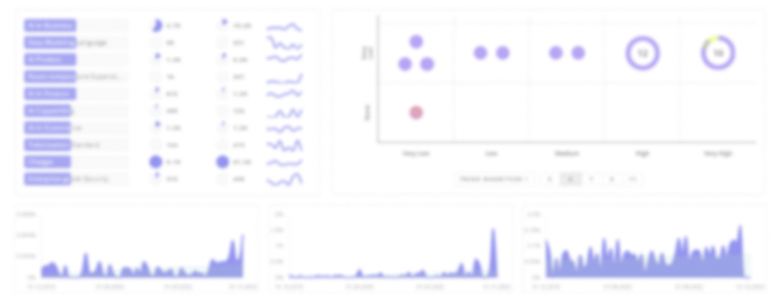
Key Activities and Applications
- Residential rooftop PV deployment — driven by subsidy frameworks, net-metering and falling module costs; residential segments appear as one of the fastest growth pockets in multiple market reports.
- Building-integrated photovoltaics (BIPV) and solar glazing — converting façades, skylights and roofing into active generation surfaces to capture urban demand for onsite generation and meet building-performance codes.
- Utility-scale farms with advanced module types — continued large ground-mount rollouts, but shifting procurement toward higher-efficiency modules and bifacial designs to lower LCOE per site footprint.
- PV + Energy Storage (solar-plus-storage) — behind-the-meter and co-located grid projects target resilience, peak shaving and ancillary services; PV+storage markets show high CAGR projections and policy support in multiple jurisdictions solar energy storage market analysis.
- Agri-PV and vertical bifacial deployments — dual-use land strategies that preserve agricultural yields while adding a revenue stream for landowners, addressing political resistance to ground-mount projects (example vertical systems capture morning/evening generation).
- PV lifecycle and circular-economy logistics — reuse, regeneration and recycling of modules (packaging, panel reclamation) are becoming operational priorities as regulatory and ESG requirements tighten.
Emergent Trends and Core Insights
- Perovskite-on-silicon tandem commercialization push — laboratory and pilot breakthroughs are shifting the conversation from peak lab efficiency to bankability and large-area manufacturing; industry reports cite tandem cells exceeding 28–33% lab efficiencies and early commercial demonstrations are advancing.
- Software and digital optimization capturing measurable value — design and asset-management platforms reduce LCOE and improve project finance metrics (example claims: 5% LCOE reduction and 20% profitability uplift for users), which shifts some margin from hardware to software/service layers RatedPower.
- Rapid adoption of PV+storage with high CAGR — integration of Li-ion (LiFePO4) and modular storage systems increases dispatchability and resilience; PV+storage market projections show a strong CAGR (internal reporting cites 17.8% CAGR for solar-energy-storage markets).
- Regional supply-chain diversification and localized manufacturing — geopolitical incentives and policy tools (tariffs, local content schemes, IRA-style incentives) push capacity builds outside dominant hubs; China continues to add >100 GW annual capacity while new plants appear in Southeast Asia and the U.S. PV Tech.
- BIPV moving from niche to code-driven demand — building performance directives and rooftop mandates increase demand for architecturally acceptable PV solutions, and BIPV CAGR estimates exceed general PV rates in specialized forecasts.
Technologies and Methodologies
- Perovskite-on-silicon tandems and multi-junction approaches — primary pathway for >30% cell efficiencies and meaningful LCOE reductions if durability and scale are proven.
- Heterojunction (HJT), TOPCon and advanced silicon manufacturing — incremental but important gains in module performance and degradation profiles; manufacturers are investing in automated industry-4.0 lines to drive down costs and improve yields.
- Bifacial and vertical bifacial systems — capture albedo and broaden daily generation windows; vertical bifacial designs enable agri-PV dual use and improve land economics.
- Organic and truly transparent PV films — roll-to-roll OPV and transparent coatings enable façade and glazing energy generation where weight, flexibility or aesthetics matter Heliatek.
- AI-driven O&M, digital twins and module-level analytics — machine-learning monitors module/module-string health, schedules cleaning and predicts degradation to recover lost yield early; module-level intelligence converts O&M from reactive to predictive SunSniffer.
- PV lifecycle and regenerative technologies — panel regeneration, certified recycling streams and reusable logistics packaging mitigate ESG and regulatory risks while lowering total system cost over long horizons.
Photovoltaics Funding
A total of 7.5K Photovoltaics companies have received funding.
Overall, Photovoltaics companies have raised $1.2T.
Companies within the Photovoltaics domain have secured capital from 23.9K funding rounds.
The chart shows the funding trendline of Photovoltaics companies over the last 5 years
Photovoltaics Companies
- CubicPV — CubicPV focuses on wafer and tandem module manufacturing that combine silicon and perovskite approaches to raise module efficiency and cut embedded carbon. The firm reports a Series B scale-up profile and positions its Direct Wafer™ and tandem integration as a lower-capex path to higher per-m2 yield. Its strategy targets manufacturers and downstream developers that need high-performance cells with a manageable capital step-up rather than wholesale retooling. Financial figures in the company profile indicate meaningful institutional backing, which supports pilot-to-industrial scale planning.
- Kardinia Energy — Kardinia Energy develops fully recyclable printed solar using roll-to-roll printed semiconducting inks designed for ultra-lightweight, flexible deployment on curved or weight-sensitive substrates. The company emphasizes a circular-economy value proposition for distributed and off-grid markets where traditional panel weight and supply chains are prohibitive. Early commercial trials and grant funding support indicate the technology is moving from lab to commercial trials with an emphasis on social impact in electrification markets.
- PVpallet — PVpallet addresses solar logistics and packaging waste through reusable pallets and BOS packaging optimized for module handling and reverse logistics. Their offering reduces damage rates and packaging waste for large developers and supports circular-supply KPIs that major EPCs and financiers increasingly require. The company's business model targets procurement and operations teams seeking cost savings and ESG improvements across multi-GW rollouts.
- EtaVolt Pte Ltd — EtaVolt builds PV regeneration, recycling and end-of-life management platforms to recover embedded value and recondition panels for secondary markets. The startup positions itself as a technology partner for sustainable PV lifecycle management and has spun out of academic research to commercialize remanufacturing processes. Their model reduces landfill risk and creates alternative revenue channels for developers facing tightening disposal regulations.
- Next2Sun AG — Next2Sun commercializes vertical bifacial and agri-PV systems that free land for continued agricultural use while harvesting solar from both panel faces. The design increases productive land use and offers an investable product for regions where land availability and social license constrain large ground-mount projects. Their deployments and awards reflect product-market fit in European agri-PV pilots and create a project archetype attractive to landowners and financiers.
Delve into the corporate landscape of Photovoltaics with TrendFeedr’s Companies tool
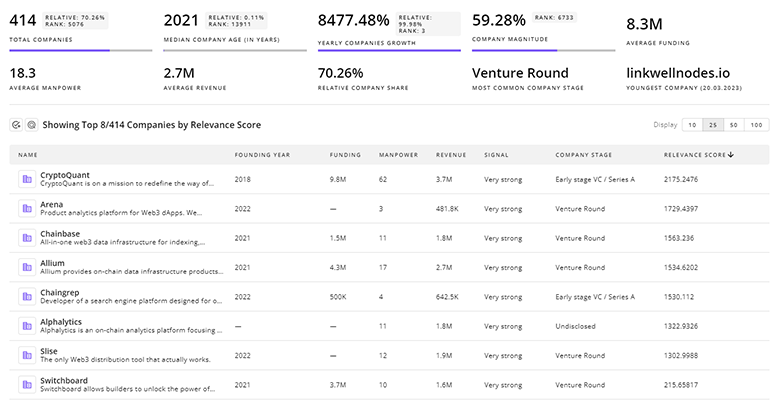
138.0K Photovoltaics Companies
Discover Photovoltaics Companies, their Funding, Manpower, Revenues, Stages, and much more
Photovoltaics Investors
TrendFeedr’s Investors tool provides insights into 17.7K Photovoltaics investors for you to keep ahead of the curve. This resource is critical for analyzing investment activities, funding trends, and market potential within the Photovoltaics industry.
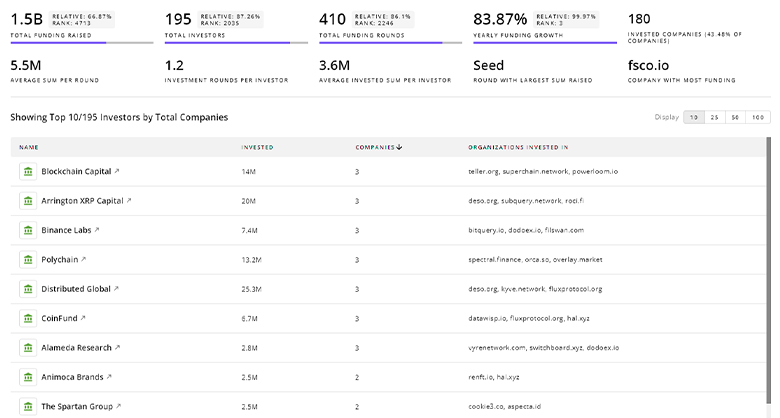
17.7K Photovoltaics Investors
Discover Photovoltaics Investors, Funding Rounds, Invested Amounts, and Funding Growth
Photovoltaics News
TrendFeedr’s News feature offers you access to 149.3K articles on Photovoltaics. Stay informed about the latest trends, technologies, and market shifts to enhance your strategic planning and decision-making.
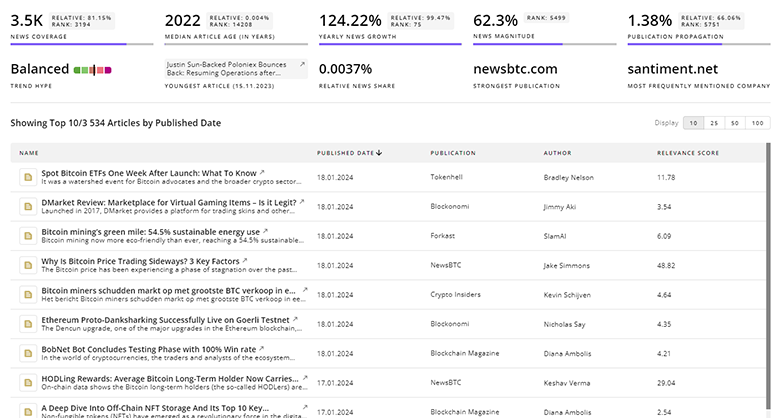
149.3K Photovoltaics News Articles
Discover Latest Photovoltaics Articles, News Magnitude, Publication Propagation, Yearly Growth, and Strongest Publications
Executive Summary
The photovoltaics market now separates raw capacity expansion from high-value integration and materials advances. Investors and strategic leaders should prioritize three vectors: (1) technologies that can demonstrate industrial-scale durability and bankable performance (notably perovskite tandems and advanced silicon variants), (2) software and system integration that measurably reduces LCOE for projects and accelerates financing, and (3) lifecycle and circular-economy enablers that preempt regulatory risk and capture secondary revenue streams. Project developers that combine higher-efficiency modules with storage and intelligent O&M tools will outcompete commodity module sellers, while BIPV and agri-PV formats will unlock urban and constrained land markets. In short, the next wave of value will accrue to firms that can industrialize new chemistries, integrate them into bankable supply chains, and operationalize generation as a managed, dispatchable asset.
Are you an insider in the trends or tech industry? We’d love for you to contribute to our content.