
Predictive Maintenance Report
: Analysis on the Market, Trends, and TechnologiesThe predictive maintenance market has entered an operational inflection point where scale and economics now matter as much as raw prediction accuracy: the market was valued at USD 10,100,000,000 in 2023 and carries a projected CAGR of 32.2%, signaling aggressive enterprise adoption tied to Industry 4.0 modernization and cloud migration. This report synthesizes recent market studies, patent activity, and vendor signals to show that commercial winners will be those that convert condition signals into scheduled actions and spare-parts logistics while meeting enterprise constraints on data sovereignty and auditability.
The last time we updated this report was 60 days ago. If there’s something missing or off, your tips are welcome!
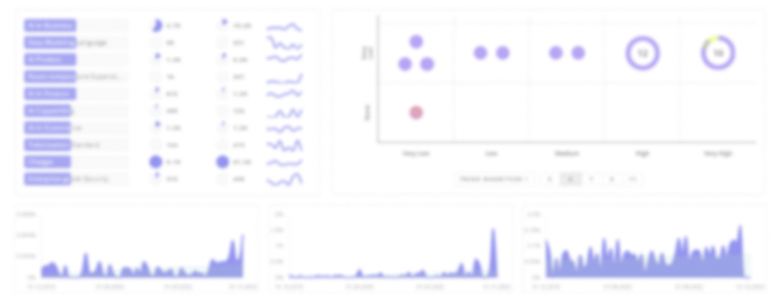
Topic Dominance Index of Predictive Maintenance
The Dominance Index for Predictive Maintenance merges timelines of published articles, newly founded companies, and global search data to provide a comprehensive perspective into the topic.
Key Activities and Applications
- Real-time condition monitoring: Deploying multi-modal IoT sensors (vibration, acoustic, thermal, oil) to capture asset health streams and flag early anomalies for technician triage.
- Remaining Useful Life (RUL) forecasting: Using time-series and sequence models to estimate failure windows and prioritize repairs, which reduces unplanned outages and optimizes spare-parts spend Predictive Maintenance Market Size, Share & Industry Trend 2034.
- Automated work-order orchestration: Translating predictions into ERP/EAM work orders and technician schedules to cut mean time to repair and reduce idle labor; this is increasingly embedded in platform offerings.
- Digital-twin simulations for intervention testing: Running virtual asset replicas to evaluate maintenance impact on throughput and quality before committing production time.
- Sector-specific prognostics: Tailored PdM for fleets, mining equipment, EV chargers, and refrigeration systems where failure cost and regulatory risk are high Predictive Maintenance Market Size | Industry Report, 2033.
- Maintenance-linked sustainability scoring: Measuring energy impact of maintenance actions and reporting savings as part of ESG commitments, which converts reliability gains into corporate KPIs.
Emergent Trends and Core Insights
- Cloud-first plus Edge-AI hybrid architectures: Platforms favor flexible hybrid deployment to balance scale and latency; cloud for cross-site model training, edge inference for sensitive or low-latency assets Predictive Maintenance Market Size, Statistics Report, 2034 and.
- Shift from detection to economic optimization: Patents and product roadmaps move PdM from “when will it fail” to “what is the economically optimal action,” embedding cost, spare availability, and production impact into scheduling logic
- Privacy-preserving learning: Federated learning and on-device model updates are gaining adoption where fleet owners or regulated industries refuse raw data export Predictive maintenance market: 5 highlights for 2024 and beyond.
- Prescriptive and autonomous workflows: Leading solutions progress from alerts to autonomous ordering and technician dispatch in low-risk cases, compressing decision loops and reducing admin overhead
- Verticalization of models: Generic anomaly detectors give way to asset-class models (e.g. turbines, compressors, refrigeration) that deliver shorter lead times to production value
- Data quality and integration remain the gating factor: Investments focus on sensor fidelity, data normalization, and EAM/CMMS integration because alert fatigue and noisy signals still block enterprise rollouts U.S. Predictive Maintenance Market.
Technologies and Methodologies
- Multi-modal sensor fusion: Combining vibration, acoustic, thermal, ultrasound, and electrical signatures to raise lead time and reduce false positives.
- Time-series and sequence models: Ensembles using LSTM, temporal convolution, and gradient boosting for RUL prediction, with unsupervised models used where run-to-failure data is sparse LSTM HVAC study.
- Digital twins and hybrid physics-AI models: Using physics-based simulations to seed or constrain ML predictions for assets with limited historical failures.
- Edge-native inference stacks: Embedded agents that process streaming signals locally to reduce telemetry costs and protect IP
- Explainable AI and audit trails: Interpretable features and human-in-the-loop validation for regulated industries to meet compliance and root-cause reporting needs.
- Virtual sensors and software-defined instrumentation: Inferring wear or component states from existing CAN/OBD or telemetry channels to avoid heavy hardware rollouts COMPREDICT.
Predictive Maintenance Funding
A total of 981 Predictive Maintenance companies have received funding.
Overall, Predictive Maintenance companies have raised $17.0B.
Companies within the Predictive Maintenance domain have secured capital from 3.5K funding rounds.
The chart shows the funding trendline of Predictive Maintenance companies over the last 5 years
Predictive Maintenance Companies
- AIRS ML — AIRS ML builds edge AI agents that perform failure prediction without moving raw data to the cloud, targeting high-value manufacturers that require local inference and data sovereignty; the company emphasizes low bandwidth operation and compressive sensing for vibration streams and graduated deployment via Techstars Berlin 2024 cohort validation
- Nanoprecise Sci Corp — Nanoprecise offers an automated AI-based PdM stack centered on a multi-modal light-harvesting sensor and energy-centric analytics that claim broad asset applicability and measurable energy savings, with global deployments and SOC 2 compliance noted as trust signals
- Coddi — Coddi focuses on AI prognostics for high-value mining robotics and heavy equipment using a SaaS model that often avoids additional hardware by leveraging existing machine telemetry; this vertical focus accelerates time to value in asset-intensive sites
- Predictive Monitor LLC — Predictive Monitor delivers OverShield, a PdM service for refrigeration and life-science cold-chain assets that pairs sensor alerts with expert investigation and scheduled repairs, addressing extremely high-cost failure domains where uptime is mission critical
- PANTOhealth — PANTOhealth applies sensor and camera monitoring to pantograph and catenary systems for rail infrastructure, using synthetic data to enrich model training and reduce the need for long run-to-failure data collection, a practical approach for infrastructure monitoring where failures are rare but costly
Delve into the corporate landscape of Predictive Maintenance with TrendFeedr’s Companies tool
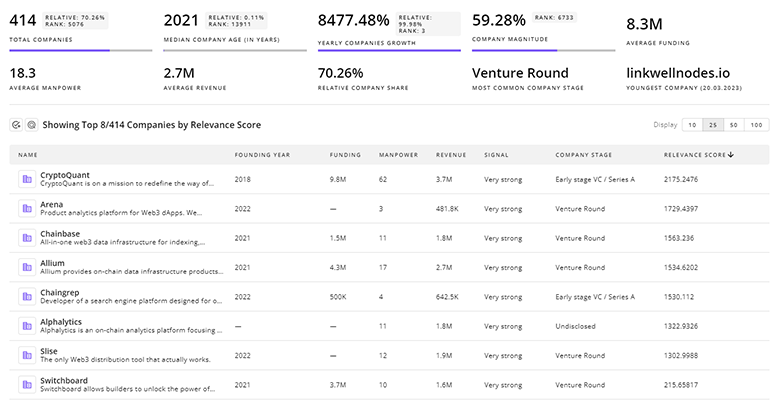
8.2K Predictive Maintenance Companies
Discover Predictive Maintenance Companies, their Funding, Manpower, Revenues, Stages, and much more
Predictive Maintenance Investors
TrendFeedr’s Investors tool provides insights into 3.5K Predictive Maintenance investors for you to keep ahead of the curve. This resource is critical for analyzing investment activities, funding trends, and market potential within the Predictive Maintenance industry.
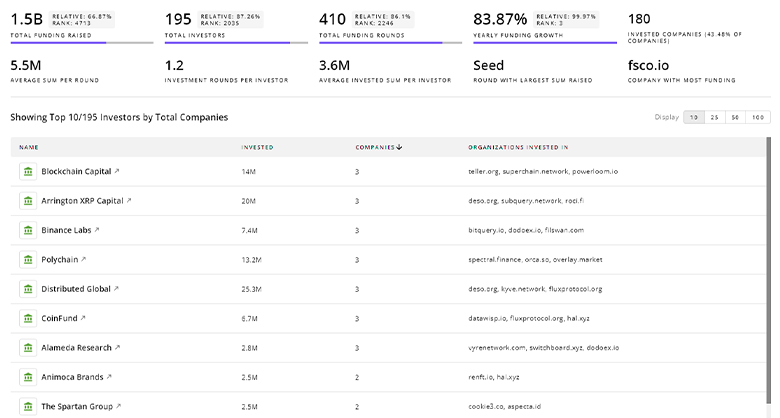
3.5K Predictive Maintenance Investors
Discover Predictive Maintenance Investors, Funding Rounds, Invested Amounts, and Funding Growth
Predictive Maintenance News
TrendFeedr’s News feature offers you access to 10.7K articles on Predictive Maintenance. Stay informed about the latest trends, technologies, and market shifts to enhance your strategic planning and decision-making.
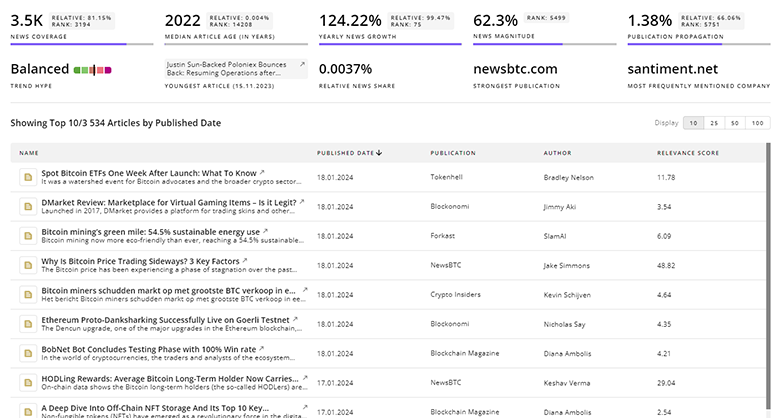
10.7K Predictive Maintenance News Articles
Discover Latest Predictive Maintenance Articles, News Magnitude, Publication Propagation, Yearly Growth, and Strongest Publications
Executive Summary
Predictive maintenance has matured into a strategic operations capability where the next wave of value comes from integrating forecasts with enterprise execution: scheduling, parts logistics, technician dispatch, and compliance reporting. Market growth projections are large, but adoption friction lives in data quality, legacy integration, and trust. Vendors that combine high-fidelity sensing or reliable virtual sensing with hybrid cloud/edge deployments and clear prescriptive outcomes will capture the greatest share. For asset owners, the immediate playbook is to prioritize pilot-to-scale paths that demonstrate measurable downtime and parts-cost reductions, enforce data standards to avoid alert fatigue, and demand explainability and auditability to satisfy regulatory and procurement stakeholders.
Are you an insider in the trends or tech industry? We’d love for you to contribute to our content.