
Recycling Report
: Analysis on the Market, Trends, and TechnologiesThe recycling sector faces an operational and strategic pivot driven by quality over quantity, with a global market valuation of $129,940,000,000 and an expected compound growth trajectory of 4.6% that rewards higher-fidelity outputs rather than pure tonnage. Investment and innovation are concentrating on material-specific recovery (batteries, PET, composites) and digital traceability, creating incentives for manufacturers to accept recycled feedstock only when it meets strict purity and compliance standards Global Recycling Equipment Market Report.
This report was last revised 257 days ago. See a missing piece? Your input can help — contact us.
Topic Dominance Index of Recycling
The Dominance Index for Recycling delivers a multidimensional view by integrating data from three key viewpoints: published articles, companies founded, and global search trends
Key Activities and Applications
- Material collection and segregation — curbside programs, deposit-return schemes, and MRF upgrades to reduce contamination and improve feedstock quality.
- Mechanical recycling (sorting, cleaning, reprocessing) — primary route for high-volume streams like paper and many plastics where input quality supports direct re-use Global Mechanical Recycling of Plastic Packaging Waste.
- Chemical/molecular recycling (depolymerization, pyrolysis, solvolysis) — targeting mixed and hard-to-process plastics to produce monomers or feedstock oils for circular polymer loops.
- Battery and critical-metal recovery — hydrometallurgical and alkali processes to recover lithium, cobalt, nickel and REEs from EV and consumer batteries, crucial for supply-chain security.
- E-waste dismantling and precious-metal extraction — high-value stream processing to reclaim gold, copper and rare earths, increasingly automated to protect material integrity and worker safety Electronics Recycling Market Size, Share & Trends Analysis Report.
- Design for disassembly and thermal/enzymatic textile recycling — upstream product design and enzymatic depolymerization to keep polymer chains intact and enable near-virgin material recovery.
- Digital traceability and compliance services — digital product passports, EPR fee calculators and blockchain provenance to certify recycled content and regulatory adherence Recyda GmbH.
Emergent Trends and Core Insights
- The financial premium now attaches to purity and certifiability of outputs rather than throughput: producers pay for certified, drop-in substitutes for virgin resin, not for aggregated tons with variable quality revalyu Resources GmbH.
- Advanced sorting and automation move from pilot to scale: AI vision, robotics, and sensor-based sorters materially cut contamination and reduce manual sorting costs, shifting MRF economics toward higher margins per ton processed
- Chemical and enzymatic recycling accelerate to capture hard-to-process streams: modular chemical plants and enzymatic depolymerization enable recovery of monomers and textile fibers at rates that can satisfy recycled-content mandates.
- Battery circularity becomes strategic policy lever: governments and OEMs legislate recycled content and collection standards, creating a predictable demand sink for recyclers that can consistently deliver high-purity battery metals Battery recycling: 10 Breakthrough Technologies 2023.
- Social-and-collection models unlock feedstock in underserved regions: incentive and community-exchange programs convert informal collection into stable supply lines while generating social value and better material capture rates Greenhill Recycling Limited.
> Key takeaway: policy, product design, and digital traceability together create a gating mechanism that separates commodity handlers from high-value recyclers.
Technologies and Methodologies
- AI-enabled optical sorting and robotics — object recognition, contamination detection and selective grasping reduce impurity and raise reprocessor yields
- Depolymerization (hydrolysis, methanolysis, glycolysis, enzymolysis) — routes to monomers for virgin-grade repolymerization, enabling closed-loop packaging and textile supply chains.
- Pyrolysis and Hydro-PRT / HTT — thermal conversion of mixed plastics to oils/syngas for downstream refining into chemicals or fuels where feedstock heterogeneity prevents mechanical recycling.
- Hydrometallurgy and proprietary alkali processes — lower-temperature, less carbon-intensive extraction for battery metals with high recovery and reduced emissions compared with smelting.
- Enzymatic depolymerization and engineered biocatalysts — scalable enzyme platforms for PET/nylon that enable material-level circularity without quality loss.
- Digital product passports, blockchain provenance, and EPR-compliance platforms — systems that provide auditable chain-of-custody to satisfy regulators and brand procurement teams
- Modular, decentralized process units — smaller chemical/thermal plants placed near feedstock sources to reduce logistics costs and improve feedstock consistency
Recycling Funding
A total of 18.3K Recycling companies have received funding.
Overall, Recycling companies have raised $1.2T.
Companies within the Recycling domain have secured capital from 54.9K funding rounds.
The chart shows the funding trendline of Recycling companies over the last 5 years
Recycling Companies
- REEcycle — REEcycle applies a patented process to extract neodymium-iron-boron magnet rare earth elements from electronic scrap with reported 99.8% recovery efficiency, enabling domestic supply of strategic REEs and converting shredded magnet waste from low-value scrap into high-value feedstock REEcycle targets a narrow but high-margin niche that intersects defense, EV motors and renewable generators, making its IP critical to material security
- Saru Recycling — Saru Recycling provides solar-powered, sensorized reverse-vending and deposit units that instantly identify deposits and return CRV (California Refund Value) to users, combining telemetry with incentives to raise capture rates in public and commercial spaces By monetizing behavioral data and reducing collection costs, Saru Recycling converts points of disposal into verifiable feedstock sources for local processors
- Composite Recycling — Composite Recycling specializes in glass and carbon fiber-reinforced plastics recovery, transforming composite waste into reclaimed fibers and thermolysis oil; this approach creates high-quality secondary fibres suitable for automotive and aerospace applications and addresses a stream that conventional recycling largely avoids Their technology targets an industrial niche with constrained supply, translating otherwise-landfilled composites into valuable inputs
- Resortecs — Resortecs embeds heat-dissolvable stitching threads and thermal disassembly systems into textile production, enabling automated garment disassembly and recovery of up to 90% of original fabric material, shortening disassembly time and increasing recyclability rates for fashion brands Their design-for-disassembly approach reduces downstream sorting complexity and strengthens supply guarantees for textile recyclers
TrendFeedr's Companies feature is your gateway to 246.3K Recycling companies.
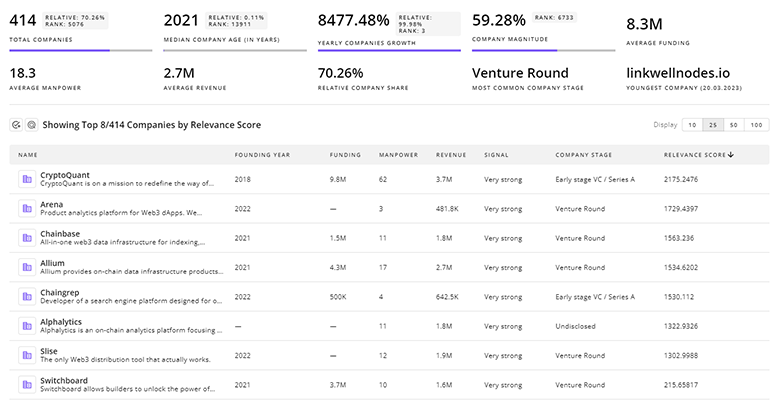
246.3K Recycling Companies
Discover Recycling Companies, their Funding, Manpower, Revenues, Stages, and much more
Recycling Investors
The Investors tool by TrendFeedr offers a detailed perspective on 34.7K Recycling investors and their funding activities. Utilize this tool to dissect investment patterns and gain actionable insights into the financial landscape of Recycling.
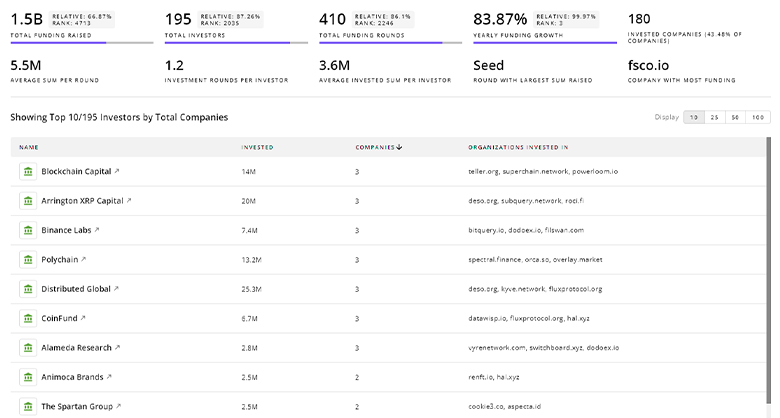
34.7K Recycling Investors
Discover Recycling Investors, Funding Rounds, Invested Amounts, and Funding Growth
Recycling News
TrendFeedr’s News feature allows you to access 128.9K Recycling articles as well as a detailed look at both historical trends and current market dynamics. This tool is essential for professionals seeking to stay ahead in a rapidly changing environment.
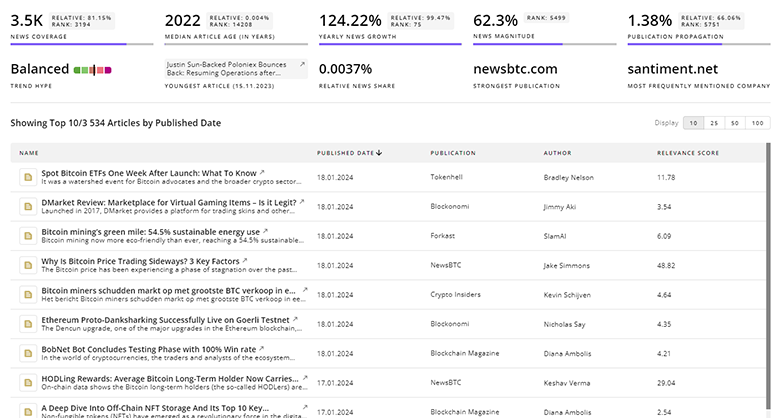
128.9K Recycling News Articles
Discover Latest Recycling Articles, News Magnitude, Publication Propagation, Yearly Growth, and Strongest Publications
Executive Summary
The recycling sector is increasingly defined by the chemical and digital fidelity of outputs. Companies that combine advanced material-specific processing (chemical, hydrometallurgical, enzymatic) with rigorous digital traceability will capture the premium of certified recycled feedstocks. For industrial buyers, this means contracting for quality and provenance; for recyclers, it means investing in sorting, preconditioning and process IP; for investors and policymakers, it means aligning incentives and capital toward material streams where supply promises to meet mandated demand. The strategic winners will be those who convert waste into verifiable, manufacturer-ready inputs rather than those who focus only on tonnage.
Partner with us to offer cutting-edge insights into trends and tech. We welcome your input.