Retrieval Augmented Generation Report
: Analysis on the Market, Trends, and TechnologiesThe RAG market shows rapid scale and concentrated strategic focus: internal trend data projects a 49.1% CAGR and a $11.0 billion market by 2030, signalling strong commercial urgency to solve retrieval quality and compliance rather than just provide generic generative interfaces. External market studies present similar high-growth scenarios that confirm enterprise demand for grounded, auditable AI outputs and place immediate commercial value on retriever performance and data pipelines RootsAnalysis – Retrieval Augmented Generation Market.
This report was last revised 110 days ago. See a missing piece? Your input can help — contact us.
Topic Dominance Index of Retrieval Augmented Generation
The Dominance Index for Retrieval Augmented Generation delivers a multidimensional view by integrating data from three key viewpoints: published articles, companies founded, and global search trends
Key Activities and Applications
- Enterprise knowledge grounding for mission-critical Q&A and compliance workflows — companies deploy RAG to connect LLMs to internal documents, logs, and APIs to produce verifiable answers and provenance metadata, a requirement most visible in legal, healthcare, and financial deployments.
- Content generation at scale with factuality checks — marketing and media teams use retrieval to reduce factual errors in automated content pipelines and maintain citation quality for publishable outputs researchandmarkets - Retrieval Augmented Generation Market - Global Strategic Business Report.
- Agentic automation and workflow execution — RAG becomes the knowledge kernel for agents that not only answer but trigger actions (database queries, ticket creation, approvals), shifting value from information to auditable action.
- Document-centric retrieval for regulated domains — high-precision document retrieval (legal briefs, clinical guidelines) drives deployments where citation traceability and provenance are mandatory.
- Multimodal retrieval and visual-text fusion — e-commerce and digital-asset systems use image + text retrieval to produce multimodal answers and product recommendations.
Emergent Trends and Core Insights
- Shift from generic LLM wrappers to retriever-centric differentiation — competitive advantage now accrues to teams who optimize ingestion, chunking, embeddings, reranking, and provenance tracking rather than to those offering only API access to models.
- Hybrid retrieval architectures (semantic + lexical + graph) gain traction — hybrid pipelines improve recall on exact-match queries while preserving semantic similarity for broader queries, which matters in legal and clinical searches.
- Agentic RAG and strategy selection — systems now decide when to retrieve, which index to query, and whether to perform multi-hop reasoning, enabling autonomous workflows that reduce human trial-and-error Dataworkz blog.
- Evaluation standardization and factuality metrics — benchmarks and end-to-end metrics (precision of retrieved evidence, citation accuracy, answer veracity) become purchasing criteria for enterprise buyers arXiv — RAG survey 2025.
- Cost, latency, and engineering overhead shape adoption curves — high compute and indexing costs constrain broad SME adoption unless vendors offer usage-based or optimized architectures.
Technologies and Methodologies
- Dense vector embeddings and vector DBs for semantic similarity search — core building blocks for high-dimensional retrieval and continuous updates to index state.
- Hybrid search (BM25 + dense vectors + metadata filters) to balance recall and precision in domain queries.
- Query-transformation techniques (HyDE / self-querying) and reranking stacks — generate hypothetical answers or reformulated queries to improve retrieval signals and then rerank with small models for higher fidelity.
- Knowledge-graph integration and Graph-RAG for multi-hop reasoning — graphs provide structured context for traversals that dense vectors alone cannot handle reliably in complex reasoning tasks.
- LLM orchestration and LLM-ops (monitoring, cost control, provenance logging) — operational tooling becomes necessary to run RAG in production while maintaining SLAs and audit trails.
Retrieval Augmented Generation Funding
A total of 351 Retrieval Augmented Generation companies have received funding.
Overall, Retrieval Augmented Generation companies have raised $17.5B.
Companies within the Retrieval Augmented Generation domain have secured capital from 1.2K funding rounds.
The chart shows the funding trendline of Retrieval Augmented Generation companies over the last 5 years
Retrieval Augmented Generation Companies
- iQ Suite — iQ Suite offers a drop-in RAG API that automates adaptive chunking, semantic contextualization, and reranking so teams avoid building bespoke ingestion pipelines. Their value proposition speeds time-to-production for developers who need enterprise-grade retrieval without maintaining index infrastructure.
- RAG.LU — RAG.LU positions itself as a privacy-first, on-premises RAG integrator for European clients, focusing on strict data residency and compliance for healthcare and finance customers. They emphasize customization and in-infrastructure deployment models to satisfy GDPR and sectoral controls.
- Knowledge² — Knowledge² delivers domain-optimized RAG with fine-tuned embeddings and custom rerankers to increase retrieval precision for technical documentation and developer-focused knowledge bases. Their stack targets teams that require low hallucination risk while integrating specialized ontologies.
- OctiAI — OctiAI specializes in prompt and query transformation as a service, converting vague user inputs into structured prompts and hypothetical embeddings that materially improve retrieval relevance. Their offering helps companies reduce iteration on prompt engineering and improves downstream generation accuracy in multi-model pipelines.
TrendFeedr's Companies feature is your gateway to 1.5K Retrieval Augmented Generation companies.
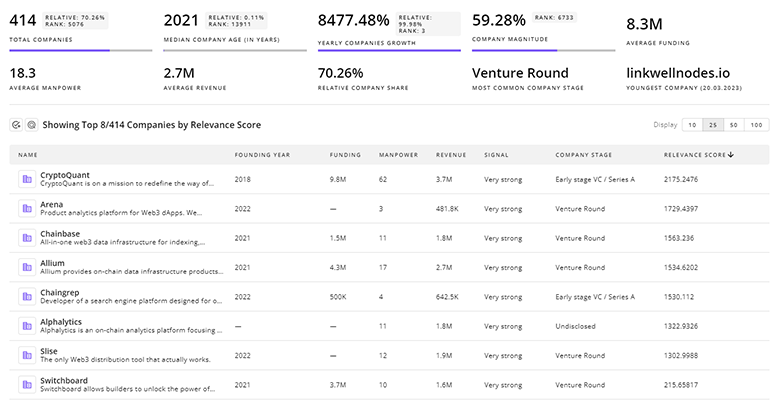
1.5K Retrieval Augmented Generation Companies
Discover Retrieval Augmented Generation Companies, their Funding, Manpower, Revenues, Stages, and much more
Retrieval Augmented Generation Investors
The Investors tool by TrendFeedr offers a detailed perspective on 2.0K Retrieval Augmented Generation investors and their funding activities. Utilize this tool to dissect investment patterns and gain actionable insights into the financial landscape of Retrieval Augmented Generation.
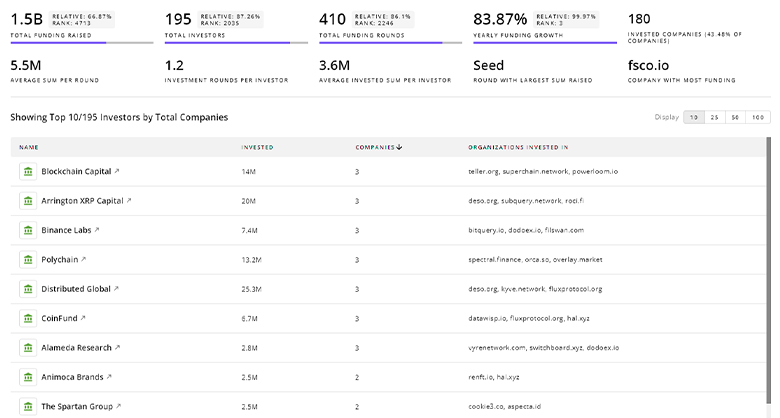
2.0K Retrieval Augmented Generation Investors
Discover Retrieval Augmented Generation Investors, Funding Rounds, Invested Amounts, and Funding Growth
Retrieval Augmented Generation News
TrendFeedr’s News feature allows you to access 5.7K Retrieval Augmented Generation articles as well as a detailed look at both historical trends and current market dynamics. This tool is essential for professionals seeking to stay ahead in a rapidly changing environment.
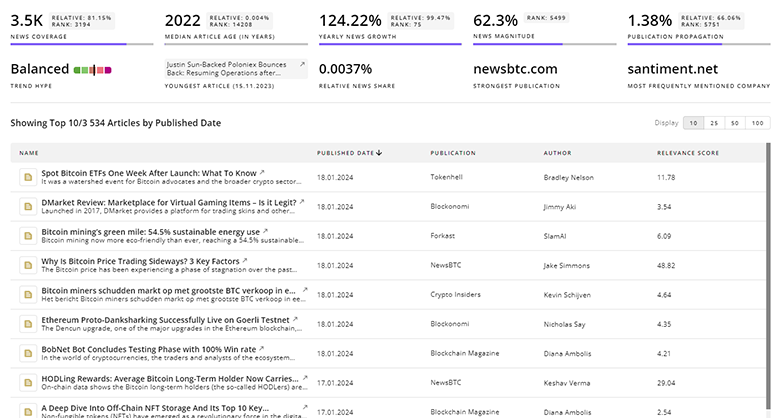
5.7K Retrieval Augmented Generation News Articles
Discover Latest Retrieval Augmented Generation Articles, News Magnitude, Publication Propagation, Yearly Growth, and Strongest Publications
Executive Summary
The immediate business battleground in Retrieval-Augmented Generation shifts from model access to retrieval mastery. The internal projection of a 49.1% CAGR to a $11.0B market by 2030 signals strong commercial pressure on enterprises to adopt grounded, auditable AI. Winning strategies will focus on (1) measurable improvements in retrieval fidelity, (2) deployment models that meet compliance needs, and (3) operational tooling that controls cost and latency. Vendors that prove verifiable evidence-level accuracy and seamless integration into enterprise workflows will command premium valuations and durable client relationships.
Partner with us to offer cutting-edge insights into trends and tech. We welcome your input.