Sensors & Measuring Instruments Report
: Analysis on the Market, Trends, and TechnologiesThe sensors and measuring-instruments market sits at an inflection point where data fidelity and system-level reliability determine value capture: the sector reported a market size of 179,700,000,000 (2023) with a CAGR of 8.9%, reflecting sustained industrial and IoT demand. Growth is concentrated in MEMS for consumer IoT, non-contact/optical solutions for process and harsh-environment monitoring, and calibration/test services that monetize measurement trust; external forecasts suggest even larger, multi-decadal expansion in total sensor spend (for example, a pathway to ≈ USD 551.03 billion by 2034 in one market projection) Sensor Market Size To Hit Around USD 551.03 Billion By 2034 – Precedence Research.
74 days ago, we last updated this report. Notice something that’s not right? Let’s fix it together.
Topic Dominance Index of Sensors & Measuring Instruments
To gauge the influence of Sensors & Measuring Instruments within the technological landscape, the Dominance Index analyzes trends from published articles, newly established companies, and global search activity
Key Activities and Applications
- Condition-Based Monitoring (CBM) for industrial uptime — deploying multi-modal vibration, temperature, and force/torque sensing to convert scheduled maintenance into event-driven workflows; this activity links sensor accuracy directly to OPEX savings and insurance exposure.
- Environmental and regulatory monitoring — high-fidelity gas, particulate and water sensors used for emissions reporting, ESG programs, and regulatory compliance; gas sensor platforms for ambient and industrial monitoring remain a high-value application Cubic Sensor and Instrument Co,Ltd..
- Process control and non-contact flow/level measurement — clamp-on ultrasonic flow meters and multi-path ultrasonic/thermal-mass devices reduce process downtime and contamination risk in food, chemical and utility sectors.
- Precision metrology and factory quality assurance — inline vision, 3D metrology and CMM/optical measurement ensure parts-level tolerances in aerospace and semiconductor supply chains, shortening inspection cycles and enabling tighter feedback loops to production Global Optical Measurement Market analysis.
- Remote, battery-free and hard-environment telemetry — solutions that eliminate maintenance logistics (wireless, batteryless readouts, optical sensing) deliver outsized TCO improvement where access is costly (nuclear, subsea, tunnels)
Emergent Trends and Core Insights
- Calibration data embedded at the sensor is becoming normative: smart sensors that carry TEDS/identity and calibration metadata reduce human error and accelerate asset onboarding; traceable data chains create monetizable trust. This pattern is visible across metrology and process instruments and is a direct response to the operational risk premium tied to inaccurate readings.
- Contactless optical and clamp-on methods are displacing invasive probes in many fluid and high-temperature applications because they preserve process integrity and reduce downtime; adoption is strongest where hygiene or corrosion risk is material.
- Sensor fusion plus edge analytics moves raw readings toward decision-ready signals at the network edge, lowering central bandwidth and improving latency for safety/ADAS and industrial control; firms pairing multi-modal sensing with on-device ML show faster customer penetration.
- Non-replicable physics remains the best defensible moat: companies that own unique measurement principles (optical MEMS, FBAR mass sensing, all-optical EMF-immune sensors) convert component sales into long-term platform inputs because their signals cannot be substituted easily
- Calibration and testing services growth tracks sensor proliferation; a rising share of value accrues to calibration, verification and continuous test platforms as enterprises demand auditable evidence for compliance and insurance purposes Sensor testing market projection.
Key inference: measurement hardware commoditizes faster than measurement trust. Companies that package verifiable calibration, secure data provenance, and continuous validation sell higher-margin services rather than just hardware.
Technologies and Methodologies
- MEMS and CMOS microplatforms — continued cost and power improvements drive high-volume inertial, pressure and environmental sensors for consumer and automotive markets; MEMS IMUs and low-power CMOS image sensors remain core building blocks Sensor Technology Opportunity Engine analyses.
- Fiber-optic distributed sensing (FBG, interferometric, Raman) — chosen for structural health monitoring and harsh environments because of immunity to EMI and long-range multiplexing capability.
- All-optical MEMS and metal-free sensor designs — enable ATEX Zone 0 compatibility and operation at extreme temperatures where electronics fail; they open pipeline, transformer and downhole monitoring use cases.
- Digital Sensor Interfaces and in-situ calibration verification — hybrid-digital flow meters and Digital Sensor Interface (DSI) approaches embed calibration checks into device firmware to surface drift and trigger condition-based recalibration.
- QCM and acoustic nanomeasurement — high-sensitivity acoustic resonator platforms enable label-free molecular detection and material interaction mapping, creating new biosensing and process-control niches.
- Edge AI and sensor fusion for safety and predictive control — combining radar, LiDAR, inertial, optical and environmental channels on-device reduces false positives and enables context-aware alarms for ADAS and industrial robotics.
Sensors & Measuring Instruments Funding
A total of 10.7K Sensors & Measuring Instruments companies have received funding.
Overall, Sensors & Measuring Instruments companies have raised $347.4B.
Companies within the Sensors & Measuring Instruments domain have secured capital from 36.7K funding rounds.
The chart shows the funding trendline of Sensors & Measuring Instruments companies over the last 5 years
Sensors & Measuring Instruments Companies
- Instrumentel — Instrumentel develops wireless, battery-less telemetry and high-integrity readout systems for very harsh conditions (radiation, high temperature, moving parts), enabling long-duration remote monitoring and condition-based predictive maintenance. Their on-reader processing extends sensitivity and reduces data volume sent over common interfaces (Wi-Fi, Zigbee), which materially lowers field maintenance cost for inaccessible assets
- CEKO Sensors ApS — CEKO offers all-optical MEMS sensors for acceleration, pressure and acoustic measurements that are passive, EMF immune and ATEX Zone 0 compatible, addressing transformer monitoring and wind/turbine applications where metal-free designs reduce failure modes. Their small size and metal-free construction make them attractive for retrofit in electrically noisy substations
- Sorex Sensors Limited — As a Cambridge spin-out, Sorex produces FBAR-based mass sensors capable of femtogram resolution with ultra-low power consumption, aimed at multiplexed particulate/contaminant monitoring and vacuum deposition process control where single-particle sensitivity changes process yield calculation materially
- AWSensors — AWSensors commercializes QCM-D acoustic instruments used in bio-interfaces and electrochemical monitoring; their instruments support low sample volumes and label-free assays, making them a strong partner for materials R&D and specialized sensing modules in advanced process control systems
- eddylab GmbH — eddylab engineers eddy-current and LVDT displacement probes for high-precision position and gap measurement; they excel at custom, application-tuned sensors for high-speed automation and specialty robotics where off-the-shelf devices fail to meet tolerance or environmental demands
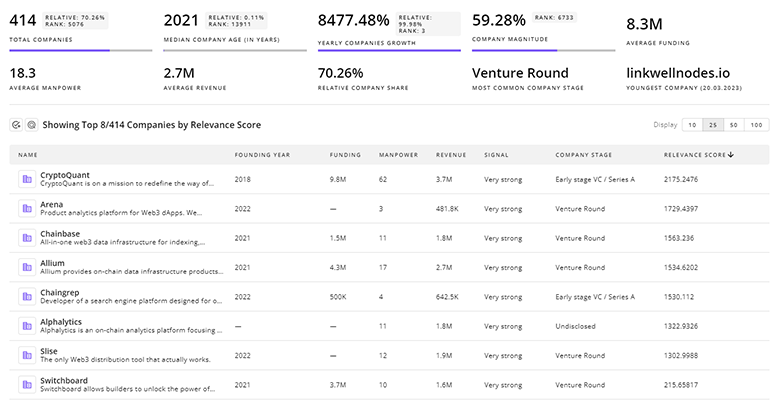
Get detailed analytics and profiles on 110.4K companies driving change in Sensors & Measuring Instruments, enabling you to make informed strategic decisions.
110.4K Sensors & Measuring Instruments Companies
Discover Sensors & Measuring Instruments Companies, their Funding, Manpower, Revenues, Stages, and much more
Sensors & Measuring Instruments Investors
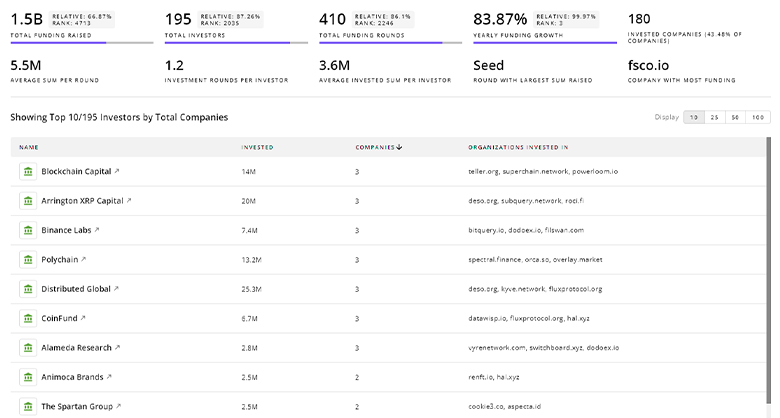
TrendFeedr’s Investors tool provides an extensive overview of 24.6K Sensors & Measuring Instruments investors and their activities. By analyzing funding rounds and market trends, this tool equips you with the knowledge to make strategic investment decisions in the Sensors & Measuring Instruments sector.
24.6K Sensors & Measuring Instruments Investors
Discover Sensors & Measuring Instruments Investors, Funding Rounds, Invested Amounts, and Funding Growth
Sensors & Measuring Instruments News
Explore the evolution and current state of Sensors & Measuring Instruments with TrendFeedr’s News feature. Access 90.3K Sensors & Measuring Instruments articles that provide comprehensive insights into market trends and technological advancements.
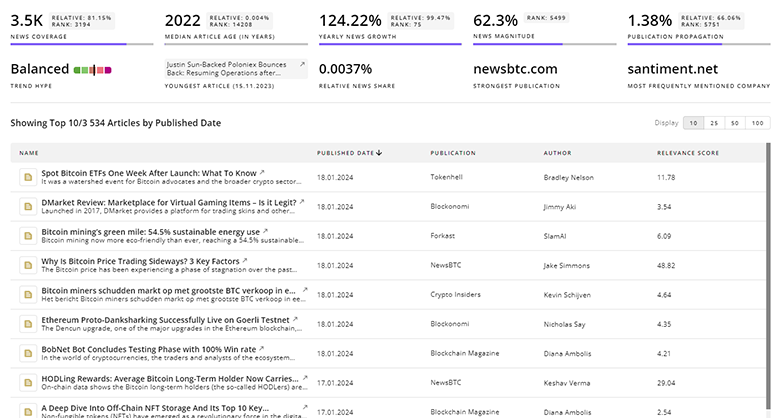
90.3K Sensors & Measuring Instruments News Articles
Discover Latest Sensors & Measuring Instruments Articles, News Magnitude, Publication Propagation, Yearly Growth, and Strongest Publications
Executive Summary
Measurement is migrating from commodity sensing toward an auditable service: enterprises pay premiums for data they can trust and for sensors that minimize operational overhead. Strategic winners will combine a defensible measurement physics (optical MEMS, FBAR, QCM, fiber optics), embedded calibration and provenance, and edge analytics that convert raw signals into contractable, audit-grade evidence used by operations, insurance and compliance teams. For companies and investors, the highest ROI will come from offerings that repackage sensor outputs as verifiable, continuous services—either as calibration-backed data streams or as low-maintenance telemetry platforms that materially reduce OPEX in hazardous and remote deployments.
We're looking to collaborate with knowledgeable insiders to enhance our analysis of trends and tech. Join us!