Smart Sensing Report
: Analysis on the Market, Trends, and TechnologiesThe smart sensing market is at a clear growth inflection: the internal smart sensing trend report records a 2023 market size of USD 56.2 billion and a 12.1% projected CAGR to a 2032 forecast of USD 162.4 billion, signaling sustained commercial expansion and investment. External market forecasts vary by scope and method but consistently indicate high double-digit or mid-double-digit growth through the 2020s, driven by healthcare wearables, industrial predictive maintenance, edge AI adoption, and environmental monitoring Global Market Insights BCC Research MarketsandMarkets.
76 days ago, we last updated this report. Notice something that’s not right? Let’s fix it together.
Topic Dominance Index of Smart Sensing
To gauge the influence of Smart Sensing within the technological landscape, the Dominance Index analyzes trends from published articles, newly established companies, and global search activity
Key Activities and Applications
- Industrial predictive maintenance and condition monitoring using vibration, temperature, and wireless sensors to reduce unplanned downtime and extend asset life; this use case figures prominently in the internal dataset and vendor offerings such as Sensoteq and SenseGiz Sensoteq SenseGiz Technologies.
- Contactless health monitoring and AgeTech applications using mmWave and UWB radar for vital-sign detection, fall detection, and assisted living; patents and product firms emphasize noncontact sensing for care and safety.
- Environmental and air/water quality monitoring with multi-gas microsensors and distributed networks for regulatory compliance, urban planning, and industrial emissions control AirSENCE.
- Smart infrastructure and structural health monitoring via fiber optic and distributed acoustic/temperature sensing for bridges, rail, tunnels, and energy assets AP Sensing.
- Privacy-preserving occupancy and people-flow analytics for buildings, retail and urban planning using edge vision, on-device counts, or RF sensing to avoid raw video capture VizioSense Husense.
Emergent Trends and Core Insights
- Edge AI becoming standard at sensor nodes: sensor makers and tool vendors position tinyML, neuromorphic inference, and chipset-ready AutoML to perform classification and anomaly detection on-device, reducing latency and data transport cost SensiML Corp SynSense.
So what: Deployments that embed inference at the sensor create new product tiers—sensors-as-intelligent-endpoints—enabling subscription analytics and lowering cloud bills while making real-time safety and control feasible. - Sensor fusion and multi-modal stacks (radar + IMU + optical + gas) drive higher decision accuracy for ADAS, HealthTech, and industrial inspection research and markets sensor reports.
So what: Companies that master cross-modal calibration and synchronization capture the highest-value vertical contracts because single-sensor solutions often fail real-world reliability targets. - Energy-aware and self-powered sensing (energy harvesting, ultra-low-power SoCs, batteryless nodes) address the deployment economics and maintenance burden cited as top limitations in the internal data researchandmarkets sensor TOE.
So what: Lower operational cost opens large-scale municipal and agricultural rollouts where battery replacement or mains power is impractical. - Privacy-first sensing architectures and non-video modalities gain commercial traction as regulations and consumer concern rise; vendors emphasize on-device aggregation or non-imaging modalities like radar and passive RF sensing.
So what: Privacy-respecting designs accelerate procurement by public agencies and healthcare providers while reducing legal and compliance friction. - Market forecast divergence reflects differing scopes and segmentation methods: forecasts range widely (mid-USD billions to >USD 300B by 2030+), but they converge on sustained double-digit growth driven by IoT and edge analytics Fortune Business Insights.
So what: Differences matter when sizing SAM/TAM for a specific vertical; business models should stress repeatable revenue (SaaS, data subscriptions) to capture value regardless of headline market magnitude.
Technologies and Methodologies
- MEMS and CMOS-integrated sensors for mass-market low-cost, high-volume sensing, with CMOS-inside approaches enabling single-chip multi-sensor modules.
- Millimeter-wave (mmWave) and Ultra Wide Band radar for noncontact vital signs, presence detection, and privacy-first occupancy sensing Aria Sensing.
- Edge compute stacks and TinyML AutoML toolchains that generate deployment-ready models for microcontrollers and low-power SoCs.
- Fiber optic distributed sensing (DTS / DAS / DTSS) for long-range structural and perimeter monitoring where EMI immunity and continuous coverage matter.
- Software-defined sensing and digital pre-processing (on-chip ADC preprocessing, analog computing primitives) to reduce data bandwidth and improve signal quality before inference.
Smart Sensing Funding
A total of 116 Smart Sensing companies have received funding.
Overall, Smart Sensing companies have raised $1.6B.
Companies within the Smart Sensing domain have secured capital from 393 funding rounds.
The chart shows the funding trendline of Smart Sensing companies over the last 5 years
Smart Sensing Companies
- DIAMSENS
DIAMSENS develops in-situ water quality sensors built on diamond nanocrystal surfaces to reduce maintenance and extend field life, targeting municipal, agricultural, and wastewater markets. Its low-energy self-cleaning approach addresses the common electrochemical sensor replacement and recalibration cost drivers called out in environmental monitoring use cases. The company's product roadmap positions it for stepwise expansion from pools to agriculture and then municipal water treatment, giving a focused, revenue-path blueprint rather than a broad product scatter. - Pontosense
Pontosense combines AI with mmWave radar to deliver contactless presence, behavior classification, and vital-sign monitoring for AgeTech, automotive child presence detection, and assisted living. The firm highlights Euro NCAP compliance for child presence detection, which signals readiness for OEM integration and regulatory-driven adoption in mobility safety programs. Its contactless approach directly answers privacy and hygiene concerns that hinder camera-based solutions. - UPTECH SENSING
UPTECH SENSING focuses on fiber-optic real-time monitoring (distributed strain/temperature) for civil infrastructure, wind energy blades, high-voltage transmission lines, and pipelines. The company provides both hardware and specialist installation expertise, recognizing that data value depends on correct fiber deployment and signal integrity in long-run monitoring programs. This systems-level capability creates higher entry barriers and more durable customer relationships. - Tiami Networks
Tiami Networks extracts sensing information from ambient 5G and Wi-Fi to build passive radar-style occupancy and flow analytics without deploying new RF infrastructure. The approach lowers deployment friction for urban-scale monitoring and supports privacy-sensitive analytics because it leverages existing emissions rather than cameras. This positions the company as a potential data marketplace provider for cities and retailers seeking anonymized footfall insights. - Nanusens
Nanusens engineers sensors built inside standard CMOS, creating single-chip NEMS/MEMS devices that shrink size and simplify integration for consumer and industrial OEMs. By embedding sensors and control electronics on one die, Nanusens reduces BOM cost and frees PCB area for batteries or additional features—an attractive value proposition for wearables, mobile, and compact IoT devices. Their patent-pending approach targets high-volume use cases where size and cost drive adoption.
Get detailed analytics and profiles on 531 companies driving change in Smart Sensing, enabling you to make informed strategic decisions.
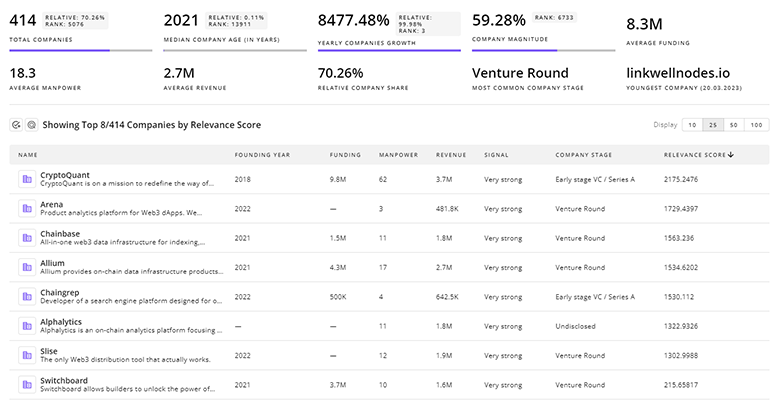
531 Smart Sensing Companies
Discover Smart Sensing Companies, their Funding, Manpower, Revenues, Stages, and much more
Smart Sensing Investors
TrendFeedr’s Investors tool provides an extensive overview of 463 Smart Sensing investors and their activities. By analyzing funding rounds and market trends, this tool equips you with the knowledge to make strategic investment decisions in the Smart Sensing sector.
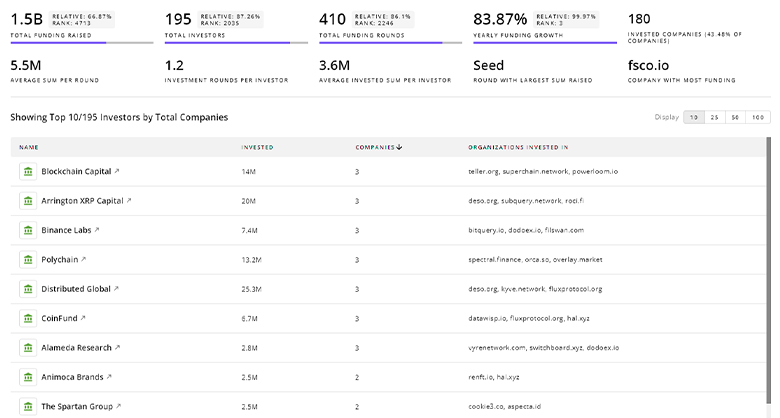
463 Smart Sensing Investors
Discover Smart Sensing Investors, Funding Rounds, Invested Amounts, and Funding Growth
Smart Sensing News
Explore the evolution and current state of Smart Sensing with TrendFeedr’s News feature. Access 1.2K Smart Sensing articles that provide comprehensive insights into market trends and technological advancements.
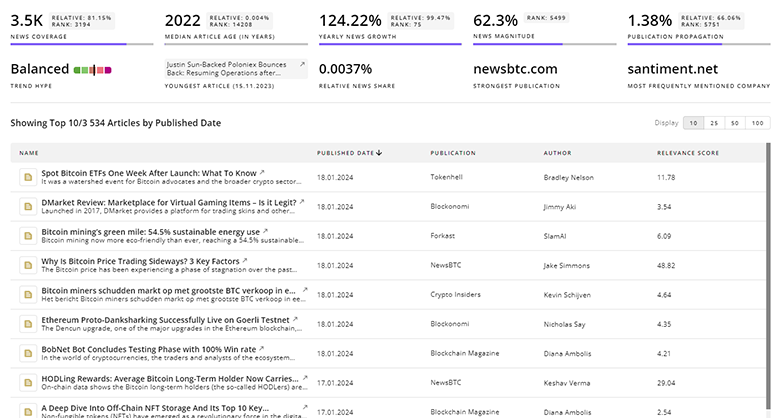
1.2K Smart Sensing News Articles
Discover Latest Smart Sensing Articles, News Magnitude, Publication Propagation, Yearly Growth, and Strongest Publications
Executive Summary
Smart sensing now sits at the intersection of hardware miniaturization, edge AI, and system-level integration. Practical commercial wins will come to companies that pair low-power, multi-modal sensing hardware with embedded analytics and clear subscription or services monetization. For buyers and investors, the most important discriminators are data quality across modalities, edge inference capability, privacy-preserving architectures, and proven deployment economics (installation plus lifecycle cost). Firms that build repeatable integration practices and platform-friendly interfaces will convert strong market growth into durable revenue streams as the sector scales.
We're looking to collaborate with knowledgeable insiders to enhance our analysis of trends and tech. Join us!