Solar Farm Report
: Analysis on the Market, Trends, and TechnologiesThe solar farm sector sits at a clear inflection point: the internal trend data reports total funding of $44.45B raised by companies active in this space, signalling sizeable capital flows into deployment and technology layers. Asia Pacific remains the primary deployment engine (regional share >50% in recent assessments) while market forecasts vary—conservative estimates place the 2024 market near USD 100–230B with mid- and long-term projections ranging widely depending on scope and methodology (IMARC Group Market Research Future Expert Market Research). The business implications are distinct: investors must choose between scale plays (utility projects and manufacturing) and specialized plays (agrivoltaics, automated construction, AI O&M) because both capital intensity and technology differentiation now determine returns.
99 days ago, we last updated this report. Notice something that’s not right? Let’s fix it together.
Topic Dominance Index of Solar Farm
To gauge the influence of Solar Farm within the technological landscape, the Dominance Index analyzes trends from published articles, newly established companies, and global search activity
Key Activities and Applications
- Utility-scale power generation: large ground-mounted farms remain the core revenue source and PPA anchor for corporate and grid buyers.
- Agrivoltaics (dual-use farms): co-locating PV with crops or grazing to monetize the same land for energy and agriculture while providing income diversification for landowners.
- Solar-plus-storage and hybrid plants: pairing BESS with solar to deliver dispatchable energy, peak-shaving and ancillary services; increasingly required in large procurement contracts.
- Community and shared-solar models: subscription and member-owned projects that expand access without rooftop installation, improving local retention of value (Solar Farms NY SolarShare Canberra).
- Site selection, pre-construction and rapid deployment services: GIS-driven parcel identification and patented fast-build construction methods reduce development time and upfront risk.
Emergent Trends and Core Insights
- Agrivoltaics moves from pilot to portfolio: patent activity and project pipelines show a systematic push to standardize agrivoltaic mounts, semi-transparent modules and crop-optimized layouts—this changes land economics by adding farm income streams to energy revenues.
- Automation and industrialized construction lower LCOE for remote, large sites: machine-led, factory-style installation approaches promise faster, lower-cost builds that shift project economics versus purely manual EPC models.
- Software-first O&M and portfolio analytics scale value capture: AI-enabled platforms that detect string-level underperformance and prioritize repairs materially reduce downtime and O&M spend, increasing asset IRR (SOLAR SPY).
- Regional supply-chain divergence and policy sensitivity: Asia Pacific dominates manufacturing and deployments; US and EU policy interventions (incentives, domestic manufacturing support) reshape where modules and BOS components are sited and who captures margins.
- Market sizing variance reflects definition differences: public forecasts differ because some reports model PV + BESS + floating and agrivoltaics comprehensively, while others use narrower utility-scale definitions—expect headline CAGR spreads between roughly 6% and 18% depending on the report (ResearchAndMarkets agrivoltaics forecast).
Technologies and Methodologies
- High-efficiency PV modules and bifacial/vertical arrays: bifacial modules and vertical mounting improve energy yield per land area and enable agrivoltaic row designs that sustain crops beneath modules.
- Battery energy storage systems (BESS) integration: co-located BESS is now a planning norm for multi-hour firming and merchant-market participation in large projects (Fulham Solar Farm).
- AI-driven O&M, digital twins and aerial inspection: remote thermography, digital twins and predictive alerts reduce mean time to repair and enable portfolio-level KPI benchmarking.
- Robotic and prefabricated construction: patented fast-build racking and site robotics compress schedule risk and labor intensity for utility projects.
- Floating PV and hybrid systems: floatovoltaics extend deployable surface area while reducing evaporation; hybrid PV + thermal + storage systems aim at industrial heat and electrification use cases.
Solar Farm Funding
A total of 358 Solar Farm companies have received funding.
Overall, Solar Farm companies have raised $46.5B.
Companies within the Solar Farm domain have secured capital from 1.0K funding rounds.
The chart shows the funding trendline of Solar Farm companies over the last 5 years
Solar Farm Companies
SolarisAI Pty Ltd
SolarisAI provides a SaaS O&M and asset-performance platform developed at the University of Queensland that applies machine learning to reduce faults, soiling losses and underperformance across large PV arrays; the product targets operators who need portfolio-scale predictive maintenance and KPI reporting for investors.Sunscale
Sunscale pursues an industrialized construction model that automates high-area solar builds, aiming to shift cost drivers from labor to machine hours and enable rapid hyperscale deployments in remote sites; the firm positions its approach as a means to reduce installation time and LCOE for very large projects.Next2Sun AG
Next2Sun commercializes vertical bifacial PV systems and a bifacial solar fence; the vertical concept captures morning and evening irradiance on east-west faces and preserves between-row land for agriculture or habitat, making it a practical agrivoltaic building block for constrained land portfolios.Meralli Solar
Meralli applies a patented fast-build construction process proven on large unsubsidised projects in Australia; its method reduces on-site framing time and supports regional workforce deployment, which shortens commercial schedules and lowers installation risk for developers.Solar Site Finders LLC
Solar Site Finders uses GIS-driven parcel analytics to locate buildable land, hosting-capacity-constrained parcels and community-solar candidates—an underwriting tool that cuts early-stage development costs and improves site prioritization for developers and investors.
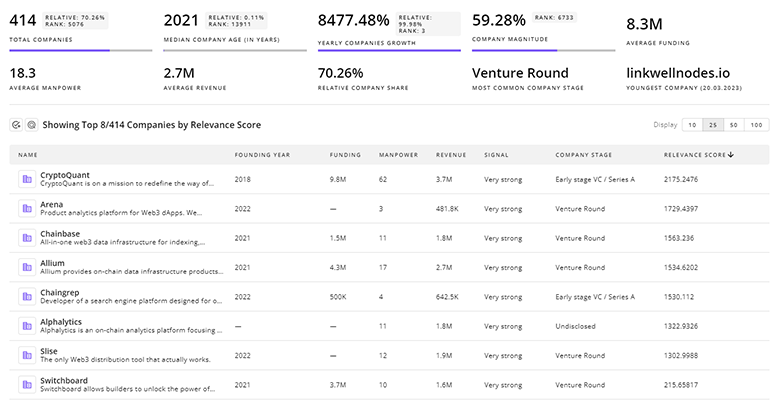
Get detailed analytics and profiles on 3.3K companies driving change in Solar Farm, enabling you to make informed strategic decisions.
3.3K Solar Farm Companies
Discover Solar Farm Companies, their Funding, Manpower, Revenues, Stages, and much more
Solar Farm Investors
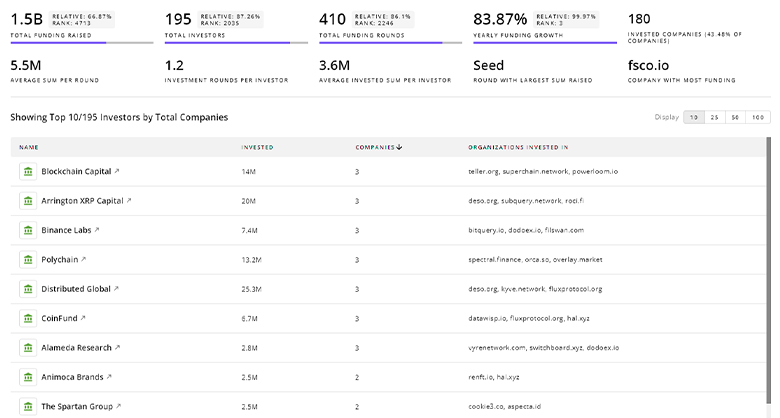
TrendFeedr’s Investors tool provides an extensive overview of 1.1K Solar Farm investors and their activities. By analyzing funding rounds and market trends, this tool equips you with the knowledge to make strategic investment decisions in the Solar Farm sector.
1.1K Solar Farm Investors
Discover Solar Farm Investors, Funding Rounds, Invested Amounts, and Funding Growth
Solar Farm News
Explore the evolution and current state of Solar Farm with TrendFeedr’s News feature. Access 9.8K Solar Farm articles that provide comprehensive insights into market trends and technological advancements.
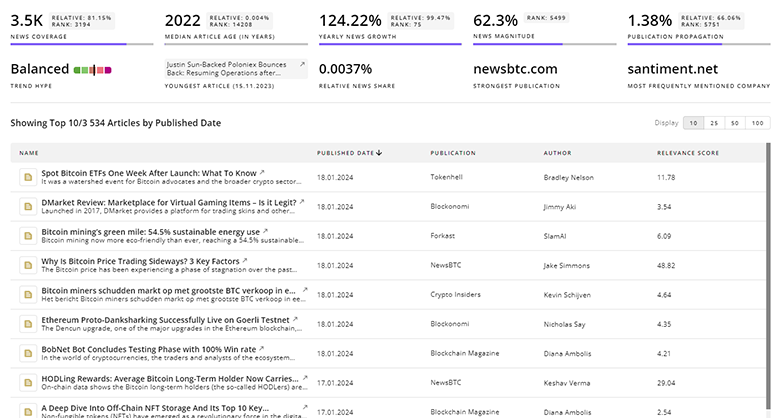
9.8K Solar Farm News Articles
Discover Latest Solar Farm Articles, News Magnitude, Publication Propagation, Yearly Growth, and Strongest Publications
Executive Summary
Solar farms now combine scale economics with targeted technology differentiation. Capital continues to flow into the sector, but returns will concentrate where project sponsors manage three levers together: land-use economics (including agrivoltaics and bifacial/vertical layouts), integrated energy value (solar plus multi-hour storage and grid services), and digital operations (AI-enabled O&M and rapid construction methods). For investors and developers, the practical next steps are clear: prioritize sites that allow dual-use or high-yield module configurations, require storage to meet offtake requirements, and adopt automation and analytics that compress schedules and reduce operating cost per MWh. These choices separate low-margin commodity projects from higher-margin, resilient assets that capture the full chain of value from module to meter to market.
We're looking to collaborate with knowledgeable insiders to enhance our analysis of trends and tech. Join us!