Sustainable Manufacturing Report
: Analysis on the Market, Trends, and TechnologiesThe sustainable manufacturing landscape is maturing into a data-first industrial movement where material circularity meets process intelligence — today the ecosystem includes 5,079 active companies and has attracted $34.20B in total funding, signaling concentrated capital flows into specialized technology plays. Market projections from external analyses show continuing high growth (for example, a forecast to USD 367.2 billion by 2029) driven by recycled materials, energy-efficient equipment, and digital factory controls PR Newswire – Sustainable Manufacturing Market. The practical implication for manufacturers and investors is clear: prioritize verifiable reductions in operational footprint (energy, waste, Scope 3 exposure) and pair those with proprietary feedstock or control-system assets to defend value.
51 days ago, we last updated this report. Notice something that’s not right? Let’s fix it together.
Topic Dominance Index of Sustainable Manufacturing
To gauge the influence of Sustainable Manufacturing within the technological landscape, the Dominance Index analyzes trends from published articles, newly established companies, and global search activity
Key Activities and Applications
- Circular feedstock conversion (waste-to-chemicals and biopolymers). Companies convert food, municipal and industrial organics into usable intermediates and polymers to displace virgin petrochemicals; this reduces raw-material risk and shortens emission-intensive supply chains
- Low-impact materials substitution (biobased polymers and plant leathers). Substitutes such as PHA, plant-based leathers, and bio-acetates lower embodied carbon in packaging, textiles and accessories while opening premium pricing paths for brands
- Inline process verification and first-time-right manufacturing. Real-time spectroscopy and sensors prevent scrap and rework by catching deviations earlier in the process, which reduces material throughput and energy per good produced
- Compact, modular biomanufacturing and continuous production. Moving from batch to continuous lines and modular skids compresses footprint, reduces utilities consumption, and enables localized production for sensitive or perishable feedstocks Stamm.
- Energy systems integration (renewables + storage + heat recovery). Factories integrate onsite solar, battery storage and waste-heat recovery to lower grid dependency and operational carbon intensity, a core pathway to net-zero operations.
Emergent Trends and Core Insights
- Materials and process bifurcation. Investment favours two clear vectors: (1) feedstock circularity — companies capturing value from waste streams, and (2) process intelligence — software/hardware stacks that shrink operating emissions. This split explains concentrated funding into high-value startups while many materials plays remain fragmented.
- Digital twin + AI as the sustainability control plane. Digital twins and AI-driven scheduling enable predictive resource allocation that reduces energy and material waste; adoption of these systems is accelerating as the primary method to convert sustainability targets into measurable operational gains From Industry.O to Green.O.
- Regulatory forcing functions are converging with purchasing preferences. Stricter disclosure and product-design mandates in Europe and rising consumer willingness to pay for sustainable products are creating immediate procurement and product-design constraints that effectively speed technology adoption Circular Economy and Sustainability Regulations.
- Localized, repairable, and service-led models reduce lifecycle emissions. Product-as-a-service and repair/refurbishment flows reduce demand for virgin input and lower total lifecycle impact; this becomes a meaningful commercial differentiation in B2B and premium consumer segments.
- Value migration toward logistics and verification. Efficient, low-emission logistics and verifiable cold-chain solutions are capturing value as buyers seek provable end-to-end reductions, not only lower emissions at the factory gate SkyCell AG
Technologies and Methodologies
- Additive and hybrid manufacturing for material efficiency. Additive Manufacturing and Hybrid AM reduce cut waste and enable consolidated parts, lowering material use for complex components marketresearchfuture - Sustainable Manufacturing Market.
- Digital twins, PAT and advanced in-line analytics. Virtual models plus Process Analytical Technology allow teams to test production changes digitally and implement real-time process corrections that materially cut rework and energy use
- AI-driven predictive resource flow and scheduling. AI models that forecast material flows and energy peaks reduce idle energy and pre-empt resource mismatches, translating into lower footprint per unit. This is where IP in control stacks becomes defensible.
- Electrothermal and biocatalytic chemical routes. New chemical routes — electrothermal processing and enzyme-catalysed conversions — lower high-temperature process emissions in specialty chemicals and polymer precursors.
- Closed-loop recovery and advanced recycling (hydrometallurgy, depolymerization). Mechanical recycling paired with chemical and hydrometallurgical routes recovers high-value streams (lithium, nickel, PHA precursors) that feed back into production, improving material resiliency Grand View Research - Sustainable Manufacturing Market.
Sustainable Manufacturing Funding
A total of 635 Sustainable Manufacturing companies have received funding.
Overall, Sustainable Manufacturing companies have raised $35.8B.
Companies within the Sustainable Manufacturing domain have secured capital from 2.2K funding rounds.
The chart shows the funding trendline of Sustainable Manufacturing companies over the last 5 years
Sustainable Manufacturing Companies
- Biotic — Biotic produces scalable PHA-class biopolymers using diverse feedstocks (including algae and agricultural residues) with the explicit goal of replacing fossil plastics at commodity scale. The company has raised $8.38M and operates as an early-stage VC growth firm pursuing drop-in substitutions for existing polymer supply chains, which lowers adoption friction for brands. Their model targets full biodegradability across environments, directly addressing downstream disposal liabilities and Scope 3 risk for consumer brands
- ChainCraft — ChainCraft scales mixed-culture fermentation to convert organic waste into medium-chain fatty acids (MCFA) that serve as chemical building blocks across feed, coatings, lubricants and polymer intermediates. The company operates a demonstration plant producing 2,000 tonnes annually and has attracted $33.22M in funding to prove scale economics and downstream partnerships. Their feedstock flexibility (food waste, agricultural residues) directly lowers feedstock volatility for downstream manufacturers
- Paques Biomaterials — Paques Biomaterials focuses on producing PHA from industrial and municipal wastewater streams, positioning the firm as an upstream supplier of fully biodegradable feedstock for packaging and textiles. With $30.47M raised, they emphasize closed-loop processing that converts waste liabilities into material inputs, reducing both disposal costs and embodied emissions for buyers
- MOICvegan — MOICvegan manufactures plant-based bio-leathers (apple, cactus, pineapple feedstocks) for luxury accessories, coupling material substitution with repairability and biodegradable packaging. The firm targets designer brands that require high cosmetic quality while removing animal and fossil inputs, enabling a premium, traceable alternative in fashion supply chains. Their product positioning reduces reputational and regulatory risk for brand partners
- tec5USA Inc. — tec5USA Inc. produces inline spectrometers (UV-VIS-NIR, LIBS, Raman) that provide real-time process verification and non-destructive quality control, enabling first-time-right manufacturing and reduced scrap rates. Their tailored solutions deliver measurable yield and energy savings by enabling immediate corrective actions on the line, a capability that becomes a direct sustainability lever across high-value materials processing. tec5USA's process instrumentation is a practical enabler of digital twins and PAT frameworks in sustainable production lines
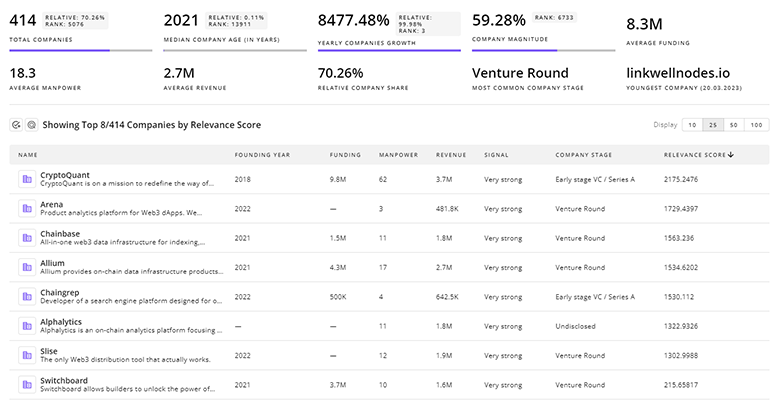
Get detailed analytics and profiles on 5.1K companies driving change in Sustainable Manufacturing, enabling you to make informed strategic decisions.
5.1K Sustainable Manufacturing Companies
Discover Sustainable Manufacturing Companies, their Funding, Manpower, Revenues, Stages, and much more
Sustainable Manufacturing Investors
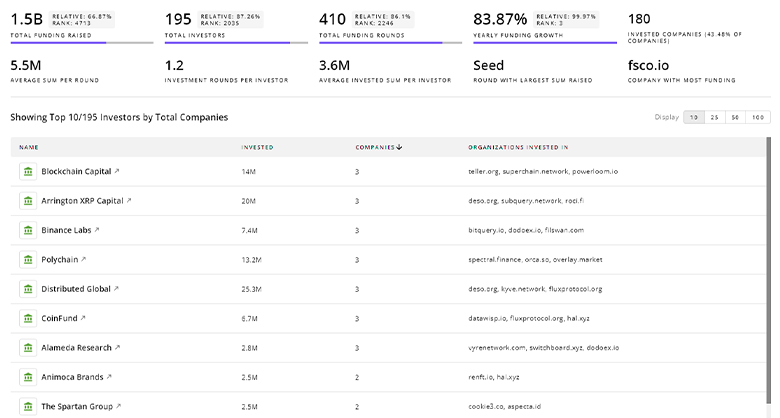
TrendFeedr’s Investors tool provides an extensive overview of 2.1K Sustainable Manufacturing investors and their activities. By analyzing funding rounds and market trends, this tool equips you with the knowledge to make strategic investment decisions in the Sustainable Manufacturing sector.
2.1K Sustainable Manufacturing Investors
Discover Sustainable Manufacturing Investors, Funding Rounds, Invested Amounts, and Funding Growth
Sustainable Manufacturing News
Explore the evolution and current state of Sustainable Manufacturing with TrendFeedr’s News feature. Access 11.2K Sustainable Manufacturing articles that provide comprehensive insights into market trends and technological advancements.
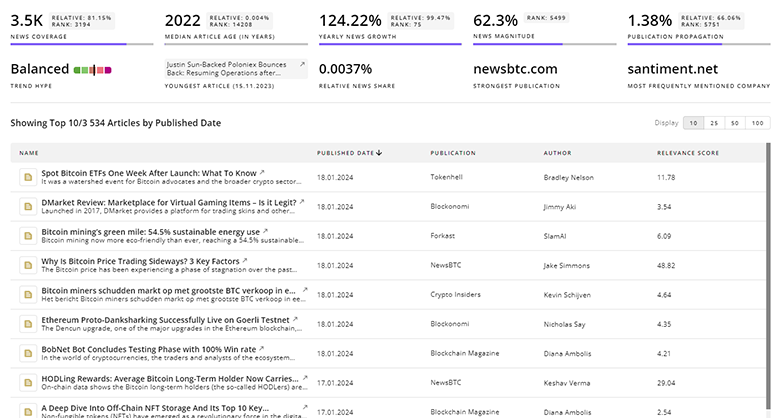
11.2K Sustainable Manufacturing News Articles
Discover Latest Sustainable Manufacturing Articles, News Magnitude, Publication Propagation, Yearly Growth, and Strongest Publications
Executive Summary
Sustainable manufacturing is now a two-track contest: firms either secure proprietary feedstock and material-level advantages or they master process control and data to shrink operational footprints. The most investable targets will demonstrate both measurable lifecycle impact reductions and commercial defensibility — either through secured low-carbon inputs, validated closed-loop flows, or control-system IP that drives persistent efficiency gains. For corporates, the pragmatic path is to combine selective material partnerships with aggressive deployment of digital twins, inline analytics and energy-system integration so that sustainability moves from compliance to margin enhancement. For investors, the highest asymmetric returns lie with companies that can prove scaled circularity or deliver quantifiable, repeatable reductions in energy and waste per unit produced.
We're looking to collaborate with knowledgeable insiders to enhance our analysis of trends and tech. Join us!