Synthetic Biology Report
: Analysis on the Market, Trends, and TechnologiesThe synthetic biology sector exhibits clear market momentum: global market size stood at $11,520,000,000 in 2023 with forecasts projecting $62,000,000,000 by 2032, reflecting sustained capital flows and technology adoption that concentrate value around faster design-build-test pipelines. This shift is driven by concentrated patenting on DNA/RNA construction and ICT-enabled sequence analysis, rising commercial CDMO activity in enzymatic and cell-free synthesis, and a rapid increase in AI-enabled molecular design that together compress iteration time and reprice manufacturing economics.
262 days ago, we last updated this report. Notice something that’s not right? Let’s fix it together.
Topic Dominance Index of Synthetic Biology
To gauge the influence of Synthetic Biology within the technological landscape, the Dominance Index analyzes trends from published articles, newly established companies, and global search activity
Key Activities and Applications
- Engineering predictable cellular chassis for therapeutics and manufacturing, moving beyond single-gene edits toward whole-cell programming and genome-scale constructs that enable controlled production of complex molecules.
- High-fidelity DNA synthesis and assembly as the axial commercial activity: teams invest in enzymatic, cell-free and desktop synthesis solutions to reduce error rates and cycle time for long constructs DNA Script.
- Precision fermentation and continuous/continuous-style bioprocessing to convert engineered microbes into scaleable production systems for chemicals, materials and APIs; cost reductions of 20–50% are reported for some continuous fermentation concepts.
- Cell-free protein expression and on-demand manufacturing for rapid prototyping and decentralized supply of biologics and diagnostic reagents SYNTHELIS.
- Design of programmable cell therapies and gene-circuit medicines that embed sensing, computation and safety logic for clinical control and lower off-target risks Senti Biosciences.
Emergent Trends and Core Insights
- Computation-first engineering: AI and sequence-analysis ICT dominate new IP; closed-loop ML that learns from experimental yield data is increasingly patented, shifting the bottleneck to integrated wet-lab throughput.
- Synthesis as strategic choke point: firms providing high-accuracy, long-read DNA and cell-free vectors capture upstream leverage because they shorten biological iteration cycles and lower failure rates ELEGEN.
- Platform winners vs component specialists: value pools concentrate on integrated platforms that combine generative design, automated assembly, and standardized chassis; component specialists must secure embed-level partnerships or risk commoditization (market analysis and landscape signals) Asimov.
- Manufacturing economics dictate market access: achieving parity with petrochemical processes or incumbent API supply chains depends on continuous processing, fermentation separation innovations, or hybrid bio/chem routes to shrink cost gaps Visolis.
- Regulatory and supply-chain sensitivity: the geography of synthesis and reagent supply creates geopolitical vulnerability; companies with sovereign or distributed cell-free capabilities gain strategic importance in stress scenarios (patent and industry reports).
Technologies and Methodologies
- Enzymatic DNA synthesis and benchtop printers as alternatives to chemical oligo assembly to improve speed, length and purity of constructs.
- Cell-free protein synthesis (CFPS) for rapid prototyping and decentralized production of proteins and multi-component biologics Invitris.
- Generative AI and geometric deep-learning for de novo protein and circuit design that feed directly into high-throughput validation pipelines Top Ten Suppliers of Synthetic Biology Technology.
- High-throughput DNA assembly and molecular-programming methods that enable multiplexed gene libraries and scalable combinatorial exploration.
- Digital twins and mechanistic modeling for process scale-up and biomanufacturing predictability that reduce physical iterations and time-to-market.
Synthetic Biology Funding
A total of 1.3K Synthetic Biology companies have received funding.
Overall, Synthetic Biology companies have raised $106.4B.
Companies within the Synthetic Biology domain have secured capital from 5.8K funding rounds.
The chart shows the funding trendline of Synthetic Biology companies over the last 5 years
Synthetic Biology Companies
- RootPath — RootPath scales gene-function interrogation with a molecular programming assembly approach that produces accurate, long synthetic genes, enabling large functional screens and shortening the path from design to validated constructs. RootPath positions itself as a toolkit for high-throughput discovery that integrates with AI training-set generation for downstream design platforms. The company has raised $68,000,000 and focuses on enabling biology at scale to feed ML and biomanufacturing pipelines.
- DAB.bio — DAB.bio commercializes the FAST platform (Fermentation Accelerated by Separation Technology) to convert batch fermentation into continuous, cost-efficient processes, claiming 20–50% manufacturing cost reductions for certain chemistries. The firm targets industrial chemicals and materials where process economics determine commercial viability and bridges lab breakthroughs to pilot-scale deployment. DAB.bio's offering directly addresses the manufacturing bottleneck identified across market data.
- Khona Scientific, Inc. — Khona Scientific applies a modular biosynthetic platform (BiDS™) to produce rare, high-value natural molecules (for cosmetics, nutraceuticals and specialty ingredients) that are otherwise costly or supply-constrained. The company's approach focuses on substituting extraction with scalable biosynthesis and aims to deliver bio-identical compounds at lower cost and higher purity. Khona is an exemplar of niche product substitution where synthetic biology yields immediate commercial substitution opportunities.
- SynPlexity — SynPlexity builds large, diverse mutational libraries and multiplexed gene synthesis products to supply the training data that powers ML models in protein and pathway engineering; this data-centric model accelerates discovery by orders of magnitude. The company sits at the intersection of wet-lab scale and AI model quality, making it a strategic partner for platform builders that require broad, validated datasets. SynPlexity's platform is optimized for massive parallel screening use cases in enzymes and therapeutics.
- BioGeometry — BioGeometry applies generative diffusion and geometric deep-learning to protein design, coupling algorithmic generation with a wet-lab validation pipeline to reduce false positives from purely in silico work. As a small, focused team, BioGeometry aims to supply structurally novel biologics and differentiated lead modalities to larger partners, addressing the crucial validation feedback loop that many AI-first firms still lack. The company exemplifies AI-driven, design-for-function strategies that feed into higher-value therapeutic pipelines.
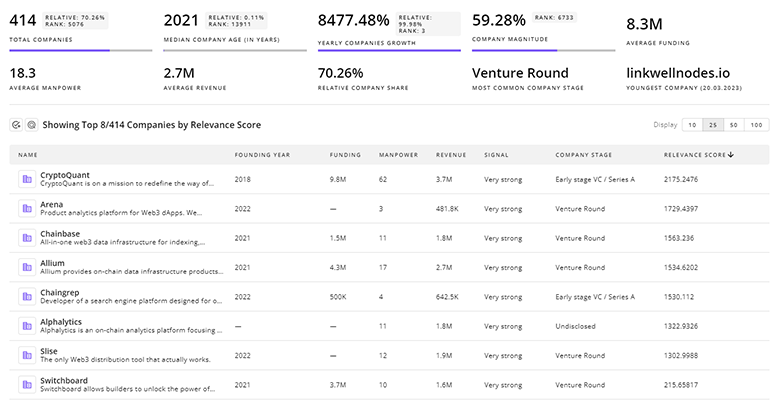
Get detailed analytics and profiles on 3.7K companies driving change in Synthetic Biology, enabling you to make informed strategic decisions.
3.7K Synthetic Biology Companies
Discover Synthetic Biology Companies, their Funding, Manpower, Revenues, Stages, and much more
Synthetic Biology Investors
TrendFeedr’s Investors tool provides an extensive overview of 5.5K Synthetic Biology investors and their activities. By analyzing funding rounds and market trends, this tool equips you with the knowledge to make strategic investment decisions in the Synthetic Biology sector.
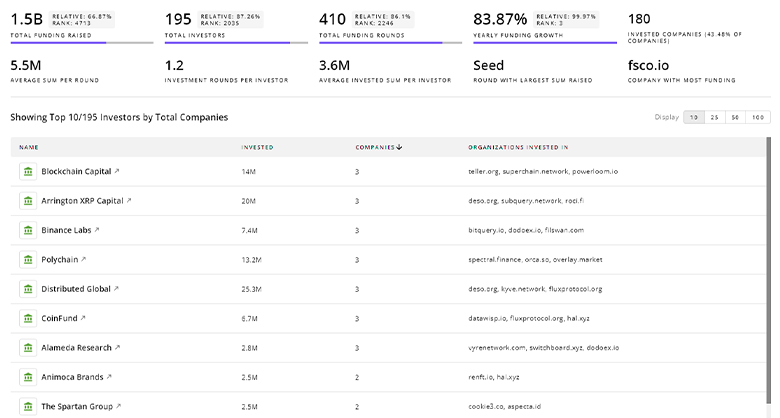
5.5K Synthetic Biology Investors
Discover Synthetic Biology Investors, Funding Rounds, Invested Amounts, and Funding Growth
Synthetic Biology News
Explore the evolution and current state of Synthetic Biology with TrendFeedr’s News feature. Access 15.0K Synthetic Biology articles that provide comprehensive insights into market trends and technological advancements.
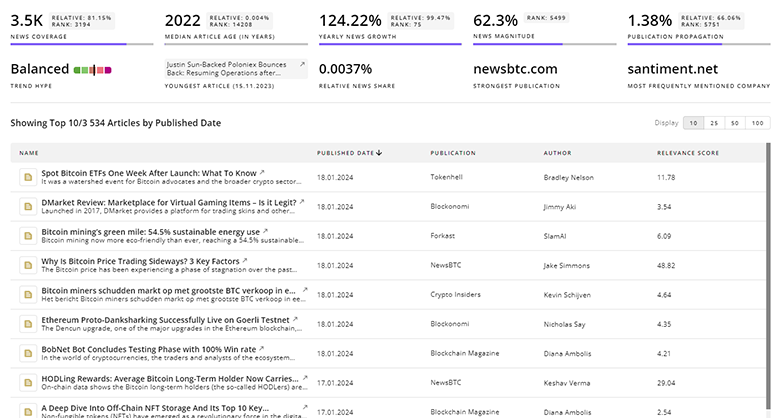
15.0K Synthetic Biology News Articles
Discover Latest Synthetic Biology Articles, News Magnitude, Publication Propagation, Yearly Growth, and Strongest Publications
Executive Summary
The strategic inflection in synthetic biology has moved from isolated discovery to integrated engineering: companies that compress the design-to-verified-product loop while controlling synthesis and manufacturing economics will capture disproportionate value. Market projections and patent activity point to DNA/RNA construction, AI-guided design, and automated assembly as the decisive levers. For investors and operators, the clear priorities are securing access to next-generation synthesis (enzymatic and cell-free), embedding predictive digital twins and ML feedback loops into experimental pipelines, and partnering across the value chain so niche technical advantages convert into platform-level defensibility. Carefully chosen partnerships between platform builders and component specialists will determine who scales from high-value lab demonstrations to reliable, commercially adoptable biomanufacturing.
We're looking to collaborate with knowledgeable insiders to enhance our analysis of trends and tech. Join us!