Unmanned Aerial Vehicles Report
: Analysis on the Market, Trends, and TechnologiesThe global unmanned aerial vehicle (UAV) market is large and growing: it was valued at about $30.4 billion in 2024 and the internal trend data projects a $100.7 billion market by 2034 at a 12.6% CAGR, driven by faster commercial adoption, extended-endurance platforms, and service models that scale operations beyond single-use hardware.
358 days ago, we last updated this report. Notice something that’s not right? Let’s fix it together.
Topic Dominance Index of Unmanned Aerial Vehicles
The Topic Dominance Index offers a holistic analysis of Unmanned Aerial Vehicles, merging data from 3 diverse sources: relevant published articles, newly founded companies, and global search metrics.
Key Activities and Applications
- Logistics and last-mile delivery — heavy-lift and VTOL systems enable urban and point-to-point cargo movement; the commercial push for package and medical deliveries (and trials combining UAVs with ground vehicles) is converting pilots and pilots’ waivers into recurring logistics services, changing unit economics for short hauls and urgent shipments researchnester.com.
So what: shifting from one-off proof-of-concept flights to fleet operations monetizes software, operations and networked infrastructure more than hardware alone. - Infrastructure inspection and maintenance — routine line, pipeline, wind-farm and rail inspections use high-resolution EO/IR, LiDAR and automated analytics to replace costly human climbs and manned sorties
So what: inspection workflows become data pipelines; providers selling analytics and regulatory compliance alongside flights capture higher recurring revenue. - Precision agriculture — multispectral mapping, targeted spraying and automated pest control improve input efficiency and yield monitoring; large ag pilots demonstrate measurable ROI per hectare
So what: agriculture proves the business case for DaaS (Drone-as-a-Service) because farmers pay for outcomes (coverage, spray accuracy), not aircraft. - Public safety, emergency response, and wildfire management — rapid situational awareness, mapping and targeted payload delivery (medical or sensors) reduce response times and personnel risk Real-Time Wildfire Operations.
So what: agencies prefer rented, certified fleets and managed services rather than owning sporadically used assets. - Maritime surveillance and shipborne support — ship-launched UAVs and coordinated UAV-USV operations expand naval ISR and MCM capabilities
So what: navies value modular, interoperable payloads and providers that integrate with existing C4I systems.
Emergent Trends and Core Insights
- AI-driven autonomy and edge processing — on-board ML reduces latency for obstacle avoidance, target recognition and GPS-denied navigation, enabling safer BVLOS missions
So what: companies owning reliable edge stacks and perception models gain a licensing and services revenue pathway (safety critical stack + certification). - BVLOS and UTM progress — testing programs and service suppliers are moving airspace governance from waivers to routine operations, which unlocks large-scale logistics and persistent monitoring use cases
So what: market expansion hinges on UTM adoption; UTM providers will capture recurring, platform-level revenue. - Platform consolidation vs. high-value specialization — the market is bifurcating: platform providers (airspace, fleet ops, analytics) seek to aggregate service flows while niche specialists monetize unique payloads and missions
So what: M&A and partnerships will intensify; buyers prefer integrated, certified stacks rather than point solutions. - Hybrid VTOL and extended-endurance propulsion — hybrid-electric, micro-turbine and hydrogen options extend mission duration and increase payload capacity, enabling longer surveillance and cargo missions gminsights.com.
So what: companies that solve power / thermal management gain the hardest technical moat. - Networked aerial services (drone-in-a-box + 5G) — automated launch/recovery with cellular or specialized links creates on-demand aerial networks for emergency response and commercial coverage MarketsandMarkets UAV report.
So what: telecommunications and cloud players will become strategic partners for persistent service footprints.
Technologies and Methodologies
- Advanced autonomy stacks and perception (edge ML, sensor fusion, SLAM) — combine LiDAR, EO/IR, multispectral sensors and on-board inference to reduce human intervention and enable GPS-denied flights emergenresearch.com.
Practical implication: certified perception stacks become required components in commercial BVLOS approvals. - Swarm coordination and multi-UAV orchestration — algorithms and C2 systems coordinate distributed assets for area coverage, inspection and contested-environment operations researchandmarkets.com.
Practical implication: services scale with software; providers can sell mission orchestration as a subscription. - Modular payload and plug-and-play airframes — rapid swapping of sensors, LiDAR, or delivery containers reduces fleet specialization and increases utilization rates
Practical implication: asset utilization and spare-parts logistics become competitive differentiators. - Hybrid and alternative propulsion (hybrid-electric, hydrogen, fuel cells) — tradeoffs in acoustic signature, endurance and payload shift platform selection for industrial and defense missions marketresearch.com.
Practical implication: operators with refueling or swap infrastructure can run persistent missions economically. - UTM, Remote ID and regulatory toolchains — cloud-based preflight deconfliction, real-time telemetry and certified service supplier models underpin safe scale-up technologyreview.com.
Practical implication: providers that embed compliance tooling into operations reduce certification friction for customers.
Unmanned Aerial Vehicles Funding
A total of 652 Unmanned Aerial Vehicles companies have received funding.
Overall, Unmanned Aerial Vehicles companies have raised $25.2B.
Companies within the Unmanned Aerial Vehicles domain have secured capital from 2.5K funding rounds.
The chart shows the funding trendline of Unmanned Aerial Vehicles companies over the last 5 years
Unmanned Aerial Vehicles Companies
- Vanilla Unmanned — Focuses on ultra-long-endurance solar and high-efficiency platforms designed for persistent ISR and wide-area monitoring. The company has demonstrated record endurance flights that materially reduce per-hour mission cost compared with conventional battery-powered VTOLs researchandmarkets.com. Vanilla’s capability is strategic for clients that need continuous presence without frequent ground recovery.
- M3 Agriculture Technologies — Combines drones with AI for precision pest control and sterile insect release programs. Their platform reduces chemical use and targets species-specific interventions, offering measurable cost and sustainability benefits to large farms and public-sector pest programs marketresearch.com. M3’s specialization creates high switching costs for agriculture customers seeking proven biological control methods.
- Xer Technologies — Develops heavy-duty hybrid-electric VTOL platforms for industrial inspection and environmental missions. Xer emphasizes custom payload integration and ruggedized systems suitable for harsh operating environments, addressing a gap between consumer drones and military-grade assets. Xer targets operators that need durable hardware and integrated support.
- Sentien Robotics — Offers autonomous fleet systems and robotic launch/transport vehicles (Hive-style platforms) that simplify multi-UAV logistics and deployment. Their approach reduces crew time and enables scalable DaaS operations for industrial and defense customers Heterogeneous Applications. Sentien’s value lies in lifecycle automation and faster mission turnaround.
- Kaizen Aerospace — Produces modular airframes and plug-and-play payload systems aimed at industrial mapping, inspection and medium-lift logistics. Kaizen’s modularity lowers integration time for custom sensors and supports rapid fleet reconfiguration for multi-mission operators Kaizen targets mid-market operators that need flexible hardware without bespoke design cycles.
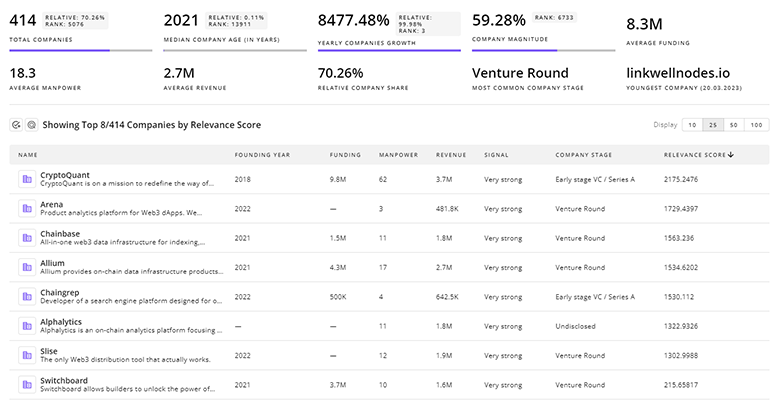
Stay connected with industry movements through TrendFeedr’s Companies tool, which covers 3.0K Unmanned Aerial Vehicles companies.
3.0K Unmanned Aerial Vehicles Companies
Discover Unmanned Aerial Vehicles Companies, their Funding, Manpower, Revenues, Stages, and much more
Unmanned Aerial Vehicles Investors
Discover investment patterns and trends with TrendFeedr’s Investors tool based on insights into 2.8K Unmanned Aerial Vehicles investors. This tool is essential for understanding the financial ecosystem of Unmanned Aerial Vehicles and developing successful investment strategies.
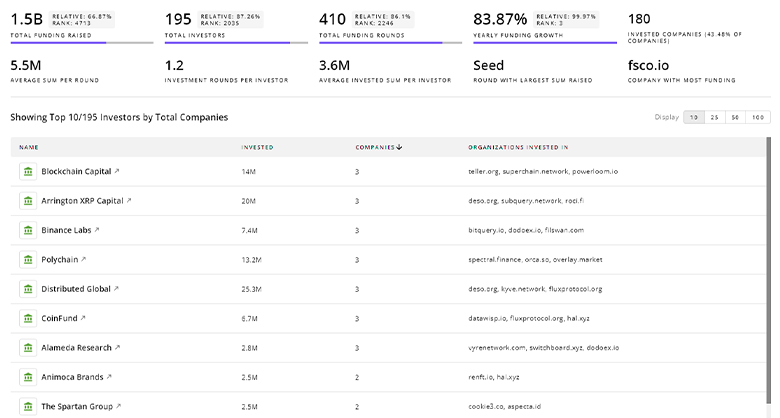
2.8K Unmanned Aerial Vehicles Investors
Discover Unmanned Aerial Vehicles Investors, Funding Rounds, Invested Amounts, and Funding Growth
Unmanned Aerial Vehicles News
TrendFeedr’s News feature grants you access to 14.7K Unmanned Aerial Vehicles articles. This tool supports professionals in tracking both past trends and current momentum in the industry.
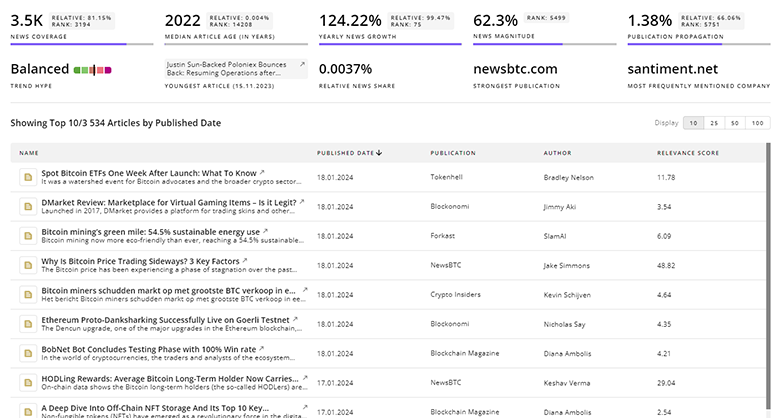
14.7K Unmanned Aerial Vehicles News Articles
Discover Latest Unmanned Aerial Vehicles Articles, News Magnitude, Publication Propagation, Yearly Growth, and Strongest Publications
Executive Summary
The UAV market today is simultaneously a technology arms race and a business-model pivot. The immediate commercial winners will be those who convert point use-cases into recurring service flows: UTM and fleet orchestration providers, edge autonomy stacks, and operators that bundle certified hardware with data analytics and compliance services. Technical advances—extended endurance, hybrid propulsion and sensor fusion—are necessary but not sufficient; regulatory integration, supply-chain resilience and operational economics determine scale. For investors and enterprise adopters, the most attractive sets of opportunities sit where mission criticality and repeatability meet differentiated technology: persistent monitoring, industrial inspection, and regulated logistics. Companies that combine certified operational frameworks with modular hardware and proven autonomy will command the highest valuations and the stickiest customer relationships.
We're looking to collaborate with knowledgeable insiders to enhance our analysis of trends and tech. Join us!