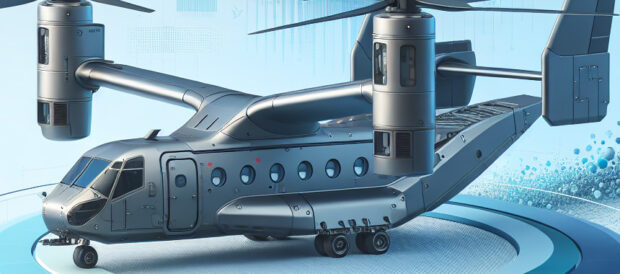
Urban Air Mobility Report
: Analysis on the Market, Trends, and TechnologiesThe UAM sector is on a steep commercial adoption trajectory with an internal trend analysis projecting a CAGR of 23.54% that makes infrastructure and energy services the most immediate monetizable segments. Market forecasts vary widely, but consensus signals accelerating investment into vertiports, charging, and UTM software, which together create the payback pathways for vehicle manufacturers and service operators grandviewresearch – Urban Air Mobility Market, 2024-2030.
11 days ago, we last updated this report. Notice something that’s not right? Let’s fix it together.
Topic Dominance Index of Urban Air Mobility
The Topic Dominance Index offers a holistic analysis of Urban Air Mobility, merging data from 3 diverse sources: relevant published articles, newly founded companies, and global search metrics.
Key Activities and Applications
- Vertiport design, construction, and operation — cities and private operators are prioritizing compact, modular vertiport deployments to enable high-frequency turnarounds and intermodal transfers marketdataforecast - Urban Air Mobility Market Report, 2025-2033.
- Air-traffic management (UTM / U-Space) integration — building certified, city-scale traffic orchestration that ties vertiports, vehicle telemetry, and national ATC is a gating item for dense operations eVertiSKY.
- Passenger air taxi services on short and medium ranges — point-to-point intracity and airport-to-city connections will form the marquee consumer product, but remain capital-intensive and regulatory dependent.
- Time-critical cargo and medical logistics — last-mile and high-value deliveries provide earlier positive cash flows and lower regulatory friction than full passenger lines.
- Energy supply and battery lifecycle services — modular battery packs, fast charging, and swap logistics reduce turnaround times and create operator lock-in opportunities.
- Regulatory sandboxing and municipal integration — local pilots, zoning, and community engagement programs are active priorities for cities that want to host early UAM services.
Emergent Trends and Core Insights
- Infrastructure-first monetization: Investors favor vertiports, VMS/UTM platforms, and charging networks because those assets generate recurring revenue earlier than passenger fleets, which still await broad certification Skyports Infrastructure.
- Energy systems become operational bottlenecks: High-power charging, modular battery arrangements, and second-life recycling will determine daily sortie rates; energy suppliers that standardize interfaces win scale advantages.
- Regulation is shifting from aircraft to ground integration: Certification progress on airframes is meaningful, but municipal approvals for vertiport siting and low-altitude airspace use will pace deployments in major cities.
- Software and data as defensible moats: UTM, vertiport management systems, and fleet orchestration software capture service margins and create strong switching costs once integrated with city systems and vehicle telemetry Skyway.
- Cargo-first commercial path: Freight and medical logistics present the fastest route to positive unit economics because missions tolerate smaller fleets and limited geographic scope.
- Autonomy and AI are maturing into certifiable subsystems, but full pilotless passenger operations still require phased regulatory acceptance and proven safety cases.
Technologies and Methodologies
- Electric and hybrid propulsion with modular battery architecture — high discharge, high charge modules with standardized mechanical/electrical docking reduce turnaround and maintenance complexity.
- Vertiport modularization and fast-turn workflows — compact, rooftop and repurposed-parking-lot vertiports with integrated charging, passenger flow, and automated ground handling lower time-to-operation.
- UTM / Vertiport Management Systems (VMS) — microservice VMS architectures that integrate with national ATC are the operational layer that enables scale.
- AI-enabled flight control and safety assurance — control barrier functions, sensor fusion and formalized failure-mode verification are being integrated to meet certification evidence requirements.
- Digital twins and CFD for vertiport siting and noise modeling — simulation is now a regulatory deliverable for many authorities to approve operations near dense urban fabric.
- Modularity across hardware and software stacks permits fleet-agnostic vertiports and enables service providers to host multi-manufacturer operations.
Urban Air Mobility Funding
A total of 179 Urban Air Mobility companies have received funding.
Overall, Urban Air Mobility companies have raised $55.8B.
Companies within the Urban Air Mobility domain have secured capital from 894 funding rounds.
The chart shows the funding trendline of Urban Air Mobility companies over the last 5 years
Urban Air Mobility Companies
- Urban-Air Port — Urban-Air Port designs and operates compact vertiport modules that combine passenger processing, charging and ground logistics into a single footprint; the firm markets variant models for passenger, cargo, and emergency missions and reports early commercial deployments and $26.10M of capital raised to scale sites. This infrastructure-first approach positions the company to capture recurring site and service revenue ahead of mass eVTOL fleet operations.
- UrbanV — UrbanV is an airport-backed vertiport network developer led by major Italian airport operators; it targets city-to-airport routes and intends to activate initial corridors rapidly by leveraging existing airport land, creating a pragmatic path to passenger services through known transport hubs.
- Mobius.energy Corporation — Mobius.energy builds high-power, modular battery packs optimized for eVTOL take-off and rapid recharge, and is commercializing a subscription model that includes maintenance and second-life reuse; its modular strategy addresses the known energy bottleneck and supports vertiport standardization.
- Dronzit Aerospace — Dronzit Aerospace develops fully autonomous eVTOL prototypes with an emphasis on AI-based loss-of-control protection and certification compliance pathways; the firm is pursuing UK and North American certification timelines for operator trials, making it a candidate for early autonomy use cases in regulated sandboxes.
- Etienne Innovation — Etienne Innovation focuses on high-efficiency multicopter platforms for urban logistics and heavy-lift deliveries, offering a logistics-first commercial route with payloads and routing optimized for dense urban networks, a practical path to early revenue outside full passenger services.
Stay connected with industry movements through TrendFeedr’s Companies tool, which covers 636 Urban Air Mobility companies.
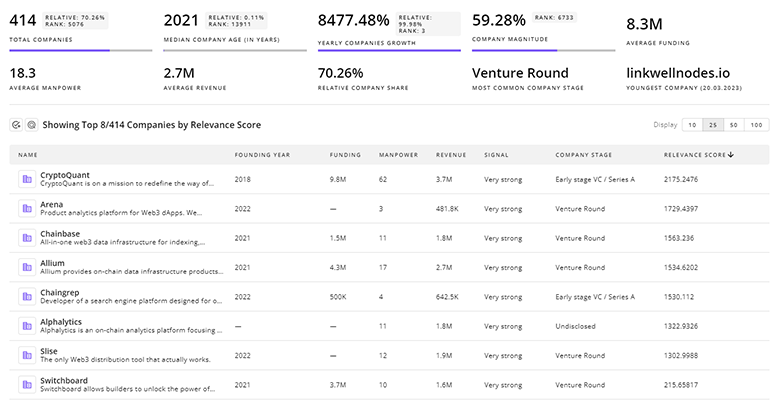
636 Urban Air Mobility Companies
Discover Urban Air Mobility Companies, their Funding, Manpower, Revenues, Stages, and much more
Urban Air Mobility Investors
Discover investment patterns and trends with TrendFeedr’s Investors tool based on insights into 1.3K Urban Air Mobility investors. This tool is essential for understanding the financial ecosystem of Urban Air Mobility and developing successful investment strategies.
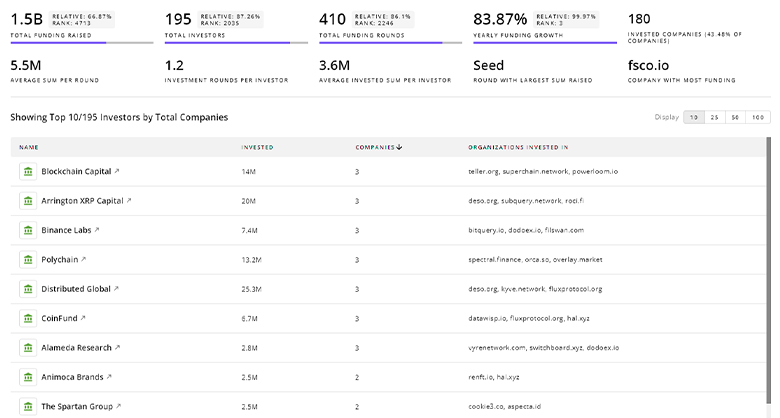
1.3K Urban Air Mobility Investors
Discover Urban Air Mobility Investors, Funding Rounds, Invested Amounts, and Funding Growth
Urban Air Mobility News
TrendFeedr’s News feature grants you access to 5.5K Urban Air Mobility articles. This tool supports professionals in tracking both past trends and current momentum in the industry.
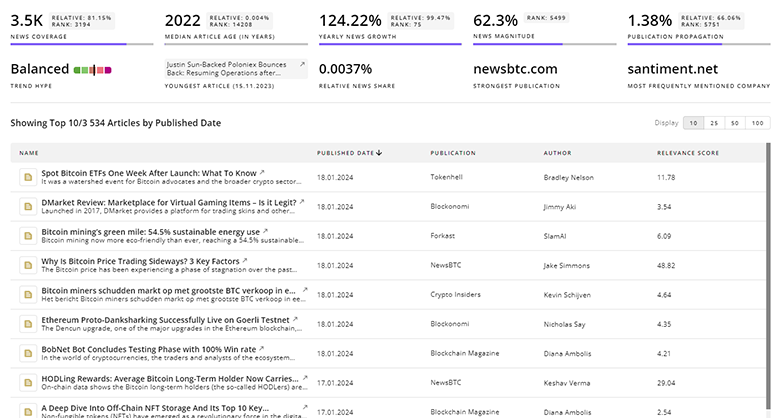
5.5K Urban Air Mobility News Articles
Discover Latest Urban Air Mobility Articles, News Magnitude, Publication Propagation, Yearly Growth, and Strongest Publications
Executive Summary
Infrastructure, energy services, and certified traffic management are the immediate value centers for the UAM market as airframes complete certification. The internal growth baseline of 23.54% CAGR places commercial opportunity within reach for parties that secure vertiport footprints, standardize charging/battery interfaces, or deliver certified UTM integrations. Vehicle makers still require aligned municipal approvals and integrated ground operations to convert orders into sustained revenue. For investors and operators the practical priority is to fund and lock in operational enablers (vertiports, charging, VMS) that create recurring cash flow and make vehicle manufacturers dependent customers rather than competitors.
We're looking to collaborate with knowledgeable insiders to enhance our analysis of trends and tech. Join us!