Vertical Farming Report
: Analysis on the Market, Trends, and TechnologiesThe vertical farming sector stands at a pivot where measured expansion meets operational scrutiny: market analysis records a 2024 market size of $14,230,000,000 with a projected $23,230,000,000 by 2029 and a CAGR of 10.30%—figures that frame short-term scale opportunities while exposing pressure points in capital and energy costs. Investors and operators now reward capital efficiency and repeatable operating models rather than novelty, and the clearest differentiator is mastery of the farm “control plane”—software, sensors, and automation—that compresses operating expense and stabilizes yields MarketsandMarkets – Vertical Farming Market.
262 days ago, we last updated this report. Notice something that’s not right? Let’s fix it together.
Topic Dominance Index of Vertical Farming
The Topic Dominance Index offers a holistic analysis of Vertical Farming, merging data from 3 diverse sources: relevant published articles, newly founded companies, and global search metrics.
Key Activities and Applications
- Local retail and foodservice supply: building-based and container farms located close to supermarkets, restaurants, and institutional kitchens to shorten lead times and reduce spoilage.
- Containerized and modular deployments: standardized shipping-container farms and plug-and-play cells for rapid site activation and routeable capacity Market Research Future – Vertical Farming Market Size, Share & Forecast.
- Controlled-environment production for leafy greens, herbs, and microgreens—the highest frequency commercial crops because of short cycles and consistent yield profiles.
- Specialty high-value crop programs: targeted industrial projects for berries, strawberries, medicinal botanicals and propagules where price per kg justifies higher CapEx (example: industrial strawberry programs). These projects shift unit economics when crop selection aligns with premium margins.
- Farming-as-a-Service (FaaS) and on-site appliance models: subscription or managed-service farms installed at retailers, workplace settings, and restaurants that trade upfront CapEx for recurring revenue and reduced commercial risk swegreen.com.
- Circular-resource projects and waste-to-energy integration: on-site anaerobic digestion and organic recycling to cut energy/net operating costs and improve resilience for distributed farms Future Greens.
Emergent Trends and Core Insights
- Operational discipline outranks novelty: following industry volatility, the winning playbook centers on lowering unit operating cost per kg through automation, energy strategy, and crop selection rather than scaling capacity alone.
- Energy and climate controls are the principal cost levers: experimental adaptive systems demonstrated ~22% reduction in specific energy for climate control versus static configurations—proof that dynamic infrastructure materially changes OPEX profiles Sustainability – Innovation in Vertical Farming.
- The control plane is the strategic moat: firms that convert agronomy into digital recipes, integrated sensor networks, and farm management platforms capture recurring value through licensing, data services, and reproducible yields GreenState.
- Shift from lettuce-only to crop diversification: enterprise models now test berries, specialty herbs, and pharmaceutical botanicals to expand TAM and improve margin per square meter, provided environmental complexity can be managed.
- Decentralized fulfillment and nontraditional endpoints: maritime, remote-site, and in-store appliance deployments illustrate how vertical farming solves specific logistics problems and commands differentiated pricing (example: ships, corporate campuses, and foodservice).
- Capital allocation is tightening; funding is selective: market reports show continued double-digit CAGR expectations but investors favor companies demonstrating capital efficiency, regulatory alignment, and route-to-contract (retail/foodservice/contract manufacturing).
Technologies and Methodologies
- Total Controlled Environment Agriculture (TCEA): integrated, tower-based systems that tightly manage light, CO₂, humidity, temperature, and fertigation—reducing variability and enabling scale-out via repeatable recipes Intelligent Growth Solutions.
- Advanced hydroponics and aeroponics: high-efficiency nutrient delivery (NFT, DWC, high-pressure aeroponics) that reduce water use and increase volumetric productivity for targeted crops.
- LED phytobiology and spectrum tuning: crop-stage LED control to optimize flavor, phytochemical content, and energy use; newer high-flux top-lighting units improve uniformity for taller or fruiting crops Grand View Research – Vertical Farming Market.
- Machine vision and digital twins: real-time phenotyping and simulation models enable predictive interventions, earlier disease detection, and automated harvest timing. Ownership of these models becomes a serviceable asset.
- Edge-to-cloud IoT orchestration: localized edge controllers for low-latency environmental adjustments feeding cloud analytics and recipe improvements—this split reduces network risk and protects per-site uptime.
- Automation for labor-intensive tasks: robotic seeding, tray conveyance, and automated harvest systems reduce OPEX and permit larger, centralized facilities to operate with thin staffing models Rooted Robotics.
- Closed-loop water and nutrient reuse: systems delivering >95% water recirculation lower variable costs and yield resilience in water-stressed regions.
Vertical Farming Funding
A total of 409 Vertical Farming companies have received funding.
Overall, Vertical Farming companies have raised $13.5B.
Companies within the Vertical Farming domain have secured capital from 1.6K funding rounds.
The chart shows the funding trendline of Vertical Farming companies over the last 5 years
Vertical Farming Companies
- Vertical Farm Systems — Vertical Farm Systems designs automated multi-level growing systems focused on commercial profitability through full process automation (sowing, growing, harvesting, media recovery). Their product suite emphasizes labor reduction and ROI improvement for site conversions and new builds; the firm reports early-stage VC funding and repeatable hardware deployments in diverse climates.
- vGreens — vGreens provides an AI-driven farm management platform (vGreensLab) that integrates sensors and ML to autonomously manage fruit and specialty crops at commercial scale. The company targets fruit quality and flavor optimization through digital recipes, offering a software-centric route to lift yields without heavy CapEx dependence; vGreens has raised seed capital and positions itself as a precision partner for growers.
- Winter Farm — Winter Farm (Ferme d'Hiver) focuses on year-round industrial strawberry production using precision engineering and AI, seeking to replace seasonal imports with predictable, premium berries. Their vertical, crop-specialist model demonstrates how crop selection and tight process control improve revenue per square meter for targeted high-value produce.
- Hydroplant Technologies — Hydroplant Technologies builds autonomous hydroponic vertical solutions with an emphasis on software-first control and scalability from seed to pack. The startup prioritizes minimal operator headcount and fast iteration of mechanical and software stacks, making it a candidate for franchise or licensed deployments in new markets.
- Agwa — Agwa develops compact, AI-enabled, autonomous devices and has moved into niche deployments (including maritime installations) to supply fresh produce where supply chains fail. By targeting adjacent markets—ships, remote facilities, and workplace kitchens—Agwa shows how appliance models can capture high CPM (cost per meal) use cases and diversify revenue beyond retail produce.
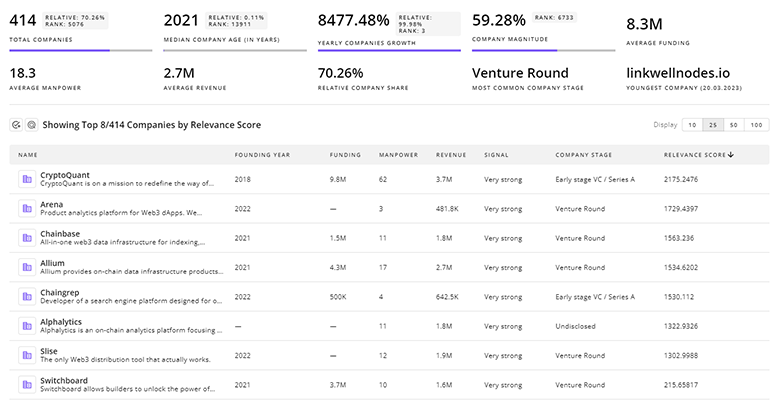
Stay connected with industry movements through TrendFeedr’s Companies tool, which covers 2.1K Vertical Farming companies.
2.1K Vertical Farming Companies
Discover Vertical Farming Companies, their Funding, Manpower, Revenues, Stages, and much more
Vertical Farming Investors
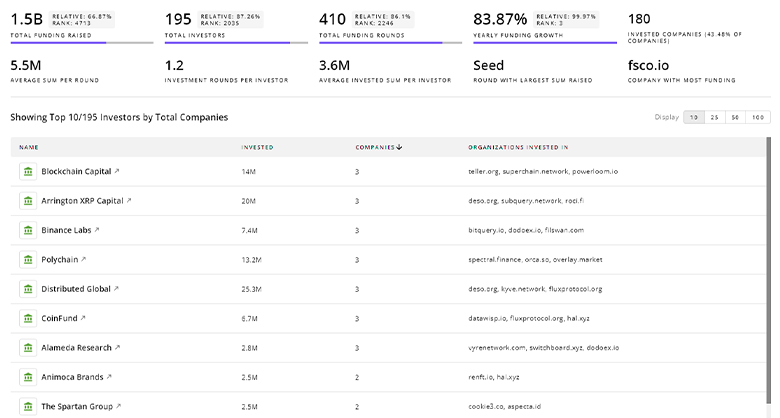
Discover investment patterns and trends with TrendFeedr’s Investors tool based on insights into 1.4K Vertical Farming investors. This tool is essential for understanding the financial ecosystem of Vertical Farming and developing successful investment strategies.
1.4K Vertical Farming Investors
Discover Vertical Farming Investors, Funding Rounds, Invested Amounts, and Funding Growth
Vertical Farming News
TrendFeedr’s News feature grants you access to 4.9K Vertical Farming articles. This tool supports professionals in tracking both past trends and current momentum in the industry.
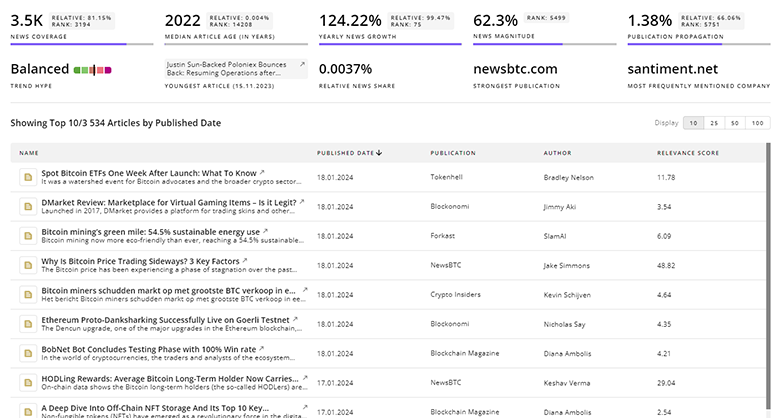
4.9K Vertical Farming News Articles
Discover Latest Vertical Farming Articles, News Magnitude, Publication Propagation, Yearly Growth, and Strongest Publications
Executive Summary
The vertical farming industry will reward disciplined operators who convert technological capabilities into repeatable, low-variance production models. Market data confirm strong top-line growth expectations, but profitability correlates tightly with energy strategy, crop selection, and the ability to package digital recipes as a service. Stakeholders should prioritize three actions: (1) embed automation and machine vision to cut labor and crop variability, (2) architect energy and circular-resource plans to compress OPEX, and (3) develop licensing or FaaS pathways to monetize software and agronomic know-how. Companies that align these vectors will shift the sector from a capex-heavy experiment to a dependable urban food supplier.
We're looking to collaborate with knowledgeable insiders to enhance our analysis of trends and tech. Join us!