
Wave Energy Report
: Analysis on the Market, Trends, and TechnologiesThe wave energy market shows measurable momentum as developers shift from prototypes to revenue-generating pilots, with the addressable market measured at $72,000,000 in 2024 and an internal forecast CAGR of 17.06% through the next decade, projecting $318,900,000 by 2033. This growth is concentrated in demonstration hubs across Europe and targeted U.S. test sites, while independent forecasts highlight rapid capacity scaling scenarios (for example, installed capacity rising toward 100 MW by 2030 in some analyses) mordor intelligence – Wave Energy Market. The immediate strategic inflection is clear: move from device validation to repeatable, maintainable deployment patterns that drive down levelized cost of energy and enable grid or high-value off-grid contracts.
270 days ago, we last updated this report. Notice something that’s not right? Let’s fix it together.
Topic Dominance Index of Wave Energy
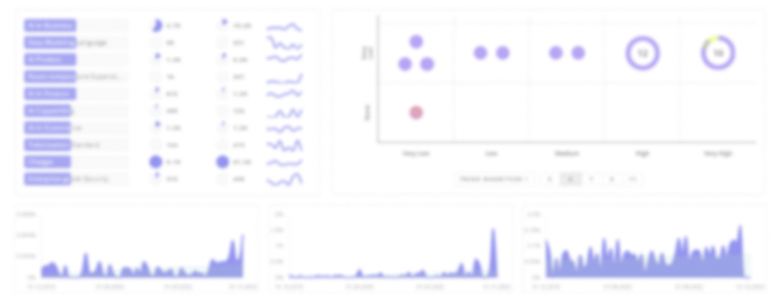
To understand the relative impact of Wave Energy relative to other known Trends and Technologies, our Dominance Index examines three correlated timelines: the volume of articles published, the number of companies founded, and the intensity of global search interest.
Key Activities and Applications
- Grid-connected power generation — deploying nearshore and offshore WECs to supply utility or local-distribution networks; nearshore projects dominate early installations because they reduce transmission and O&M friction market.us – Wave Energy Converter Market.
- Hybrid renewable platforms — co-locating wave devices with floating wind or solar to share foundations, subsea cables and reduce project-level CAPEX marine energy market analysis.
- Desalination and water services — wave-driven desalination and wave-powered freshwater production as high-value, off-grid revenue streams for islands and coastal communities.
- Coastal resilience and multi-use infrastructure — devices integrated into breakwaters, ports and protective works to combine energy output with erosion control and port services.
- Remote and industrial power — powering aquaculture, remote monitoring stations, and maritime facilities where diesel replacement yields clear operating-cost savings and rapid payback wave energy converter market insights.
Emergent Trends and Core Insights
- Modular, array-based industrialization is becoming the dominant commercialization pathway as developers prioritize standardized units and repeatable installation and maintenance procedures; modularity shortens lead times and compresses unit costs relative to bespoke one-off devices.
- Survivability-first design — designers emphasize submerged architectures, passive storm-safe modes, or minimal in-water moving parts to cut replacement and insurance costs; survivability now trades as highly as peak conversion efficiency in investor screens Ocean Energy Stats & Trends 2024 – Ocean Energy Europe PDF.
- Digital controls and predictive operations — advanced control (MPC), AI forecasts and digital twins shift performance from passive capture to adaptive energy conditioning and reduced downtime.
- Adjacent revenue pathways — desalination, hydrogen production and coastal services provide critical early cash flows that derisk WEC projects before LCOE parity with mature renewables is achieved Global Wave Energy Market – Spherical Insights.
- Regionally concentrated demonstration momentum — Europe leads installations, test infrastructure and public funding; targeted U.S. programs and specific APAC initiatives create localized acceleration pockets.
Technologies and Methodologies
- Oscillating Water Columns (OWC) — shore and nearshore variants retain favorable maintenance profiles because mechanical prime movers can be shore-based; they continue to account for a significant share of deployed demonstrators.
- Oscillating-body / Point-absorber architectures — modular point absorbers lead commercial development because of scalability and compatibility with array deployment economics.
- Advanced Power Take-Off (PTO) systems — direct-drive linear generators, hybrid hydraulic-electric PTOs and force-control PTOs are the locus of IP that differentiates device economics and maintenance profiles.
- Submerged, low-exposure platforms — submerged reaction structures and buoy-surface bodies minimize peak loads and lower failure rates during extreme events, improving availability metrics used by utilities.
- CFD-driven design validation and array optimization — high-fidelity hydrodynamic models and array-interaction optimization are enabling designers to predict constructive interference, spacing benefits and layout-level gains prior to deployment.
- Hybrid energy conversion and value stacking — combining wave generation with on-site electrolysis (green hydrogen), desalination, or energy storage increases project IRR in island and industrial contexts.
Wave Energy Funding
A total of 161 Wave Energy companies have received funding.
Overall, Wave Energy companies have raised $4.2B.
Companies within the Wave Energy domain have secured capital from 545 funding rounds.
The chart shows the funding trendline of Wave Energy companies over the last 5 years
Wave Energy Companies
- INGINE Wave Energy Systems Ltd. (IWES)
INGINE offers an onshore-type converter designed to harvest nearshore wave motion by mounting the generator and electrical equipment onshore, which reduces marine installation complexity and O&M cost. The developer targets shoreline installations, breakwaters and remote islands with a stated ambition to scale across Atlantic coasts. IWES positions its approach as lower-capex, faster-to-deploy compared with deep-water alternatives, enabling earlier revenue capture from municipal and port clients. - Wavepiston
Wavepiston develops a compact oscillating water column and multi-chamber architecture that simultaneously produces electricity and desalinated water at small-to-medium scales. The company has advanced to full-scale Atlantic testing off Gran Canaria and emphasizes coupling generation with water services for island clients. Their modular, low-footprint units aim to shorten deployment timelines and create immediate cash flows via desalination contracts. - Ocean Harvesting Technologies AB
Ocean Harvesting pursues a high annual energy-yield converter featuring advanced force-control PTO and Model Predictive Control to maximize per-device output. The InfinityWEC design focuses on materials circularity and a low CO2 footprint for manufacturing, aiming to reduce embedded-carbon capital costs. Their emphasis on per-unit energy density and controls positions them for array economics where per-device yield determines farm-level LCOE. - Weco – the Wave Energy Collective
Weco develops a novel horizontal converter aimed at delivering competitive cost per kWh by simplifying mooring and installation logistics. The company targets reduced installation risk through ship-anchored concepts and emphasizes nearshore deployment to exploit grid proximity. Its strategy centers on manufacturing simplicity and predictable O&M cycles to compress lifecycle costs versus complex offshore alternatives.
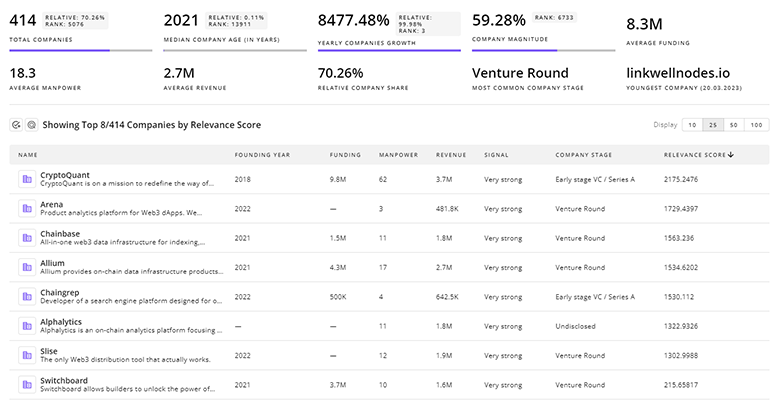
TrendFeedr’s Companies feature offers comprehensive insights into 1.1K Wave Energy companies.
1.1K Wave Energy Companies
Discover Wave Energy Companies, their Funding, Manpower, Revenues, Stages, and much more
Wave Energy Investors
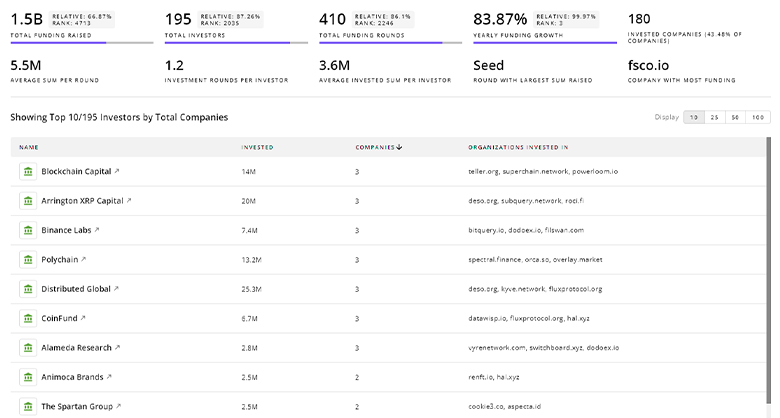
TrendFeedr’s Investors tool offers you a detailed perspective into 408 Wave Energy investors and their funding activities. This information enables you to analyze investment trends and make informed decisions in the Wave Energy market.
408 Wave Energy Investors
Discover Wave Energy Investors, Funding Rounds, Invested Amounts, and Funding Growth
Wave Energy News
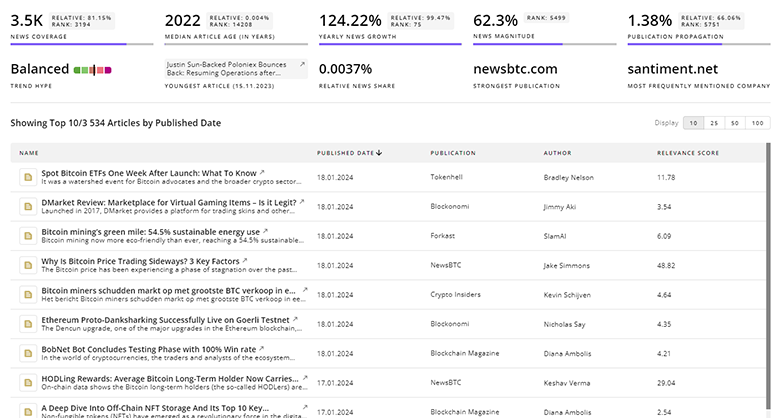
TrendFeedr’s News feature delivers access to 5.5K articles focused on Wave Energy. Use this tool to stay informed about the latest market developments and historical context, which is crucial for strategic decision-making.
5.5K Wave Energy News Articles
Discover Latest Wave Energy Articles, News Magnitude, Publication Propagation, Yearly Growth, and Strongest Publications
Executive Summary
The wave energy sector now faces a pragmatic commercial test: convert promising device-level physics into predictable, serviceable energy assets that meet payer expectations for availability, cost and integration. The most investable opportunities sit where engineering choices reduce lifecycle exposure to extreme ocean loads, where digital controls improve effective capture and availability, and where early, high-margin use cases (desalination, island microgrids, industrial off-grid power and hydrogen) produce revenue that sustains scale-up. For investors and industrial partners, priority actions are: commit to funded pilot arrays that validate LCOE pathways; secure offtake or multi-use contracts that accelerate cash flow; and invest in standards, shared supply chains and installation/maintenance capacity so the industry can move from custom demonstrations to industrialized rollout.
We're looking to collaborate with knowledgeable insiders to enhance our analysis of trends and tech. Join us!