3D Imaging Report
: Analysis on the Market, Trends, and TechnologiesThe 3D imaging market reached an estimated USD 51.1 billion in 2024 and the internal data projects strong expansion, with a reported CAGR of 14.8% and a 2030 projection of roughly USD 116.9 billion, signaling large near-term commercial opportunity in healthcare, industrial inspection, e-commerce, and immersive media. Key drivers are AI-enabled reconstruction that shortens pipeline times, cloud-native processing that enables collaboration, and advanced sensors that extend capture to new environments; these changes shift value from raw capture to actionable 3D assets and analytics, creating buyer demand for integrated capture-to-insight solutions and market forecasts that show double-digit growth across segments 3d imaging market report.
This report was last updated 350 days ago. Spot an error or missing detail? Help us fix it by getting in touch!
Topic Dominance Index of 3D Imaging
To identify the Dominance Index of 3D Imaging in the Trend and Technology ecosystem, we look at 3 different time series: the timeline of published articles, founded companies, and global search.
Key Activities and Applications
- Medical diagnostics and preoperative planning — 3D CT, MRI, ultrasound and AI segmentation create patient-specific models used for surgical planning, implant design, and minimally invasive guidance; this reduces procedure time and improves outcomes, which supports hospital procurement cycles and recurring software service revenue and 3D Cameras for Healthcare Market.
- Industrial inspection and quality assurance — 3D scanning, X-ray CT and AI analysis detect geometric and material defects earlier in production, raising per-line throughput and lowering scrap costs in aerospace, automotive and electronics and.
- E-commerce product visualization and virtual try-on — automated image-to-3D pipelines and fast photogrammetry reduce asset creation cost and time, improving conversion and lowering return rates for apparel and consumer goods and web research on automated photogrammetry platforms (Grand View Research).
- Digital twins for operations and infrastructure — regular, mobile LiDAR and photogrammetry captures feed live twins for predictive maintenance and planning, reducing downtime and enabling remote asset audits and industry service cases in construction and utilities 3D Mapping Services.
- 3D histology, microscopy and biological imaging — volumetric reconstruction and AI support whole-sample analysis for pathology and research, enabling more quantitative diagnostics and accelerating R&D and company examples in 3D histology services HistoDigital (HiD) UG.
- Robotics and autonomy perception — compact 3D vision sensors and fused sensor stacks enable bin picking, navigation and ADAS features, reducing integration time for automation projects and 4D radar advances for automotive applications.
Emergent Trends and Core Insights
- AI-first reconstruction and segmentation — deep learning converts sparse inputs into diagnostic-grade 3D output and automates segmentation, which reduces human annotation and accelerates clinically useful deliverables; this moves value toward software and compute subscription models and web coverage of AI-driven reconstruction improvements (NextMSC). > So what: vendors that package validated, regulatory-aware AI pipelines gain margin expansion because capture hardware becomes a lower-margin commodity.
- Cloud-first collaboration and SaaS delivery — cloud PACS and cloud 3D processing enable multi-stakeholder workflows and reduce on-site IT burden, changing buying decisions from capital equipment to operational spend and cloud adoption trends in medical imaging reports (ResearchNester). > So what: software-first companies can scale faster across geographies and lock in recurring revenue via API and integration partnerships.
- Democratization of 3D capture — smartphone photogrammetry and short-video-to-3D tools shrink time-to-asset to minutes, creating new addressable markets in e-commerce and small-scale surveying and direct services such as Covision Media. > So what: enterprises will trade some fidelity for scale; premium capture remains for regulated medical and industrial use.
- Sensor innovation and modality fusion — Time-of-Flight, LiDAR, SPAD and photon-counting CT expand capture capability in low-light, high-speed and spectral domains, enabling new clinical and industrial measurements and technical roadmaps in X-ray CT and photon-counting (internal 3d x-ray imaging data). > So what: companies that combine sensor IP with software pipelines will command higher ASPs and defend margins with integration lock-in.
- Edge processing and real-time inference — on-device pre-processing reduces bandwidth and enables low-latency 3D use cases for field inspection and AR-assisted workflows and industry discussion of edge-enabled scanners (Quality Magazine). > So what: hardware vendors that include efficient inference engines increase adoption in bandwidth-constrained environments.
- Vertical specialization in medical subsegments — target-focused solutions for breast screening, histology, dental CBCT and surgical planning create clearer reimbursement and regulatory pathways, enabling faster commercial traction and niche clinical companies such as PerfeQTion Imaging PerfeQTion Imaging. > So what: focused clinical evidence leads to faster procurement cycles than general-purpose imaging tools.
Technologies and Methodologies
- Photogrammetry and structured light pipelines for high-resolution surface capture — widely used in retail, cultural heritage and product digitization; combined with AI post-processing to remove noise and produce reduced, web-ready meshes and commercial photogrammetry services.
- Time-of-Flight and LiDAR sensing for range and scene mapping — essential for robotics perception, AEC, and large-scale digital twin creation; miniaturization continues to lower unit costs for embedded use and 3D data capture summaries.
- Volumetric and spectral X-ray innovations — flat panel CBCT, spectral photon-counting CT and phase-contrast imaging increase diagnostic content and material differentiation in medical and industrial CT use cases and CT software markets (MarketResearchFuture).
- Deep-learning reconstruction and segmentation — neural inverse methods reconstruct dense volumes from sparse projections and automate anatomical labelling, enabling low-dose protocols and faster throughput and AI coverage (NextMSC).
- SPAD and photon-timing sensors for 4D/low-light imaging — improving temporal resolution and enabling time-resolved measurements for scientific and lidar-like applications, opening new inspection and microscopy workflows and companies developing advanced sensors Singular Photonics.
- Cloud PACS, collaborative viewers and SaaS APIs — cloud native storage, visualization and annotation accelerate multidisciplinary workflows and remote review for medical and enterprise customers and cloud imaging market observations (ResearchNester).
- Hybrid capture rigs and autonomous scanning — turn-key stations that automate viewpoint planning and lighting for consistent, production-grade capture of small-to-medium objects Verus Digital - CultArm3D and automated scanning systems verus.digital.
3D Imaging Funding
A total of 894 3D Imaging companies have received funding.
Overall, 3D Imaging companies have raised $17.7B.
Companies within the 3D Imaging domain have secured capital from 2.9K funding rounds.
The chart shows the funding trendline of 3D Imaging companies over the last 5 years
3D Imaging Companies
- Covision Media — Covision offers high-performance, automated 3D scanning systems and services that convert physical products into relightable, reality-grade digital twins in minutes, targeting large e-commerce and fashion customers to scale product digitization; the company positions both hardware sales and asset-as-a-service to remove manual bottlenecks in content pipelines Covision Media. Their approach aligns with the trend toward democratized, high-throughput asset creation and directly addresses cost-per-asset constraints in retail.
- Verus Digital GmbH - CultArm3D — Verus ships modular, mobile scanning stations built with Fraunhofer IP that deliver repeatable, high-quality object scans at the push of a button, targeting heritage, museums and industrial digitization where safety and reproducibility matter; the system exports ready-to-use assets with minimal manual cleanup Verus Digital GmbH - CultArm3D. Their product reduces skilled-operator dependence and shortens project timelines for large catalog captures verus.digital.
- Lumirithmic — An Imperial College spin-out, Lumirithmic develops compact facial appearance capture combining computational imaging and AI to produce studio-quality facial scans with realistic skin rendering, aimed at beauty-tech, games, and identity applications Lumirithmic. Their focus on appearance fidelity and desktop portability addresses content quality needs for avatar creation and AR commerce while optimizing cost relative to high-end capture rigs.
- IMAI MedTech — IMAI develops automated 3D histology workflows that avoid manual thin-slicing and deliver full-volume digital tissue visualization for pathology, with the stated mission of improving cancer diagnostic accuracy via complete biopsy quantification IMAI MedTech. Their pipeline combines rapid sample prep with 3D reconstruction and algorithmic analysis, matching the market trend toward verticalized, evidence-led medical imaging solutions.
- Deep Scan Tech — Deep Scan Tech provides non-invasive 3D subsurface scanning from surface measurements to reveal underground structures and geological layers, serving infrastructure, construction and environmental projects; this capability reduces costly surprises in groundworks and speeds permitting and planning Deep Scan Tech. Their offering maps to demand for digital twins in built-environment projects and to the trend of expanding 3D capture into previously inaccessible domains.
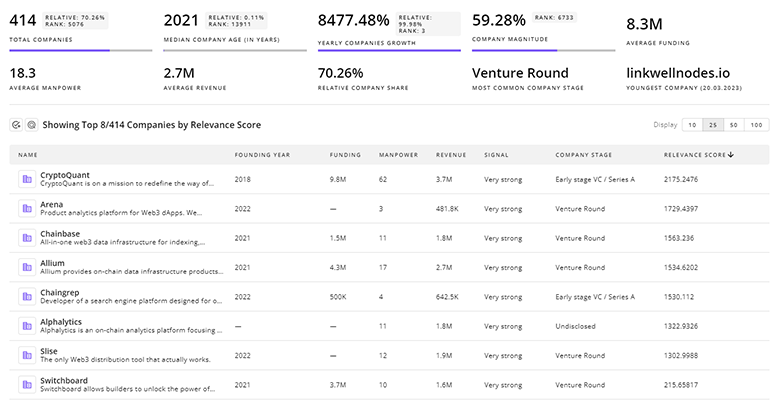
Identify and analyze 6.7K innovators and key players in 3D Imaging more easily with this feature.
6.7K 3D Imaging Companies
Discover 3D Imaging Companies, their Funding, Manpower, Revenues, Stages, and much more
3D Imaging Investors
TrendFeedr’s investors tool offers a detailed view of investment activities that align with specific trends and technologies. This tool features comprehensive data on 2.6K 3D Imaging investors, funding rounds, and investment trends, providing an overview of market dynamics.
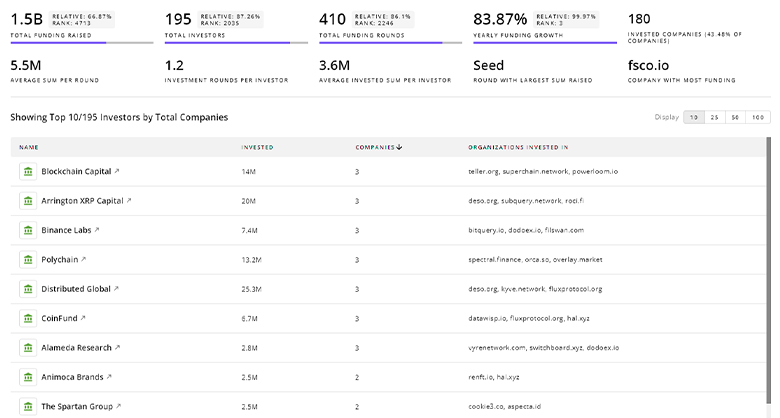
2.6K 3D Imaging Investors
Discover 3D Imaging Investors, Funding Rounds, Invested Amounts, and Funding Growth
3D Imaging News
Stay informed and ahead of the curve with TrendFeedr’s News feature, which provides access to 3.2K 3D Imaging articles. The tool is tailored for professionals seeking to understand the historical trajectory and current momentum of changing market trends.
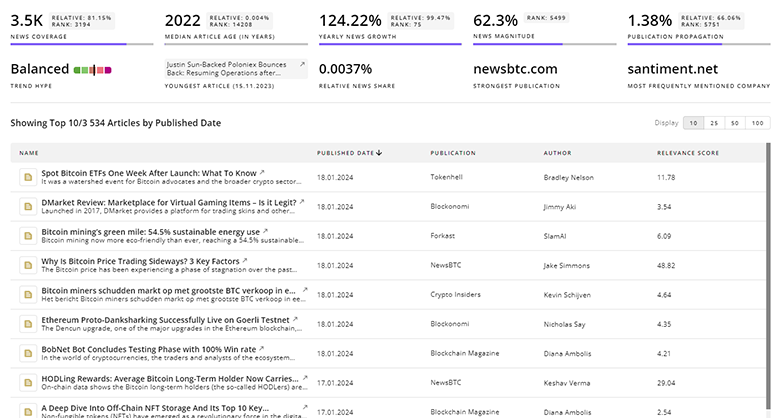
3.2K 3D Imaging News Articles
Discover Latest 3D Imaging Articles, News Magnitude, Publication Propagation, Yearly Growth, and Strongest Publications
Executive Summary
The available data shows a market moving from capture hardware toward integrated, software-rich 3D ecosystems that deliver immediate business outcomes. High-growth pockets appear where AI reduces manual labor in reconstruction and segmentation, where cloud delivery enables distributed workflows, and where novel sensors expand measurable phenomena. Strategic winners will package validated vertical solutions, secure clinical or industrial evidence of efficacy, and design pricing to convert capital purchases into recurring, platform-based revenue. For buyers, the priority will be solutions that shorten time-to-action for operations and clinical workflows, and for investors the priority will be companies that combine defensible sensor or algorithm IP with scalable SaaS distribution.
Interested in enhancing our coverage of trends and tech? We value insights from experts like you - reach out!