Advanced Batteries Technology Report
: Analysis on the Market, Trends, and TechnologiesThe advanced batteries market sits at a clear growth inflection with a measured industrialization path and concentrated technical bottlenecks: the market size was $81.2 billion in 2024 and the internal data projects a steady 11.5% CAGR toward a $216.3 billion opportunity by 2033, driven by automotive electrification, stationary storage, and new cell chemistries.
Key immediate implications: manufacturers that lower cell manufacturing cost per kWh and solve scaleable solid-electrolyte or high-silicon anode integration capture the highest near-term value; recyclers and second-life integrators capture margin on materials and service layers as volume grows.
This report was last updated 358 days ago. Spot an error or missing detail? Help us fix it by getting in touch!
Topic Dominance Index of Advanced Batteries Technology
To identify the Dominance Index of Advanced Batteries Technology in the Trend and Technology ecosystem, we look at 3 different time series: the timeline of published articles, founded companies, and global search.
Key Activities and Applications
- Automotive electrification: cell and pack engineering for passenger, commercial, and fleet EVs (cell-to-pack and cell-to-body integration efforts are accelerating across OEMs).
- High-energy portable and aerospace power: silicon anodes, lithium-metal approaches, and ultra-light cell architectures for drones, eVTOL and space systems.
- Manufacturing scale and process innovation: dry electrode and additive (3D) printing processes aiming to eliminate solvent steps and cut OPEX/CAPEX per kWh.
- Lifecycle services and circularity: commercial recycling of cathode precursor materials and second-life BESS projects that monetize retired EV packs for grid flexibility.
Emergent Trends and Core Insights
- Solid-state pilots are moving into production lines and investor focus: internal metrics report an 18% year-over-year increase in solid-state pilot projects, and OEM–supplier integration activity (CTP/CTB/CTC) is pushing packaging and safety architectures into vehicle design cycles Integrated Battery (CTP, CTB, CTC, and CTV)and Battery Innovation Technology Report 2025.
- Multiple market estimates coexist because scope differs; reconcile before planning: an independent market estimate (MRFR) reports a narrower 2024 market view (~$26.8B with ~16.5% CAGR) while the internal dataset uses a broader advanced-battery definition and reports $81.2B (2024) and 11.5% CAGR to 2033 — the gap reflects differences in included chemistries, form factors, and application scope, and it matters for capex sizing and partner selection marketresearchfuture – 2025.
- Alternative chemistries scale for specific use cases: sodium-ion and improved LFP variants provide lower levelized cost for stationary and low-power mobility markets; large deployments (multi-GW) already appear for stationary projects in specific regions.
- Manufacturing process innovations matter as much as cell chemistry: solvent-free dry electrodes and additive manufacturing both reduce environmental footprint and lower manufacturing step count, which shortens time to commercial scale and reduces unit cost per kWh.
- Materials and IP concentration: patenting activity concentrates in Asia and among large electronics OEMs; a notable rise in lithium-metal anode filings indicates focused R&D on dendrite suppression and protective interlayers US20240123456 – Lithium-metal anode technologies.
- Circularity and policy become commercial levers: recyclers that supply pCAM/CAM at scale reduce scope-1 emissions for downstream cell makers and improve eligibility for regional incentives tied to sourcing rules.
Technologies and Methodologies
- Solid electrolytes (sulfide, oxide and polymer classes) plus interfacial engineering: key to replacing flammable liquids and to enabling lithium-metal anodes with manageable interfacial resistance.
- Silicon-dominant anodes and engineered binders: commercial silicon platforms aim to deliver 2x energy density vs graphite while addressing expansion via coatings and structured porosity Amprius silicon anode platform Ecellix high silicon anode process.
- Dry electrode and solvent-free processing: removes solvent recovery steps, lowers emissions, and shortens process cycles; this reduces per-kWh environmental and operating costs when scaled.
- Additive and spray-based cell fabrication: 3D and spray deposition enable conformal batteries and structural integration that increase pack volumetric efficiency and reduce parts count.
- AI and data systems for rapid materials discovery and BMS optimization: machine learning shortens candidate screening time and enables predictive lifetime management, which drives higher utilization rates in fleet and second-life applications.
- Hydrometallurgical recycling to pCAM/CAM: scalable recycling technologies that produce cathode precursor materials directly from scrap create a vertically integrated materials loop that cuts embedded emissions Ascend Elements Hydro-to-Cathode®.
Advanced Batteries Technology Funding
A total of 527 Advanced Batteries Technology companies have received funding.
Overall, Advanced Batteries Technology companies have raised $84.7B.
Companies within the Advanced Batteries Technology domain have secured capital from 2.1K funding rounds.
The chart shows the funding trendline of Advanced Batteries Technology companies over the last 5 years
Advanced Batteries Technology Companies
- Piersica — Piersica develops high-energy-density solid-state lithium cells that target >600 Wh/kg energy density using proprietary anode, separator and assembly approaches; the company positions a product-first development path (cell design backsolved into component development) to accelerate commercialization, focusing on safe propulsion and medical implant power applications.
- Adden Energy — Adden commercializes a dynamically-stable solid-state cell developed from academic research; the company claims high manufacturing scalability for its approach and has raised Series A capital to fund scale-up, aiming to compete on both cell performance and manufacturability.
- AM Batteries — AM Batteries offers solvent-free, dry electrode manufacturing that reduces processing steps and emissions while improving electrode performance; their focus on process change rather than only cell chemistry gives them a direct route to partner with existing cell makers to lower unit manufacturing cost.
- Kinetic Batteries — Kinetic developed a patented additive manufacturing process for battery production that promises >40% production cost reduction and flexible form-factor cells; their technology targets structural battery use cases and rapid customization for specialty markets.
- Nuvola Technology — Nuvola commercializes SafeCoat™ direct deposition polymer separators that encapsulate electrodes to reduce short-circuit and fire risk; the approach improves safety and yield for high-energy cells, making high-performance architectures more manufacturable.
Identify and analyze 2.0K innovators and key players in Advanced Batteries Technology more easily with this feature.
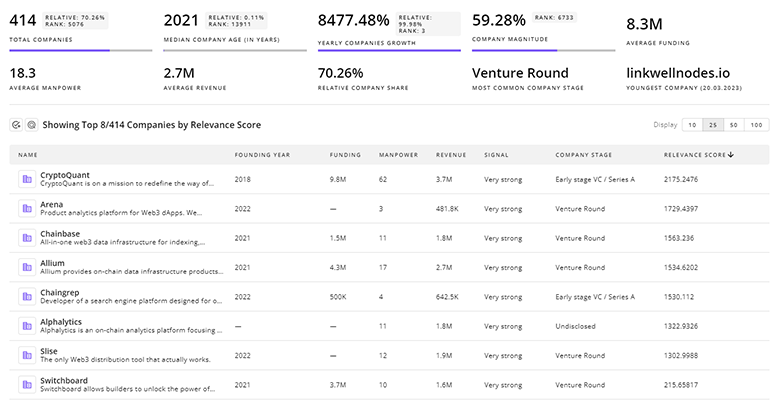
2.0K Advanced Batteries Technology Companies
Discover Advanced Batteries Technology Companies, their Funding, Manpower, Revenues, Stages, and much more
Advanced Batteries Technology Investors
TrendFeedr’s investors tool offers a detailed view of investment activities that align with specific trends and technologies. This tool features comprehensive data on 2.3K Advanced Batteries Technology investors, funding rounds, and investment trends, providing an overview of market dynamics.
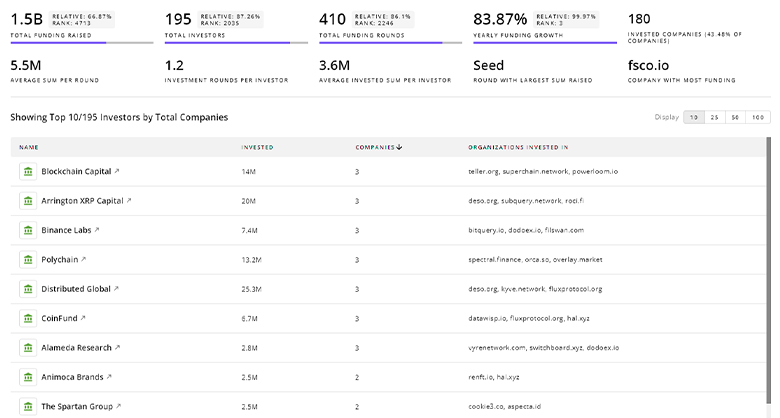
2.3K Advanced Batteries Technology Investors
Discover Advanced Batteries Technology Investors, Funding Rounds, Invested Amounts, and Funding Growth
Advanced Batteries Technology News
Stay informed and ahead of the curve with TrendFeedr’s News feature, which provides access to 2.0K Advanced Batteries Technology articles. The tool is tailored for professionals seeking to understand the historical trajectory and current momentum of changing market trends.
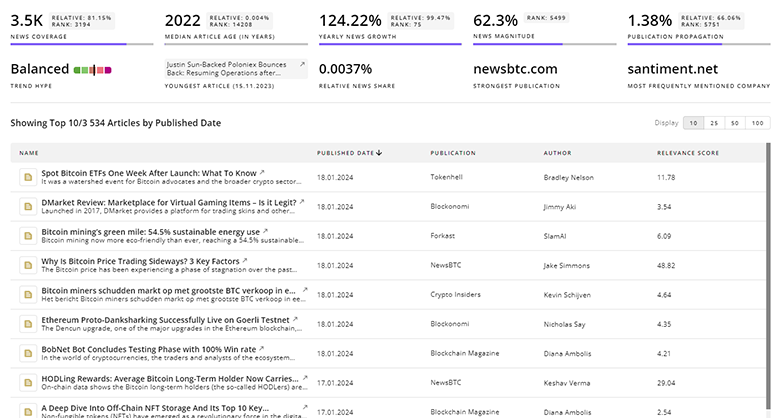
2.0K Advanced Batteries Technology News Articles
Discover Latest Advanced Batteries Technology Articles, News Magnitude, Publication Propagation, Yearly Growth, and Strongest Publications
Executive Summary
The advanced-battery sector now presents a two-track commercial landscape: one track rewards material and cell-chemistry breakthroughs that raise energy density and charging speed (solid-state, lithium-metal, silicon anodes), and the other rewards manufacturing and lifecycle innovations that lower cost per kWh and close materials loops (dry electrodes, additive fabrication, and hydrometallurgical recycling). Stakeholders should align investment and partnership strategies to their position in the value chain: cell-level innovators must secure manufacturing pathways and early OEM integrations, while process and circularity players must scale feedstock supply and regulatory compliance to capture margin from rising volumes. Finally, choose market sizing inputs carefully: differences in definitions produce materially different TAMs, so use the forecast that matches the product scope being funded or deployed and stress-test capital plans against the broader projections shown above.
Interested in enhancing our coverage of trends and tech? We value insights from experts like you - reach out!