Advanced Robotics Report
: Analysis on the Market, Trends, and TechnologiesThe advanced robotics market is accelerating sharply, with the sector recorded at $44,740,000,000 in 2024 and projected to grow at a 20.13% CAGR to reach $280,010,000,000 by 2034—signalling a rapid commercialization of AI-enabled mobile, collaborative, and dexterous systems.
This report was last updated 34 days ago. Spot an error or missing detail? Help us fix it by getting in touch!
Topic Dominance Index of Advanced Robotics
To identify the Dominance Index of Advanced Robotics in the Trend and Technology ecosystem, we look at 3 different time series: the timeline of published articles, founded companies, and global search.
Key Activities and Applications
- Intelligent intralogistics and AMRs — Autonomous Mobile Robots and fleet orchestration are replacing rigid AGVs for picking, sorting, and intra-warehouse transport, lowering manual handling costs and enabling continuous operations in high-mix fulfilment centres.
- High-mix precision manipulation — AI-driven vision and force control move robots into flexible welding, piece picking, and surface finishing tasks previously reserved for skilled humans, enabling manufacturers to automate small-batch and bespoke production runs.
- Autonomous inspection and hazardous operations — Legged and wheeled platforms for industrial inspection convert site visits into continuous data streams for predictive maintenance, keeping personnel out of dangerous environments and improving asset uptime.
- Assistive and medical robotics — Surgical-assist systems, exoskeletons, and socially assistive robots expand capacity in hospitals and eldercare, addressing workforce shortfalls and clinical precision needs.
- Agricultural autonomy — Field robots for scouting, selective harvesting, and logistics reduce labour dependencies in seasonal work and enable precision inputs for sustainability objectives.
Emergent Trends and Core Insights
- Physical AI as the integration layer — Robotics is shifting from isolated controllers to an integrated intelligence stack that couples perception, language-like task specification, and real-time motion planning, enabling robots to operate in dynamic human environments researchandmarkets - Robotics, 2025.
- Platform bifurcation — Investment flows split between capital-intensive general-purpose humanoid platforms and lean, application-specific stacks that deliver immediate ROI; the latter often show superior revenue-per-dollar metrics and faster time-to-payback marketresearch - Global Advanced Robotics Market.
- From teach-based programming to embodied authoring — No-code programming, demonstration learning, and foundation models for vision-language-action reduce integration friction and broaden the pool of deployers beyond robotics specialists.
- Edge-first compute and modular autonomy — Edge AI and autonomy modules decouple expensive compute from form factor, enabling reuse of autonomy stacks across vehicle and manipulator bodies and lowering total cost of ownership.
- Human-robot teaming with safety-first controls — Force-aware actuation, tactile sensing, and predictive collision modelling allow closer physical collaboration and reduce need for exclusionary guarding, opening new shop-floor topologies.
Technologies and Methodologies
- Vision-Language-Action models and foundation stacks — Multimodal models that map visual inputs and high-level instructions into action primitives are enabling zero-shot task transfer across bodies and environments
- Sim-to-real pipelines and digital twins — High-fidelity simulation accelerates policy training and reduces commissioning cycles, while digital twins provide continuous optimization during operation
- Sensor fusion with tactile + 3D vision — Combined depth, lidar, and force/tactile sensing improves grasp reliability and manipulation in unstructured contexts, driving adoption in electronics and medical device assembly.
- Reinforcement learning for adaptive control — Policy learning and continual adaptation allow robots to refine trajectories and force profiles in response to part variation and wear, shortening set-up time for new SKUs
- Modular autonomy and RaaS business models — Standardized autonomy modules plus Robot-as-a-Service contracts reduce upfront capex and make advanced robotics accessible to mid-sized firms.
Advanced Robotics Funding
A total of 1.2K Advanced Robotics companies have received funding.
Overall, Advanced Robotics companies have raised $63.8B.
Companies within the Advanced Robotics domain have secured capital from 4.8K funding rounds.
The chart shows the funding trendline of Advanced Robotics companies over the last 5 years
Advanced Robotics Companies
- AICA SA — AICA commercializes AI-driven closed-loop robot control that shortens integration time for complex tasks such as battery disassembly and precision polishing. The company emphasizes sensor-forward control and reinforcement learning to let standard industrial arms adapt to part variation without extensive offline programming. Its strategy targets OEMs and system integrators that need faster robot redeployment across heterogeneous lines
- ABAGY Robotic Systems — ABAGY focuses on autonomous robotic welding programming and no-expert deployment for manufacturers facing welder shortages. Their software generates weld paths and adapts parameters to part variance, reducing on-floor engineering time and lowering cycle variability for high-mix production. ABAGY packages workflow tools for small-to-mid manufacturers that require rapid ROI
- Augmentus Robotics — Augmentus delivers AI-powered robot vision and automated toolpath generation for surface finishing, coating, and thermal spray tasks. Their no-code capture-to-path workflow cuts programming downtime dramatically and targets contractors and shops that cannot afford extensive robot integration teams. Augmentus positions itself as the software layer that turns general robot arms into specialist finishing cells
- **True Position Robotics — True Position builds metrology-grade robot guidance and adaptive digital twins for aerospace-scale drilling and inspection, delivering sub-millimetre accuracy that fits tight aerospace tolerances. Their offering combines multi-sensor calibration, real-time correction, and a virtual commissioning toolset that reduces scrap, rework, and fixture costs in large-part assembly
- eBots — eBots develops coordinated dual-arm systems focused on eye-hand coordination to handle electronics assembly and medical device manufacturing. Their approach uses synchronized vision and force control to enable two-handed manipulation for tasks that single-arm cells struggle with, addressing precision, cycle time, and changeover challenges in high-value manufacturing
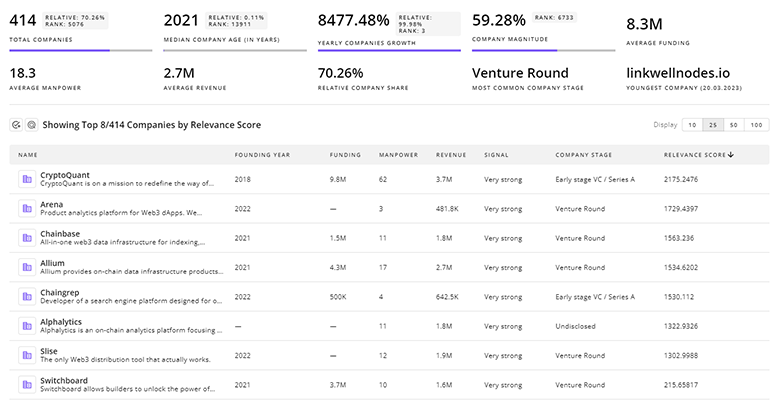
Identify and analyze 5.7K innovators and key players in Advanced Robotics more easily with this feature.
5.7K Advanced Robotics Companies
Discover Advanced Robotics Companies, their Funding, Manpower, Revenues, Stages, and much more
Advanced Robotics Investors
TrendFeedr’s investors tool offers a detailed view of investment activities that align with specific trends and technologies. This tool features comprehensive data on 5.6K Advanced Robotics investors, funding rounds, and investment trends, providing an overview of market dynamics.
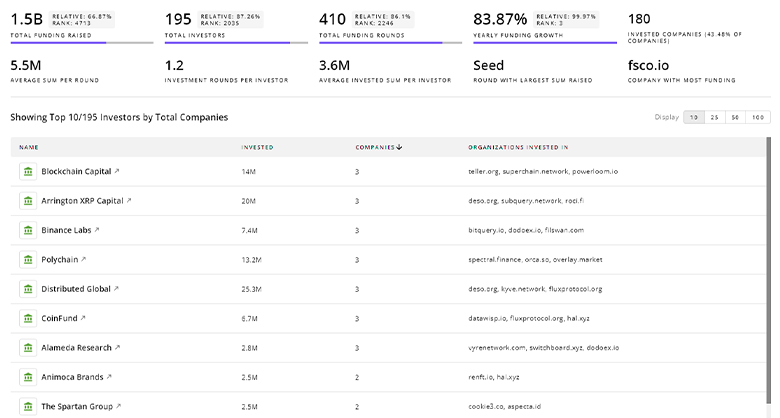
5.6K Advanced Robotics Investors
Discover Advanced Robotics Investors, Funding Rounds, Invested Amounts, and Funding Growth
Advanced Robotics News
Stay informed and ahead of the curve with TrendFeedr’s News feature, which provides access to 5.3K Advanced Robotics articles. The tool is tailored for professionals seeking to understand the historical trajectory and current momentum of changing market trends.
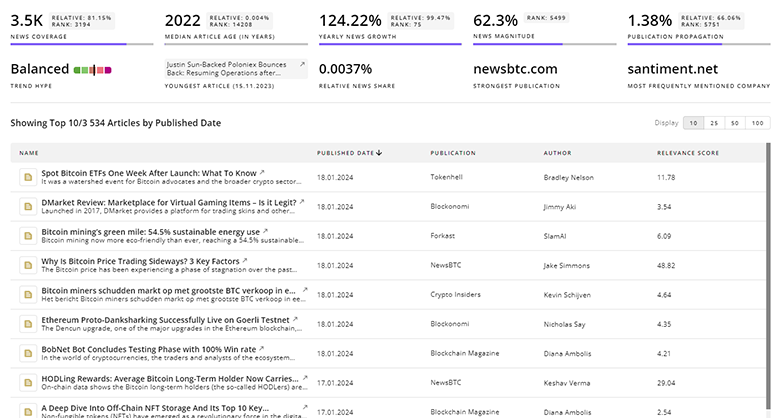
5.3K Advanced Robotics News Articles
Discover Latest Advanced Robotics Articles, News Magnitude, Publication Propagation, Yearly Growth, and Strongest Publications
Executive Summary
Advanced robotics now combines mature perception hardware with rapidly improving cognitive stacks, creating a split market: immediate commercial wins come from application-focused automation that replaces specific human tasks, while long-term platform plays pursue generalized humanoid embodiments that integrate into human workflows. Firms that concentrate on a clear value metric—reduction in labour hours per unit, uptime improvement, or scrap reduction—will continue to draw acquisition interest from larger automation incumbents. For implementers, prioritizing modular autonomy components, edge compute for latency-sensitive control, and simulation-first deployment will shorten payback periods. Policymakers and procurement teams should hedge between targeted automation for near-term productivity and staged investments in shared intelligence platforms that enable cross-domain skill transfer across robot bodies.
Interested in enhancing our coverage of trends and tech? We value insights from experts like you - reach out!