
AI Robotics Report
: Analysis on the Market, Trends, and TechnologiesThe AI robotics market is growing at scale, with internal data reporting a 29.45% CAGR in the AI robotics topic that underpins a rapid commercial expansion and urgent deployment pressure across logistics, healthcare, and manufacturing. This growth combines three forces: large, recent capital inflows into humanoid and logistics automation The Global Robotics Market Outlook, the shift of software foundation models into embodied agents OEMs and Suppliers’ Embodied Artificial Intelligence (and AI Robot) Layout Trend Report, 2024-2025, and concentrated patenting around application-specific autonomy that signals near-term commercialization pathways (examples include core architectures for robot intelligence). The consequence: product strategies that prioritize modular, edge-first AI stacks, reconfigurable hardware, and validated safety behavior will capture the largest short-term commercial opportunity.
This report was last updated 111 days ago. Spot an error or missing detail? Help us fix it by getting in touch!
Topic Dominance Index of AI Robotics
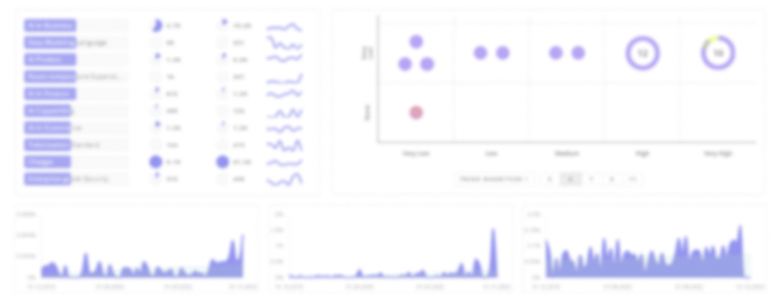
To identify the Dominance Index of AI Robotics in the Trend and Technology ecosystem, we look at 3 different time series: the timeline of published articles, founded companies, and global search.
Key Activities and Applications
- Autonomous mobile manipulation for intralogistics and on-demand picking — vision-enabled manipulators perform dynamic grasping and path planning in unstructured warehouses, reducing reliance on fixed automation and addressing labor shortfalls.
- Human-robot collaboration in assembly and inspection — lightweight collaborative arms (cobots) operate safely alongside humans for assembly, packaging, and quality inspection, enabling SMEs to automate without heavy cell rework AI Robots Market Research Report Information By Offering (hardware and software) (2023).
- Predictive and prescriptive maintenance using edge AI — onboard sensor fusion (thermal, ultrasonic, LiDAR) and local inference detect anomalies and schedule interventions, shifting operations from calendar maintenance to condition-based service.
- Assistive and care robotics — service robots for elder care, telepresence, and clinical assistance expand where workforce shortages exist, supported by government pilots and hospital deployments.
- Humanoid and legged platforms for complex environments — general-purpose embodied agents and modular bipedal/quadruped systems tackle tasks that require mobility plus manipulation (facility maintenance, retail assistance, emergency response) and are receiving major OEM attention.
Emergent Trends and Core Insights
- Edge-first AI and data sovereignty as procurement drivers — customers prefer onboard inference to protect proprietary process telemetry and reduce latency; this creates a premium for compact, secure edge stacks and federated update models.
So what: vendors that deliver validated, auditable on-device models and secure update channels will shorten procurement cycles in regulated industries. - Cobot mainstreaming with measurable revenue momentum — collaborative robots are shifting from niche to broad adoption; market signals project strong growth in cobot revenue and unit share as SMEs automate repetitive tasks.
So what: integrators that bundle safety certification, quick programming, and subscription services will capture the fastest ROI for buyers. - Componentization and modular upgradeability — suppliers split hardware and intelligence into interchangeable modules (grippers, tactile modules, edge AI units), enabling lower total cost of ownership through incremental upgrades.
So what: business models will shift toward RaaS and modular leasing to convert capex into recurring revenue. - Funding concentration around humanoids and fleet orchestration — large recent rounds and strategic OEM plays signal investor belief in high-value humanoid use cases and in scalable fleet software for mixed robot populations.
So what: incumbents and series-A winners will use capital to validate vertical pilots; later entrants face higher cost to prove the same outcomes. - Hardware remains cost center but opens differentiation paths — hardware accounts for the majority of spend in some market breakdowns, making motor, actuator, and sensor innovations a key leverage point for performance gains.
So what: component specialists can command margin by delivering higher power density, sensing fidelity, or lower maintenance profiles.
Technologies and Methodologies
- Vision-Language-Action (VLA) foundation stacks — multi-modal models that integrate perception, language, and action reduce task-specific engineering and allow few-shot adaptation for new manipulation goals AI and digital twins / VLA coverage.
- Sim2Real and digital twins — physics-accurate simulation pipelines (digital twins) accelerate policy training and cut on-site tuning, enabling direct deployment of trained policies to hardware.
- Federated learning and privacy-preserving model updates — distributed training across fleets lets organizations improve generalized behaviors without centralizing sensitive site data, addressing data sovereignty concerns.
- Real-world reinforcement learning and few-shot imitation — field deployments increasingly use RL and imitation learning to adapt manipulation policies from limited demonstrations, reducing manual programming time Real-World RL early deployments and research summaries.
- Neuromorphic and event-based sensing for high-speed perception — event cameras (DVS) and low-power neuromorphic processors deliver lower latency and energy use for fast manipulation and locomotion tasks.
AI Robotics Funding
A total of 720 AI Robotics companies have received funding.
Overall, AI Robotics companies have raised $41.1B.
Companies within the AI Robotics domain have secured capital from 2.8K funding rounds.
The chart shows the funding trendline of AI Robotics companies over the last 5 years
AI Robotics Companies
- Roboforce.ai — Roboforce appears in the internal topic company listings as an AI robotics player focused on workforce automation and software orchestration for mixed fleets; the firm fits activity in autonomous logistics and fleet management and benefits from the market move to cloud/edge hybrid management. Their position in orchestration maps directly to the demand for fleet-level digital twins and OTA model governance described in the industry data.
- Captic — Listed among topic participants, Captic aligns with assistive and inspection robotics capabilities; the assistive robotics data identify healthcare and eldercare as priority verticals where companies with human-centric interaction stacks can win pilot programs and recurring RaaS contracts. Captic's implied niche is rapid integration for care environments.
- MavenRobotics.ai — Appears in the internal company list and connects to adaptive robotics trends where AI, vision, and modular grippers enable multi-purpose cells; Maven's profile corresponds to the market need for flexible, SME-targeted automation that shortens retooling time. Its value lies in packaging Sim2Real workflows into turnkey integrator services.
- Artpark — Included in the topic company list, Artpark maps to cognitive robotics and perception stacks for complex manipulation and human interaction; the patent and news trends emphasize multi-modal fusion and social fluency as differentiators in service robotics, which aligns with Artpark's implied capabilities. Artpark can capitalize on pilot opportunities where social sensing matters.
- Willogy.io — Present in the topic listing and relevant to edge AI and vision stacks for industrial inspection; the sector data point to hardware-heavy cost structures and the opening for software retrofits that deliver predictive maintenance capabilities with rapid payback. Willogy's implied business model (software retrofit and subscription) matches the RaaS and subscription models noted in the dataset.
Identify and analyze 3.4K innovators and key players in AI Robotics more easily with this feature.
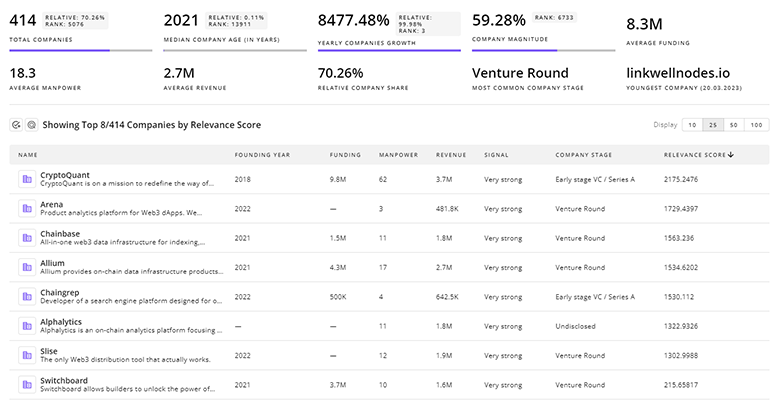
3.4K AI Robotics Companies
Discover AI Robotics Companies, their Funding, Manpower, Revenues, Stages, and much more
AI Robotics Investors
TrendFeedr’s investors tool offers a detailed view of investment activities that align with specific trends and technologies. This tool features comprehensive data on 3.5K AI Robotics investors, funding rounds, and investment trends, providing an overview of market dynamics.
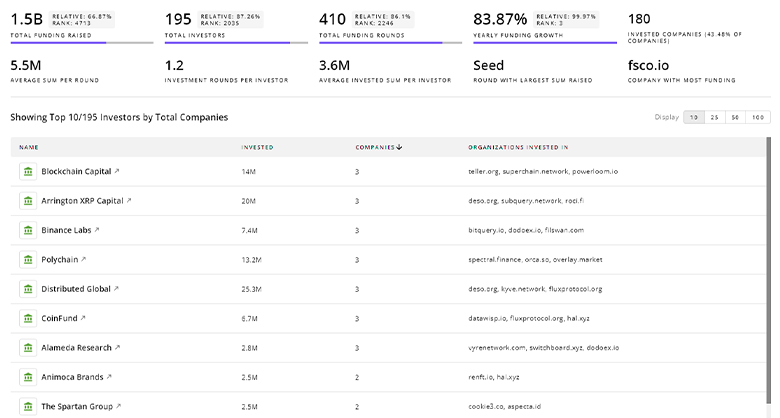
3.5K AI Robotics Investors
Discover AI Robotics Investors, Funding Rounds, Invested Amounts, and Funding Growth
AI Robotics News
Stay informed and ahead of the curve with TrendFeedr’s News feature, which provides access to 4.9K AI Robotics articles. The tool is tailored for professionals seeking to understand the historical trajectory and current momentum of changing market trends.
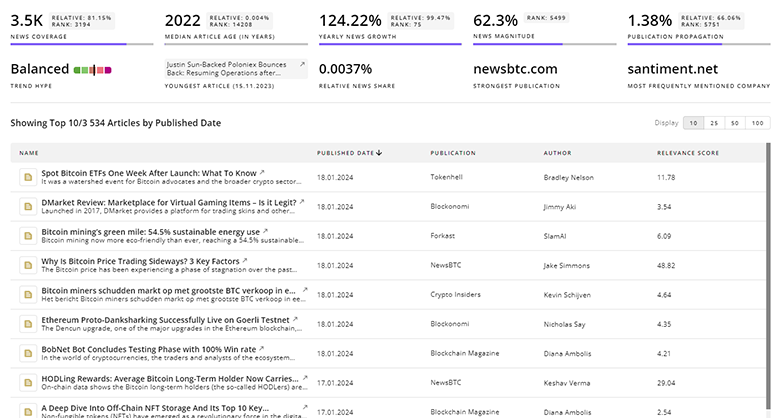
4.9K AI Robotics News Articles
Discover Latest AI Robotics Articles, News Magnitude, Publication Propagation, Yearly Growth, and Strongest Publications
Executive Summary
The AI robotics field has entered a commercial inflection where software foundation models, edge compute, and modular hardware combine to move robotics from bespoke installations to repeatable products and services. Short-term winners will be firms that (1) package validated, auditable local inference and secure update mechanisms to satisfy procurement and regulatory constraints; (2) offer modular upgrade paths that convert capex into recurring revenue; and (3) provide measurable operational outcomes—reduced downtime, higher throughput, or lower labor cost—for targeted vertical pilots. Investors and integrators should prioritize solutions that shorten deployment time (Sim2Real, digital twins), minimize integration risk (standardized modules and federated learning), and demonstrate safety and explainability in human-adjacent applications. The near-term technical battleground centers on perception-action integration and safe fleet orchestration; the commercial battleground centers on proving ROI in logistics, healthcare, and discrete manufacturing.
Interested in enhancing our coverage of trends and tech? We value insights from experts like you - reach out!